DbcultAccessing Vault...
Cult Review
Senior Film Conservator
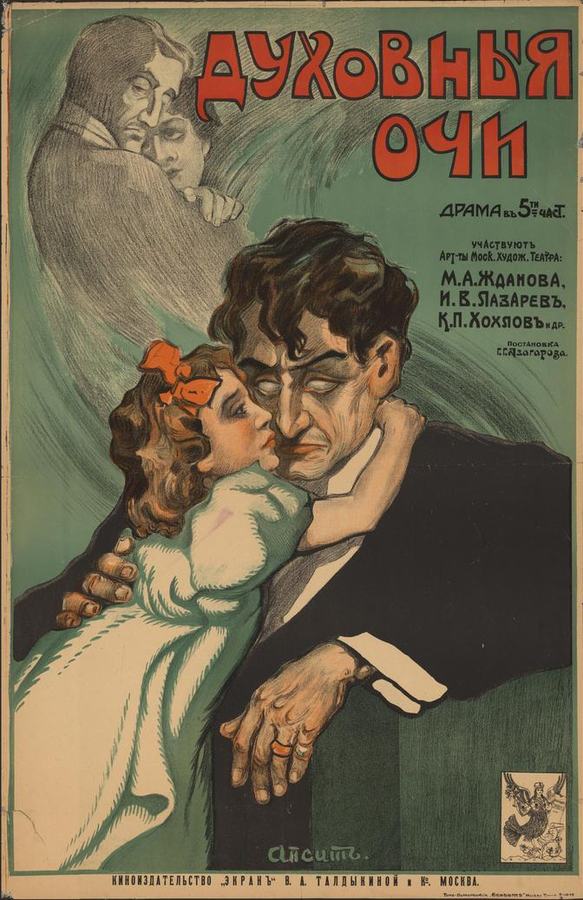
There are films that merely tell a story, and then there are those that endeavor to recalibrate your very understanding of narrative, of perception, of the cinematic medium itself. Olga Blazhevich’s 'Dukhovnye ochi' decidedly falls into the latter, a work of audacious vision that dares to peer beyond the veil of conventional reality, inviting its audience into a world both intimately familiar and unsettlingly alien. This is not a film to be passively consumed; it demands engagement, introspection, and a willingness to surrender to its unique, often disorienting rhythm. From its opening frames, 'Dukhovnye ochi' establishes itself as a profoundly atmospheric piece, a meditation on the fragility of sanity and the terrifying grandeur of an expanded consciousness.
At its core, the film traces the harrowing journey of Mariya, portrayed with an astonishing raw vulnerability by Mariya Zhdanova. Her character is a vessel, a conduit through which the audience experiences an unraveling of the mundane. Following an ambiguous, yet clearly cataclysmic, event—one that remains tantalizingly unarticulated, existing more as a psychic wound than a plot point—Mariya finds her perception irrevocably altered. The world, once a solid, predictable construct, begins to fracture, revealing layers of spectral energy, echoes of past events, and the raw, unfiltered essence of human emotion that most remain blissfully ignorant of. It’s a sensory overload, a constant barrage of information that transforms everyday life into a cacophony of hidden truths and resonant frequencies. Zhdanova’s performance is nothing short of transformative; she navigates this internal maelstrom with a haunting grace, her eyes conveying volumes of terror, wonder, and a profound, isolating loneliness. Her portrayal isn't merely acting; it feels like an embodiment, a channeling of a soul grappling with an unwelcome enlightenment.
Blazhevich, as the sole writer, constructs a screenplay that is less a traditional narrative arc and more a series of meticulously crafted psychological states. The dialogue is sparse, often elliptical, allowing the visual and aural landscapes to carry the bulk of the storytelling. This is where 'Dukhovnye ochi' truly excels, creating an immersive experience that mirrors Mariya's own disoriented state. The film's aesthetic is deliberately unsettling, utilizing a palette of muted tones punctuated by sudden, vibrant flashes of the 'unseen' world. Cinematography plays a crucial role, often employing subjective camera angles, shallow depths of field that blur the periphery, and subtle distortions that replicate Mariya's fracturing vision. The sound design, too, is a masterclass in psychological manipulation, weaving together ambient noise with unsettling whispers, resonant hums, and sudden, piercing frequencies that underscore the constant assault on Mariya's senses. It’s a symphony of disorientation that effectively places the viewer squarely within her fractured reality.
The supporting cast, while less central, nonetheless provides crucial anchors in Mariya's spiraling world. Ivan Lazarev delivers a nuanced performance as a figure representing a more conventional, rational world view. His interactions with Mariya are fraught with a mixture of concern, frustration, and a subtle undercurrent of fear. He embodies the societal response to the 'other,' the uncomfortable skepticism that often greets those who perceive beyond accepted norms. Lazarev's portrayal is vital in grounding the film, providing a counterpoint to Mariya’s escalating detachment from consensus reality. Without this grounded perspective, Mariya's journey might feel entirely untethered; instead, Lazarev's presence highlights the profound chasm opening between her and the world she once knew. His character’s gradual bewilderment is as compelling as Mariya’s own internal struggle, reflecting the audience’s potential journey from doubt to a hesitant understanding.
Dimitri Gundurov, on the other hand, occupies a more enigmatic space. His character seems to hover on the periphery, a figure of obscure knowledge or perhaps a fellow traveler in the liminal spaces Mariya now inhabits. Gundurov's performance is understated yet potent, his eyes often conveying a deeper understanding or a shared burden that he cannot, or chooses not to, articulate. This ambiguity is one of Blazhevich's strengths, allowing for multiple interpretations and enriching the film's thematic depth. Is he a guide, a warning, or merely another lost soul? The film never explicitly answers, preferring to let the audience wrestle with the implications of his presence. His interactions with Mariya are fleeting but impactful, often marked by an unspoken recognition that transcends mere words, hinting at a shared, profound loneliness that comes with such unique perception.
The thematic resonance of 'Dukhovnye ochi' is vast and profoundly thought-provoking. It delves into questions of sanity, the nature of reality, and the burden of truth. What happens when the world reveals itself to be far more complex, more terrifying, and more beautiful than we ever imagined? Is ignorance truly bliss, or is there an inherent value in confronting the overwhelming totality of existence, even if it costs one their peace of mind? The film doesn't offer easy answers, instead opting to immerse the viewer in the experiential dilemma. It challenges the very notion of objective reality, suggesting that what we perceive as 'normal' is merely a collective agreement, a convenient fiction that shields us from a truth too immense to bear. This thematic exploration aligns it with other films that probe the boundaries of human perception, though 'Dukhovnye ochi' carves out its own distinct, often more visceral, path. While films like The Lifted Veil explore similar concepts of heightened sensory awareness and its tragic consequences, Blazhevich's work feels more immediate, more grounded in a raw, psychological realism rather than a purely fantastical one.
The contributions of Konstantin Khokhlov and Vladimir Kvanin, though perhaps less central in terms of screen time, are no less integral to the film's intricate tapestry. They populate Mariya's world, often appearing as figures who inadvertently trigger or amplify her visions, serving as unwitting catalysts for her deepening spiritual sight. Khokhlov, with his subtle shifts in expression, might represent the oblivious masses, their everyday concerns trivialized by Mariya's overwhelming awareness. Kvanin, in turn, could embody a more direct, perhaps even confrontational, element within her new reality, forcing her to confront the implications of her perception. Their presence, however brief, adds texture and depth to the unfolding drama, preventing Mariya’s journey from becoming a purely solitary internal monologue. Instead, it underscores how her 'spiritual eyes' irrevocably alter her interactions with everyone and everything around her, making the most mundane encounters fraught with unseen meaning.
The direction, though not credited in the provided details, is clearly a singular, uncompromising vision, undoubtedly guided by Blazhevich's written word. The pacing is deliberate, almost hypnotic, allowing moments of profound quietude to alternate with bursts of sensory overload. This ebb and flow mirrors Mariya's own struggle to control and comprehend her new abilities. There’s a palpable sense of artistic control throughout, a meticulous attention to detail in every frame, every sound cue. The film never feels rushed, never panders to conventional narrative demands, instead trusting the audience to immerse themselves in its unique rhythm. This artistic bravery is commendable, especially in an era often dominated by formulaic storytelling. The choice to avoid explicit exposition regarding the 'trauma' that triggers Mariya’s abilities is particularly effective; it universalizes her experience, allowing the audience to project their own understanding of loss or transformation onto her journey, making the film resonate on a deeper, more personal level.
Visually, 'Dukhovnye ochi' is a triumph of atmospheric filmmaking. The use of color, or rather the deliberate lack thereof in many scenes, is striking. When vibrant hues do appear, they are often associated with Mariya's visions, making them pop with an almost hallucinatory intensity. The camera often lingers on textures, on subtle shifts in light, on the minute details of everyday objects, imbuing them with a newfound significance as Mariya's perception deepens. The film’s aesthetic could be described as a brutalist poetry, stripping away superficiality to reveal the raw, often unsettling, beauty beneath. This visual language is crucial in conveying the film's central premise: that true sight often means seeing beyond the immediate, beyond the comforting illusions we construct for ourselves. It’s a stark contrast to the overt symbolism of a film like The Seven Pearls, which might rely on more traditional allegorical imagery; 'Dukhovnye ochi' finds its symbolism in the very fabric of its visual and auditory reality.
One of the most compelling aspects of 'Dukhovnye ochi' is its unflinching commitment to its premise. It never backs down, never offers a convenient resolution or a simple explanation for Mariya’s abilities. This steadfastness imbues the film with an extraordinary power, transforming it from a mere psychological drama into something akin to a spiritual experience. It forces the viewer to confront uncomfortable questions about the nature of reality, about what constitutes 'normal' perception, and about the potential loneliness that comes with seeing too much. The film doesn't provide comfort; instead, it offers a challenging, yet ultimately rewarding, journey into the abyss of consciousness. It’s a film that lingers long after the credits roll, its unsettling images and profound questions continuing to echo in the mind, prompting further contemplation about our own perceptions and the unseen worlds that might lie just beyond our grasp. The profound sense of isolation Mariya experiences, despite being constantly bombarded by information, is a poignant commentary on human connection in a world that struggles to understand anything outside its established paradigms.
In an era where many films prioritize instant gratification and neatly packaged narratives, 'Dukhovnye ochi' stands as a defiant, artistic counterpoint. It is a work that demands patience, an open mind, and a willingness to engage with its challenging themes on a deeply personal level. Olga Blazhevich has crafted a film that is not just seen, but felt, an experience that resonates with a haunting intensity. It’s a testament to the power of independent cinema to explore profound philosophical questions with artistic integrity and uncompromising vision. For those who seek cinema that transcends mere entertainment and ventures into the realm of profound introspection, 'Dukhovnye ochi' is an indispensable experience. Its originality and depth place it firmly among the most significant art-house achievements of recent memory, a film that truly opens 'spiritual eyes'—both its protagonist's and, perhaps, the audience's own.
The performances, particularly Zhdanova's, are etched into the viewer's memory, not just for their technical brilliance but for their sheer emotional honesty. She embodies the raw vulnerability and terrifying strength required to navigate such an extraordinary state of being. Her ability to convey internal landscapes through subtle gestures, fleeting expressions, and the profound depth of her gaze is truly remarkable. This is a performance that doesn’t just interpret a character; it defines an experience. The film’s narrative structure, or lack thereof in a conventional sense, contributes significantly to its immersive quality. Rather than a linear progression of events, the audience is presented with a mosaic of fragmented perceptions, mirroring Mariya's own disoriented reality. This choice, while potentially challenging for some viewers, is precisely what allows 'Dukhovnye ochi' to achieve its unique power and impact, forcing a more active, interpretive role from its audience. It’s a deliberate deconstruction of storytelling, allowing the film to speak in a language beyond mere plot points.
Furthermore, the film's exploration of the societal response to extraordinary perception is handled with a delicate yet incisive touch. The characters portrayed by Lazarev, Khokhlov, and Kvanin represent different facets of this response: skepticism, indifference, and perhaps even a nascent understanding. These interactions highlight the profound isolation that Mariya experiences, not just from her altered perception, but from a world ill-equipped to comprehend it. This aspect of the film resonates deeply, prompting reflection on how society often marginalizes or pathologizes experiences that fall outside its accepted frameworks. It serves as a poignant reminder of the narrow confines of human understanding and the courage required to exist beyond them. The film doesn't preach, but rather presents this reality with an observational detachment that allows the viewer to draw their own conclusions about empathy and acceptance.
Ultimately, 'Dukhovnye ochi' is a demanding but deeply rewarding cinematic achievement. It’s a film that asks profound questions and trusts its audience to grapple with the answers, or lack thereof. It’s a testament to the power of cinema as an art form, capable of transcending mere storytelling to offer a truly transformative experience. Olga Blazhevich has delivered a masterpiece of psychological depth and visual artistry, a film that will undoubtedly provoke discussion and introspection for years to come. It’s an essential watch for anyone seeking a film that challenges, inspires, and ultimately expands the very horizons of their perception.

IMDb —
1915
Community
Log in to comment.