DbcultAccessing Vault...
Cult Review
Senior Film Conservator
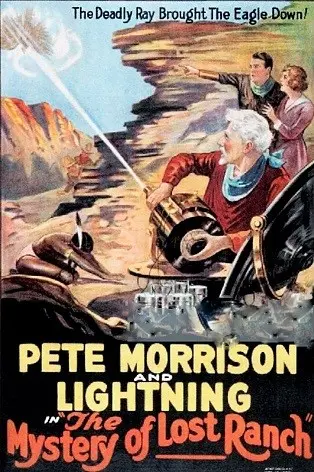
Is The Mystery of Lost Ranch worth watching today? Short answer: yes, but with significant caveats that demand a specific kind of viewer. This silent Western, a peculiar genre mash-up from an era when cinematic rules were still being written, offers a fascinating glimpse into early Hollywood's boundless imagination and its often-naive execution.
This film is unequivocally for silent film enthusiasts, Western historians, and those with a keen interest in the nascent stages of genre fusion. It serves as a historical document, showcasing the experimental spirit of early cinema. However, it is decidedly not for viewers seeking modern pacing, sophisticated narrative complexity, or high-fidelity visuals. If your expectation is a tightly plotted, action-packed thrill ride with contemporary polish, you will find The Mystery of Lost Ranch a challenging, perhaps even frustrating, experience.
This film works because its ambitious, albeit naive, genre blend—a Western featuring a 'death ray'—is genuinely unique and the raw charisma of star Pete Morrison, a true cowboy of the silver screen, elevates even the most rudimentary scenes.
This film fails because its rudimentary plot mechanics, often simplistic character motivations, and frequently sluggish pacing betray its intriguing premise, preventing it from ever truly capitalizing on its wild ideas.
You should watch it if you appreciate historical cinema, can forgive its technical limitations, and seek a peculiar, charmingly earnest glimpse into early Hollywood's imaginative spirit, especially where genres collide in unexpected ways.
The Mystery of Lost Ranch, even by the standards of its time, is an oddity. Its premise, which pits foreign agents against a lone scientist developing a 'death ray' in the heart of the American West, feels less like innovation and more like two disparate ideas duct-taped together. The narrative unfolds with a certain frontier logic, where scientific marvels are simply another element to be discovered and either exploited or defended, much like gold mines or water rights.
The story’s strength lies in its unashamed embrace of its own absurdity. We are asked to believe that a powerful weapon capable of mass destruction can be developed and tested in secret, in a remote Grand Canyon valley, without much more than a passing nod to its implications. This isn't a critique of the film's realism, but an observation of its tone. It treats the death ray with the same gravitas—or lack thereof—as a cattle rustling plot, which is both its charm and its critical weakness.
The inclusion of foreign agents as the antagonists is a common trope of the era, often tapping into post-war anxieties. Here, it feels somewhat generic, serving merely as a catalyst for Jim Wilson's heroic intervention. There’s a distinct lack of nuanced espionage, replaced instead by broad strokes of villainy that are easy to spot and, ultimately, easy to defeat. The film’s focus remains firmly on the frontier heroics rather than any genuine spycraft, which might disappoint those expecting a more thrilling genre blend.
The romance between Jim and Blair's daughter, while predictable, provides a necessary human element amidst the death ray shenanigans. It's a classic Western trope, the strong silent type winning the heart of the resourceful frontier woman. This predictability, however, grounds the more fantastical elements of the plot, making the film feel more familiar and less alienating to its contemporary audience.
Pete Morrison, a real-life cowboy turned screen star, anchors The Mystery of Lost Ranch with his understated yet potent screen presence. As Jim Wilson, he embodies the laconic heroism that would define the Western genre for decades to come. Morrison doesn't rely on grand gestures or exaggerated facial expressions, a common pitfall in silent cinema. Instead, he conveys determination and integrity through his posture, his measured movements, and a certain quiet intensity in his gaze.
Consider the scene where Jim first encounters Blair and his daughter. Morrison's reaction isn't one of shock or overt curiosity, but rather a subtle shift in his demeanor, signaling his understanding of the delicate situation without a single title card needing to spell it out. This kind of nuanced performance is rare for the period and speaks to Morrison's natural talent, setting him apart from some of his more theatrical contemporaries, such as those seen in films like The Teaser or The Pretty Sister of Jose.
Beth Darlington, as Blair's daughter, provides a commendable foil to Morrison's stoicism. Her performance is characterized by an expressive face and a palpable sense of concern for her father's dangerous work. While her character arc is largely conventional—the damsel in distress who also proves resourceful—Darlington imbues her with a quiet strength that prevents her from becoming a mere plot device. Her moments of subtle defiance against the foreign agents are particularly effective, showcasing a burgeoning independence that resonates even without dialogue.
The supporting cast, particularly the actors portraying the foreign agents, lean more into the theatricality typical of the era. Their villainy is often telegraphed through exaggerated sneers and menacing postures, lacking the subtlety that Morrison brings. While effective for the period's storytelling conventions, it creates a stark contrast with the more grounded performances of the leads. The horse, Lightning, also deserves a mention, delivering a reliable, if uncredited, performance that adds to the film's authentic Western feel.
The direction in The Mystery of Lost Ranch, while competent, often feels constrained by the technological and stylistic limitations of its time. The action sequences, particularly the confrontations with the foreign agents, are straightforward and functional rather than dynamic or suspenseful. There's a pragmatic approach to storytelling, where the camera largely observes rather than actively participates in shaping the audience's experience. This is not necessarily a flaw, but a characteristic of early filmmaking that prioritizes clarity over visual flair.
Cinematographically, the film benefits immensely from its Arizona setting, particularly the glimpses of the Grand Canyon. These natural backdrops provide a sense of scale and grandeur that no studio set could replicate. However, it's my strong, perhaps controversial, opinion that the film under-utilizes its spectacular location. The Grand Canyon, with its immense depths and dramatic vistas, feels more like a static painting than a dynamic environment that actively shapes the narrative or characters. One wishes for more sweeping shots, more adventurous explorations of the terrain, akin to what later Westerns like Way Out West would achieve with their landscapes.
The depiction of the 'death ray' itself is, understandably, primitive. We largely see its effects rather than the device in action, which is a clever workaround for the era's special effects limitations. A scene showing birds falling from the sky or animals collapsing implies its destructive power without needing elaborate visual trickery. This forces the audience to engage their imagination, which can be a powerful tool for silent cinema. Yet, the overall visual language struggles to convey the true menace or wonder of such an invention, often treating it with a detached clinicality.
The interior shots are functional, focusing on character interactions within relatively simple sets. Lighting is generally flat, prioritizing visibility over dramatic effect. This is typical for the period, but it means that moments of tension or emotional intensity often rely solely on the actors' performances rather than atmospheric visual cues. The film rarely deviates from standard camera angles, which, while ensuring clarity, also limits its capacity for visual storytelling innovation.
The pacing of The Mystery of Lost Ranch is, to put it mildly, leisurely. This is a common characteristic of silent films, which often relied on longer takes and less rapid-fire editing than modern cinema. For contemporary viewers, this can feel like a significant hurdle. The narrative unfurls at its own pace, allowing scenes to play out without the urgency that audiences have come to expect. While this slower rhythm can be meditative for some, it often stretches out moments that could benefit from tighter editing, particularly during the investigative and confrontational sequences.
There are stretches where the plot seems to meander, focusing on the simple day-to-day life at the ranch or the scenic beauty of the landscape, rather than propelling the central conflict forward. While these moments contribute to the film's atmosphere and sense of place, they invariably test the patience of anyone not fully immersed in the historical context of silent film viewing. It’s a film that demands a certain level of commitment and a willingness to adapt to a different narrative tempo.
The tone of the film oscillates between earnest adventure and almost quaint melodrama. The threat of the death ray and the foreign agents is presented seriously, yet there's an underlying innocence to the storytelling that prevents it from ever feeling truly dark or suspenseful. The villainy is clear-cut, the heroism unambiguous, and the romance sweet. This tonal consistency, while perhaps simplistic, ensures that the film remains accessible and avoids any jarring shifts. It’s a straightforward adventure, told with a clear moral compass, even when a superweapon is involved.
One unconventional observation I have is that the film's most compelling 'pacing' element isn't its narrative drive, but the lingering shots of nature. The moments where the camera simply observes the vastness of the landscape or the seemingly mundane activities on the ranch inadvertently become the most 'modern' in their contemplative stillness, offering a stark contrast to the often frenetic energy of later action films.
Yes, The Mystery of Lost Ranch is worth watching today, but only if you approach it with the right mindset. It is not a film that will resonate with a broad, mainstream audience accustomed to modern blockbusters. It is a historical artifact, a curio that offers insights into the early days of genre filmmaking and the unique charm of silent cinema.
For those interested in the evolution of cinema, particularly the Western genre and early science fiction, it provides valuable context. You see the raw materials that would later be refined into more sophisticated narratives. Pete Morrison's performance alone makes it a worthwhile watch for fans of early cowboy stars. The film's blend of frontier adventure with a fantastical element is genuinely unique, even if imperfectly executed.
However, be prepared for a slow pace and a narrative style that requires active engagement. The lack of sound, the reliance on title cards, and the visual storytelling conventions of the 1920s demand patience. It's a film for the cinephile, the historian, or anyone with a deep appreciation for the foundational works of cinema, not for casual viewing.
The Mystery of Lost Ranch is a fascinating, if flawed, relic from a bygone era of cinema. It works. But it’s flawed. Its ambition to blend the rugged frontier with futuristic weaponry is commendable, even if the execution feels more quaint than groundbreaking. Pete Morrison carries the film with his authentic cowboy persona, providing a steady presence amidst the more outlandish plot elements. However, its deliberate pacing and simplistic narrative structure will undoubtedly challenge contemporary audiences.
This isn't a film you watch for edge-of-your-seat thrills or profound thematic depth. You watch it to understand where cinema has come from, to appreciate the raw, unpolished creativity of early filmmakers, and to witness a truly unique genre experiment. It’s a curio. While it might not hold up as a compelling piece of entertainment for everyone today, its historical value and peculiar charm make it a worthwhile experience for the discerning cinephile. It's a testament to a time when anything was possible on the silver screen, even a death ray in the Grand Canyon.
IMDb —
1928
Community
Log in to comment.