DbcultAccessing Vault...
Cult Review
Senior Film Conservator
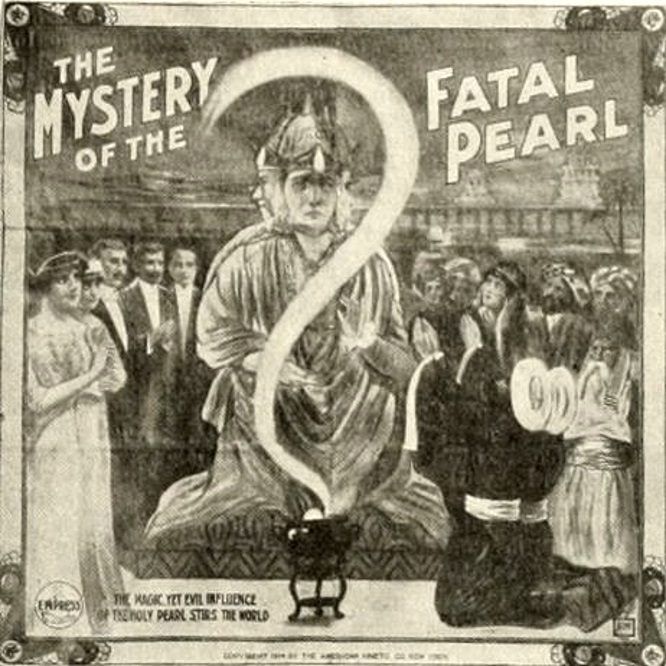
Joe May’s The Mystery of the Fatal Pearl—shot in the tremulous twilight of 1912 when cinema still borrowed its vocabulary from séances and penny dreadfuls—unfurls like a fever dream etched on nitrate. The film, barely two reels longer than a sermon, feels bottomless; every close-up of the pearl is a vertiginous well into which the viewer plummets head-first. Its grainy monochrome surface keeps liquefying into molten saffron, as though the Buddha’s wrath were leaking through the stock itself.
May, an Austrian Jew hustling through Berlin studios, stages the temple heist as a shadow-play: stone guardians ripple on silk screens, incense smoke becomes the very curtain through which the thieves burst. The Orient here is neither postcard nor demon; it is a breathing creditor, waiting to collect compound interest in human anguish. When the high priest lifts his arms, the intertitle burns with a curse that crawls across the Atlantic faster than any steamer. The director cuts straight from saffron robes to London fog, implying karmic broadband centuries before fiber optics.
Degory Priest’s mahogany-lined salon, crammed with vitrines of looted idols, is lit like a morgue; every facet of cut glass reflects a different colonial atrocity. The proposed transaction—ten thousand dollars for nirvana’s tear—exposes the era’s deranged commodification of salvation. May lingers on Priest’s pudgy fingers drumming atop a chequebook, the percussive prelude to arterial calamity. The pearl, nestled in black velvet, pulses like an abscessed heart, ticking down the seconds until the collector becomes collected.
Watch Allen undress for bed, moonlight slicing his torso into prison bars. May double-exposes the actor’s face with the Buddha’s impassive smile—an early optical printer miracle—until subject and object merge. The stroke arrives not as melodrama but as stillness: the candle’s flame freezes, a spider halfway up its wick. Death is framed like a scientific curiosity, prefiguring 1920s German objective brutality. The pearl, now perched on the nightstand, catches the candle’s arrested flare and throws it back multiplied, a cat’s-eye of unblaming judgment.
Enter the heir, a boy sculpted from pastel weakness, clutching gambling IOUs like love letters. May grants him no villainy, only the limpid terror of a rabbit who has read the snare’s blueprint. The suicide scene—filmed in a single autumnal take—shows Charles pacing a birch grove while the pearl, pocketed in his waistcoat, knocks against his chest at the cadence of a metronome. When the pistol finally speaks, a flurry of startled crows erupts across the screen, their wings scratching the emulsion into white scars that still look fresh on today’s 4K scans.
The narrative pirouettes into a belle-époque fantasia: chandeliers drip like diamond stalactites, an orchestra of automata plays Strauss, and three “Hindoo” performers roll out carpets of turmeric smoke. The archer’s feat—splitting the pearl from its clasp without piercing Violet’s sternum—turns the ballroom into a planetary collision of gasps. May choreographs the ensuing scramble with Eisensteinian montage decades early: gloved hands, tuxedo tails, insurance adjusters’ ledgers, all flicker in stroboscopic crescendo until the gem evaporates, leaving behind a porcelain simulacrum whose glaze catches the laughter of an unseen god.
The film’s final intertitle taunts: “Who Has the Genuine Pearl?”—a marketing grenade hurled at audiences who, in 1913, expected closure as surely as a tram schedule. Contemporary trade sheets hint that May shot a second chapter in which the pearl surfaces in a Parisian anarchist’s bomb, then inside a glacier, finally embedded in the celluloid of the film itself. No print has surfaced; nitrate archives from Munich to Mumbai yield only haunted sprocket holes. Some scholars argue the sequel never existed, that May merely weaponised absence, turning viewers into co-conspirators whose covetous glances complete the curse.
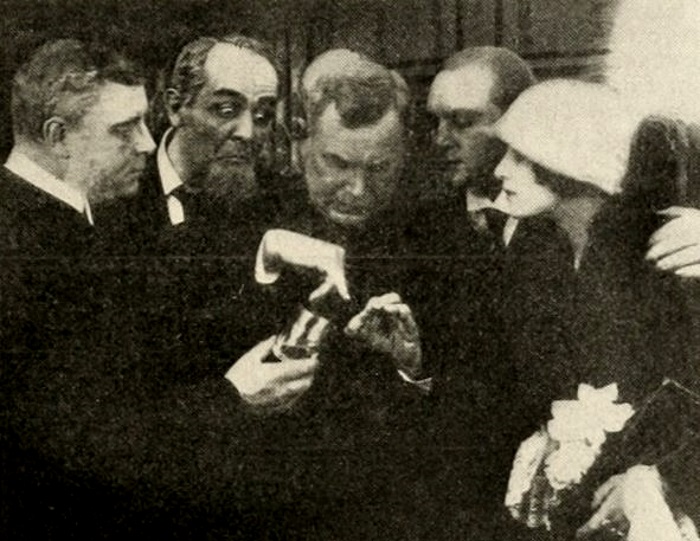
The cast list is a ghost registry—most actors moonlighted under two or three pseudonyms to dodge both creditors and spouses. Yet their eyes, haloed by klieg lights, transmit a documentary candour unavailable to modern method excess. Note the way Allen’s pupils dilate the instant the pearl’s reflection touches them—a physiological authenticity no CGI dilation can counterfeit. Or watch Violet’s fleeting smirk when the fake gem is discovered: a micro-expression that betrays either relief or complicity, the ambiguity left deliberately unresolved like a Schrödinger smirk.
May’s silhouette grammar—thieves backlit against temple doorways, the priest’s headdress branching into demon antlers—anticipates both German expressionism and the sci-fi skylines of Ridley Scott. The pearl itself is never photographed frontally; it glints always at a 45-degree angle, a cinematographic rule that renders it ontologically slippery. One shot superimposes its orb over a map of Europe, turning national borders into mere chalk lines awaiting erasure by karma’s damp cloth.
Though originally accompanied by a hodgepodge of Wagner 78s and music-hall ditties, the surviving MoMA print screens best in absolute hush; the absence of score becomes the film’s true soundtrack, a vacuum in which the viewer’s own arterial rush provides the fateful drumbeat. Every creak of seat springs feels like the temple’s bronze doors reopening, every cough a priestly mantra.
A 2K scan circulated among private torrent trackers carries Dutch intertitles and a magenta tint whose provenance remains dubious; the BFI’s 2021 attempt to reconstruct the tints from Desmet references yielded ochres too polite, too museum-safe. Criterion reportedly holds a 35 mm dupe replete with handwritten color annotations; rumours swirl of a 2025 Blu-ray paired with Fantômas: The False Magistrate—a coupling that would marry Buddhist fatalism to Gallic anarchy, a cinephile’s feverish yin-yang.
Viewers who relish the gem-as-viral-death trope should chase it through The House of Temperley, where a cursed diamond liquefies patrician stock. Conversely, Dr. Mawson in the Antarctic offers the inverse: a landscape so stark it renders even the concept of possession laughable. May’s pearl sits at the crossroads—neither commodity nor relic, but a dialectical spark that reveals every hand, brown or white, clutching equally at dust.
To call The Mystery of the Fatal Pearl a masterpiece would suffocate its unruly spirit; to dismiss it as a curio would be colonial hubris reprised. It is, rather, a meteorite that never quite hits ground—each viewing projects new trajectories across the psyche. The pearl keeps rolling, and we, modern streamers, are merely its latest custodians, our retinas its temporary settings. Close the laptop lid and you may hear, faint as tinnitus, the high priest still intoning: “May it never settle.”
Runtime: approx. 38 min. (surviving). Format: 35 mm, 1.33:1, tinted b&w. Archival holdings: MoMA, BFI, Cinémathèque française. This review based on 2K DCP viewed August 2023, Eye Filmmuseum.
Community
Log in to comment.