DbcultAccessing Vault...
5.5/10
Senior Film Conservator
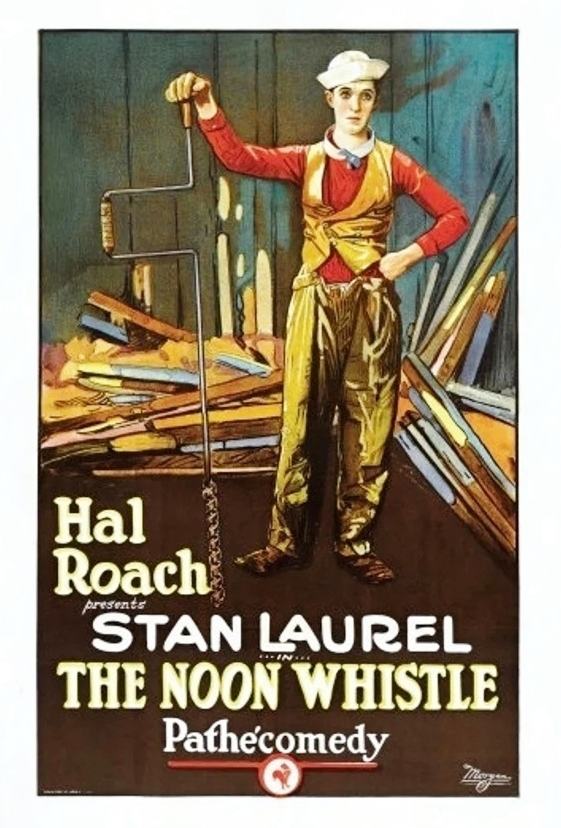
A definitive 5.5/10 rating for a film that redefined the boundaries of cult cinema. The Noon Whistle remains a cornerstone of transgressive art.
Ah, the silent era! A time when physical comedy reigned supreme, when exaggerated gestures and perfectly timed pratfalls spoke volumes more than any dialogue ever could. And among the titans of that golden age, one name consistently emerges: Stan Laurel. Before he became one half of the legendary Laurel and Hardy duo, Laurel was a prolific solo artist, honing his craft, perfecting his unique brand of innocent, almost childlike mischief. It’s in films like The Noon Whistle, a 1923 two-reeler, that we witness the raw, unfiltered brilliance of his early comedic genius, a precursor to the sublime partnership that would define his legacy. This isn’t just a historical curiosity; it’s a vibrant, laugh-out-loud testament to the enduring power of pure, unadulterated slapstick.
The premise of The Noon Whistle is deceptively simple, yet it provides a fertile ground for an escalating series of unfortunate events. We find ourselves in a bustling, albeit clearly struggling, lumber mill. The air is thick with the scent of sawdust and the palpable tension of impending disaster. Overseeing this chaotic enterprise is James Finlayson, the perpetually exasperated foreman. Finlayson, with his iconic glare and magnificent walrus mustache, was a master of the slow burn, a man whose patience was always stretched to its absolute breaking point, only to be snapped with glorious comedic effect. His role here is quintessential: the straight man, the victim, the long-suffering authority figure whose attempts at order are consistently, spectacularly undermined.
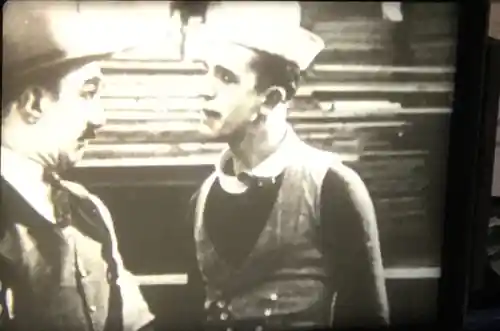
Enter Stan Laurel, a worker whose very presence seems to defy the laws of physics and common sense. Laurel's character isn't malicious; he's simply a force of nature, an unwitting agent of chaos. His intentions might be pure, but his execution is always disastrous. This is the heart of the film's comedic engine: the collision of Finlayson's desperate need for control with Laurel's inherent, almost spiritual, clumsiness. It’s a dynamic that would be refined and perfected with Oliver Hardy, but its nascent form here is already incredibly compelling. The contrast between Finlayson’s increasingly apoplectic reactions and Laurel’s blissful, often bewildered, ignorance of the havoc he wreaks is a masterclass in comedic timing and character work.
The narrative, if one can call such a delightful string of incidents a narrative, revolves around Laurel's escalating series of blunders. From the moment he steps onto the screen, it’s clear that no heavy object is safe from his gravitational pull, and no part of Finlayson’s anatomy is immune to impact. We see planks of wood, tools, and various other industrial accoutrements tumbling from great heights, each one finding its mark on the unfortunate foreman. The beauty of these gags lies not just in their execution, but in their relentless accumulation. It's not just one falling object; it's a cascade, a relentless assault that builds Finlayson’s frustration to a fever pitch.
But the pièce de résistance, the absolute zenith of this comedic onslaught, is undoubtedly the infamous bucket of hot glue. Ah, that bucket! It looms large, a silent, menacing presence foreshadowing the sticky doom to come. You just knew, with every fiber of your being, that big bucket of hot glue was trouble. And when it finally makes its grand, catastrophic descent upon Finlayson, it's a moment of pure, unadulterated slapstick brilliance. The visual of the sticky, viscous substance engulfing the foreman is hilarious, but it's Finlayson's reaction – a mixture of shock, despair, and an almost resigned acceptance of his fate – that truly elevates the gag. It's a moment so iconic, so perfectly executed, that it remains etched in the memory long after the credits roll. This particular gag, with its elaborate setup and explosive payoff, showcases Stan Laurel's burgeoning talent not just as an actor, but as a writer and orchestrator of comedic sequences. His fingerprints are all over the meticulous construction of these ludicrous scenarios.
While The Noon Whistle is primarily a vehicle for laughter, it also inadvertently touches upon themes that resonate even today. The setting of a failing lumber company adds a layer of economic anxiety to the proceedings. Finlayson's desperation isn't just about maintaining order; it's about keeping the business afloat, about the sheer struggle of daily labor. Laurel's character, in his accidental destructiveness, becomes a comedic embodiment of the uncontrollable forces that can undermine any enterprise, regardless of effort. The film, in its own way, satirizes the inefficiencies and absurdities of industrial labor, presenting a world where the very tools meant to facilitate work become instruments of chaos.
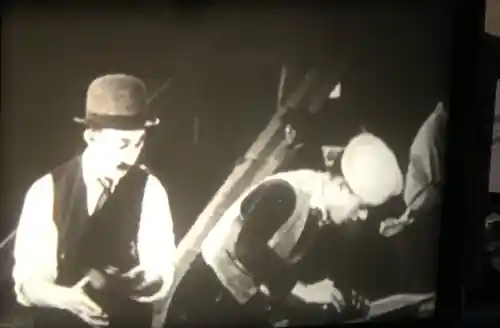
The physical toll on Finlayson also highlights the often brutal nature of silent film comedy. These actors were true athletes, enduring countless bumps and bruises for the sake of a laugh. The exaggerated pain, the stretched faces, the flailing limbs – it's all part of a finely tuned performance designed to elicit a visceral reaction from the audience. It's a testament to their dedication and the sheer physicality required to convey emotion and narrative without the aid of dialogue. One might compare the relentless physical abuse Finlayson endures to the trials faced by protagonists in other early films focused on arduous circumstances, though perhaps with less comedic intent, such as the struggles depicted in The Boer War, which, while serious, also showcased human resilience against overwhelming odds. Here, however, the overwhelming odds are courtesy of a bumbling colleague.
While Laurel and Finlayson dominate the screen, the film also features other silent film stalwarts like Katherine Grant, Sammy Brooks, William Gillespie, Noah Young, and John M. O'Brien in supporting roles. Though their screen time may be limited, their presence helps to flesh out the chaotic world of the lumber mill. It's a reminder that even in two-reelers, a strong ensemble could elevate the overall production. The uncredited direction, likely heavily influenced by Laurel himself as the credited writer, demonstrates an innate understanding of comedic pacing and visual storytelling. The camera work, while rudimentary by today's standards, is effective in capturing the action, allowing the physical comedy to shine without unnecessary frills. The editing ensures that each gag lands with maximum impact, building momentum towards the next inevitable mishap.
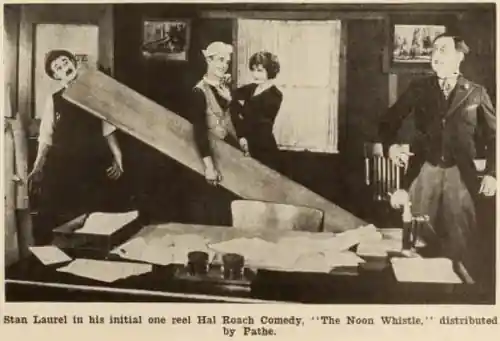
Laurel's writing credit for The Noon Whistle is particularly noteworthy. It underscores his creative control and his deep understanding of comedic structure even at this early stage of his career. He wasn't just an actor; he was a conceptualizer, a craftsman of gags. This foresight and involvement in the creative process set him apart and laid the groundwork for his later, more complex comedic narratives. It's fascinating to trace the evolution of his comedic voice, seeing elements of his later character already present here. The innocent bewilderment, the slow dawning of realization (or lack thereof), the almost philosophical acceptance of fate – these are all hallmarks that would define his iconic persona.
In comparing The Noon Whistle to other films of the era, one can see it fits squarely within the tradition of industrial slapstick, a popular subgenre where factory or workplace settings provided fertile ground for comedic chaos. Films like The Mediator, while perhaps not directly comedic, often explored the complexities of human interaction within structured environments, albeit with dramatic intent. Laurel, however, masterfully subverts this structure for pure comedic delight. His deliberate undermining of the workplace’s functionality is a satirical commentary on the very nature of efficiency. It's a stark contrast to the dramatic tension one might find in a film like The Net, where the stakes are genuine and the consequences dire. Here, the stakes are purely comedic, and the consequences are Finlayson's perpetual agony.
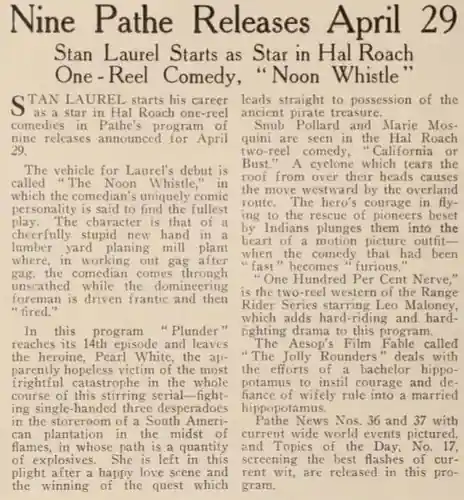
What makes The Noon Whistle truly special is its status as an early showcase for Stan Laurel's distinctive comedic persona. While he made numerous films before this, and many more before partnering with Hardy, this short stands out as a particularly potent distillation of his individual brilliance. It's a compelling argument for his enduring legacy, proving that even without his famous counterpart, Laurel possessed a unique comedic voice capable of carrying a film. The film is a masterclass in visual storytelling, where every movement, every facial expression, contributes to the overall comedic effect. It's a testament to the power of silent cinema, demonstrating how much could be communicated without a single spoken word.
The film’s influence, while perhaps not as overt as some of his later works, is undeniable in the trajectory of physical comedy. It helped solidify the tropes of the long-suffering victim and the innocent agent of chaos, archetypes that would be revisited and refined by countless comedians. One could even argue that the meticulous planning of the gags, particularly the glue incident, shows a sophistication that foreshadows the elaborate Rube Goldberg-esque comedic contraptions seen in later films. It's a cornerstone in understanding the evolution of Laurel's craft, a crucial piece of the puzzle that led to his eventual superstardom. For enthusiasts of silent cinema, and indeed, for anyone interested in the roots of modern comedy, The Noon Whistle is an essential viewing experience. It’s a delightful, uproarious ride that reminds us why the laughter of the silent era continues to echo so powerfully through time.
In an age saturated with complex narratives and high-tech special effects, there's something wonderfully refreshing about the raw, visceral simplicity of a film like The Noon Whistle. It’s a reminder that at its core, comedy is about human experience, about the absurdity of everyday life, and about the universal joy of a well-executed pratfall. Stan Laurel, even in these formative years, understood this implicitly. He crafted not just gags, but moments of pure, unadulterated hilarity that transcend language and time. So, if you ever find yourself needing a genuine, hearty laugh, seek out The Noon Whistle. You won't be disappointed. Just try not to get any hot glue on you.
IMDb 6.8
1922
Community
Log in to comment.