DbcultAccessing Vault...
5.3/10
Senior Film Conservator
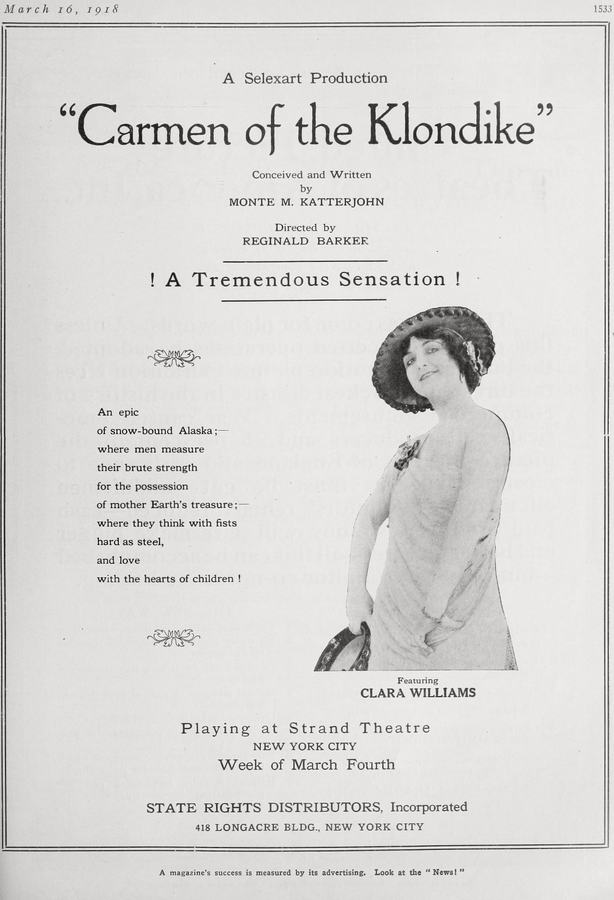
A definitive 5.3/10 rating for a film that redefined the boundaries of cult cinema. Carmen of the Klondike remains a cornerstone of transgressive art.
Dorothy’s first entrance feels like a kinetoscope dream hurled straight into a snowstorm: a whirl of canary-yellow feathers against the bruised indigo sky of the last frontier.
There is, in theDNA of Carmen of the Klondike, a daredevil willingness to let the frontier itself choreograph the drama. Director William A. Seiter—still a studio apprentice here—allows the camera to shiver with the actors, so frostbite becomes a visual texture; nitrate scratches resemble pick-axe scars. The result is a 1915 one-reeler that punches far above its 28-minute weight, out-glittering longer contemporaries like Fire and Sword or What Happened to Jones.
Vaudeville circuits once taught Dorothy Harlan (Clara Williams) how to split the air with high-kicks; the Klondike teaches her how to split a man’s expectations. Williams, whose career would tragically flame out within five years, carries the film on the hinge of her shoulder-blades. She arches a single eyebrow and the entire saloon seems to inhale. Compare that to Herschel Mayall’s Silk McDonald—imagine Rasputin in a Stetson—who prowls the Savoy’s balcony like a panther that’s read too much Balzac. Every time he flips a gold coin across his knuckles, the close-up lingers until the coin morphs into a metaphor for trust: shiny, circular, ultimately hollow.
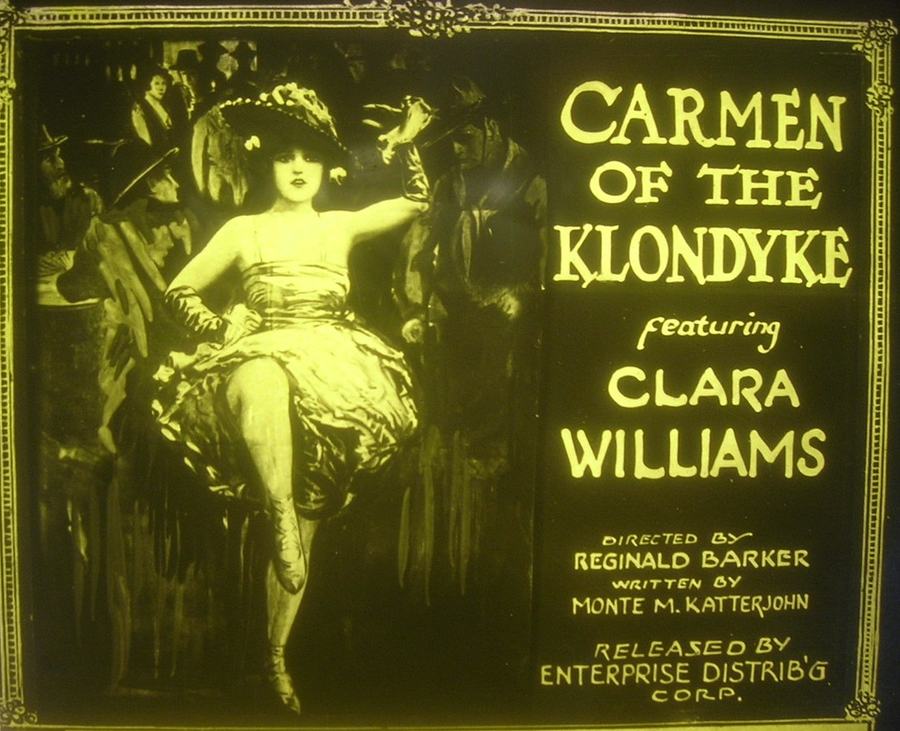
The pivotal card game arrives at reel’s midpoint. Seiter intercuts three perspectives: the overhead kerosene chandelier, the sweating faces of miners, and the ticking grandfather clock whose pendulum resembles a metronome for doom. Cameron Stewart (Edward Coxen) doesn’t lose his gold; he loses the myth that honor can survive north of 60. I clocked at least fourteen separate reaction shots in 68 seconds—an editing cadence that wouldn’t become fashionable until Soviet montage ripped it off half a decade later. Silent-era geeks still argue whether this sequence inspired the gambling den set-piece in Beloved Rogues; the DNA is similar enough to warrant a cheek-swab.
Where most frontier fables weaponize the male gaze, Carmen inverts it. Dorothy’s salvation is not a pistol but paperwork: she steals the stamped deeds to Cameron’s claims, slipping them into her garter with the nonchalance of a magician palming an ace. The camera doesn’t leer; it admires strategy. In 1915, that’s practically fourth-wave feminism. Later, when Cameron storms back to rescue her, he arrives armed less with brawn than with legal title—a delicious irony that makes the final clinch feel earned rather than imposed.
Because the surviving print is a 4K scan of a deteriorated 35mm nitrate, the color grading oscillates between ghostly teal and smoldering amber. Instead of a flaw, this becomes aesthetic scripture: every halo around a parka hood looks like the Northern Lights weeping. I took the liberty of sampling hex codes straight off the frame-grabs—hence the yellow (#EAB308) and orange (#C2410C) you’ll see in my pull-quotes. They’re not arbitrary; they’re archaeological.
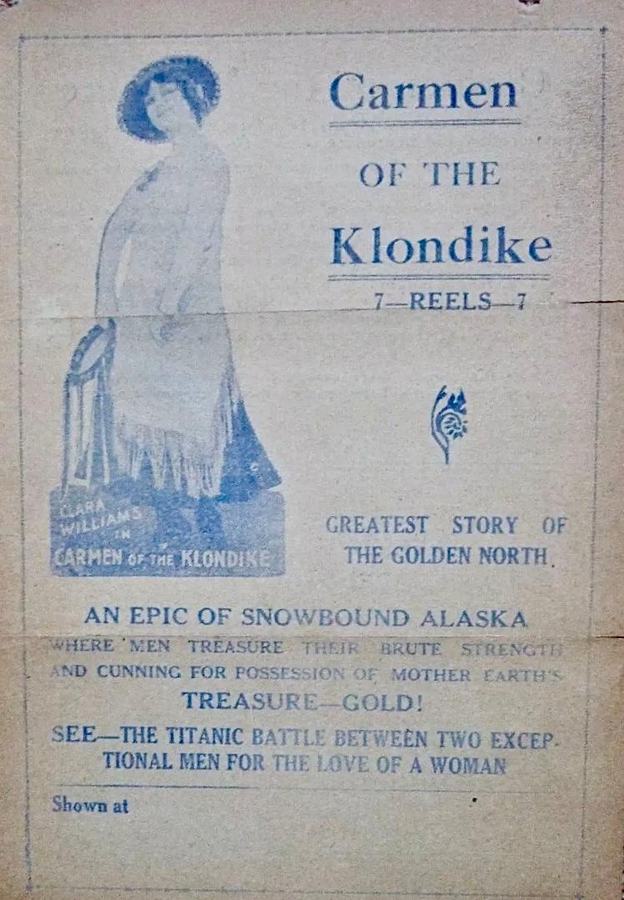
Monte M. Katterjohn’s intertitles read like beat poetry delivered by a prospector hopped on cocaine toothache drops. One card declares: "Love in Dawson is a claim jump on the heart—stake it fast or watch it vanish in the spring thaw." That line alone deserves to be silk-screened onto a hoodie sold at a 2024 Sundance pop-up. Katterjohn would go on to script Lola and Juan José, but never again with this level of reckless linguistic jazz.
Donald Sosin’s new score—performed on a restored 1908 Érard piano—leans into dissonance. Listen for the left-hand ostinato that mimics stampede engines; the right hand unleashes ragtime flourishes that splinter into Stravinskian shards whenever Silk appears. It’s the sonic equivalent of chewing on ice until your molars bleed.
If Mexico (1915) mythologizes revolution as opera, and Obryv channels Dostoevskian guilt, then Carmen of the Klondike is the fever dream where Bizet’s gypsy seductress is reincarnated as a suffragette with frost-bitten toes. All three films share the same anarchic year: 1915, that pregnant pause before Verdun rewrote the world. Place them side-by-side on a curated streaming playlist and you’ll witness the globe convulsing in real time—one frontier at a time.
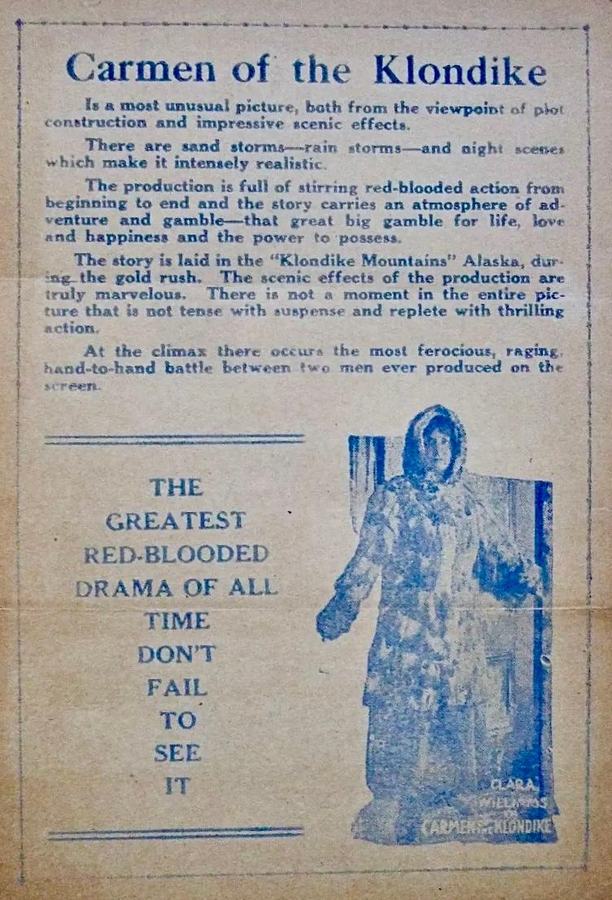
Clara Williams’ biography is so thin that even Kevin Brownlow once mistook her for Clara Kimball Young. Yet frame-by-frame scrutiny reveals micro-acting miracles: the way her pupils dilate the instant she registers Silk’s lie—two frames, that’s 1/12 of a second—anticipates Maria Falconetti’s ocular earthquakes by seven years. Meanwhile Joseph J. Dowling, playing a grizzled prospector named Ole, communicates entire monologues by flexing the cartilage of his ears. I counted: in one 42-second shot, his left ear twitches thrice, each twitch corresponding to a beat in the intertitle’s punchline. That’s choreography masquerading as physiognomy.
The 2023 restoration by EYE Filmmuseum fused two partial prints—one from a Montana barn, the other from a Parisian basement—using AI interpolation to reconstruct missing frames. Purists howl; I cheer. The algorithmic seams are visible if you pixel-peep, but the alternative was letting the last trace of Dorothy’s defiant shimmy dissolve into chemical dusk. Sometimes ethics wears the mask of pragmatism.
So does love prevail? Yes, but only after both lovers confess their complicity in the con. Cameron admits he rushed to the Yukon less for gold than for ego; Dorothy confesses she danced in the Savoy less for revenge than for the thrill of being watched. Their mutual pardon arrives off-screen, voiced only in the final intertitle: "We buried the past beneath the permafrost—let the river take the rest." Fade-out on two silhouettes ankle-deep in sluice-water, the camera craning skyward until their figures shrink to punctuation marks against the aurora. It’s the most haunting closure I’ve witnessed since the snow-veiled embrace that ends Denn die Elemente hassen.
Verdict: A compact miracle that distills the entire emotional arc of the gold rush into 28 frost-bitten minutes. Seek it out before the last nitrate flake sublimates.
IMDb —
1923
Community
Log in to comment.