DbcultAccessing Vault...
Cult Review
Senior Film Conservator
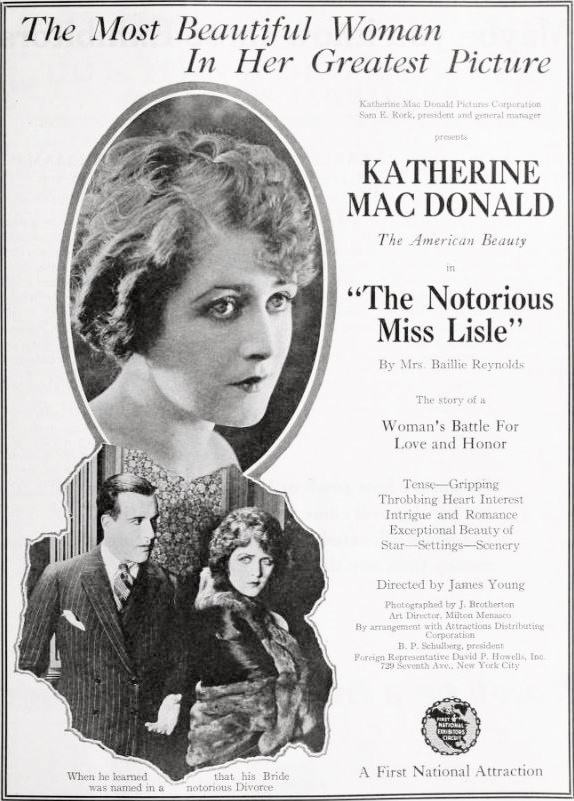
The cinematic landscape of 1920 was a fascinating crossroads, a temporal bridge where the rigid moralism of the Victorian age collided with the burgeoning, often reckless, liberation of the Jazz Age. Within this volatile milieu, The Notorious Miss Lisle emerges not merely as a melodrama, but as a scathing indictment of the socio-legal structures that permitted a woman’s reputation to be dismantled by the mere suggestion of impropriety. Directed with a keen eye for atmospheric tension by James Young, the film navigates the treacherous waters of 'notoriety'—a term that, in the context of the early 20th century, acted as a permanent brand of social leprosy.
The narrative impetus—a divorce scandal where our protagonist, Gaenor Lisle, played with a luminous vulnerability by Katherine MacDonald, is unjustly named as a co-respondent—serves as a grim reminder of the period's legal inequities. Unlike the protagonists in A Wife on Trial, who often find themselves battling overt physical or financial constraints, Gaenor is besieged by the intangible. She is a pariah in a silk dress, her exile to the Continent a self-imposed sentence designed to shield her from the scorching glares of the British gentry. Young’s direction emphasizes this isolation through expansive, lonely shots that dwarf MacDonald against the backdrop of European vistas, suggesting that even in the beauty of France, the shadow of the English court remains omnipresent.
The entry of Peter Garstin (Nigel Barrie) introduces the film's central romantic conflict. Their courtship is a masterclass in the 'silent' language of the era—lingering glances, the delicate interplay of light on MacDonald’s porcelain features, and a sense of impending doom that permeates their every shared moment. Peter represents the idealized Edwardian gentleman: protective, affluent, and tragically oblivious. His ignorance of Gaenor’s past is the ticking clock at the heart of the film. One cannot help but draw parallels to the thematic weight of hidden histories found in The Sealed Envelope, where the revelation of a secret threatens to incinerate the present. In The Notorious Miss Lisle, the secret isn't a crime of malice, but a crime of circumstance, making the eventual fallout all the more agonizing.
The shift to Paris marks the film's descent into high tragedy. The chance encounter between Peter and a friend who 'remembers' the Lisle scandal is handled with a chilling economy. The casual nature of the gossip—the way a woman’s life can be dismantled over a drink at a café—is perhaps the film’s most biting commentary. When Peter confronts Gaenor, the expected cinematic trope would be a frantic defense. Instead, Gaenor retreats into a dignified, albeit self-destructive, silence. This refusal to plead for her own humanity is a nuanced character choice that elevates the film above standard potboilers like Baby Mine, which lean more toward theatrical artifice than psychological realism.
The sequence involving the English Channel crossing is a triumph of early cinematography. The churning grey waters serve as a literal and metaphorical barrier between Gaenor’s failed escape and the confrontation she desperately seeks to avoid. It is here she encounters Craven, the man whose cowardice initiated her ruin. The visual language of their meeting—staged against the backdrop of a looming storm—mirrors the internal turbulence of the characters. The subsequent accident that leaves Gaenor hospitalized is the pivot point from which the film shifts its focus toward Peter’s transformation. No longer the passive lover, Peter must become the investigator, a role that echoes the desperate search for truth seen in The Sacred Flame.
Katherine MacDonald, often referred to as the 'American Beauty,' justifies the moniker here, but she offers far more than aesthetic appeal. Her performance is anchored in a profound interiority. In an era where silent acting often drifted into the histrionic, MacDonald employs a restraint that is modern in its execution. Her portrayal of Gaenor is one of quiet endurance, a woman who has accepted the world’s cruelty but refuses to let it diminish her grace. This subtle approach contrasts sharply with the more overt stylings found in contemporary European works like Impéria or the raw emotionality of Freie Liebe. MacDonald’s Gaenor is a woman of the transition, caught between the expectations of the past and the burgeoning autonomy of the future.
The third act of the film belongs to the pursuit of Craven. The character of Craven is a fascinating study in the banality of malevolence. He isn't a mustache-twirling villain but a man of weak character who chose his own comfort over another's survival. The hunt for his confession is paced with a rhythmic intensity that foreshadows the noir sensibilities of later decades. As Peter follows the breadcrumbs, the film explores the concept of 'honor'—not as a static virtue, but as something that must be actively reclaimed. This thematic exploration is much more sophisticated than the binary morality found in Westerns of the time, such as The Virginian or Taming the West.
The Notorious Miss Lisle subverts the 'fallen woman' trope by insisting on the protagonist's absolute innocence from the outset. While films like Heart and Soul deal with the heavy price of emotional transgression, Young’s film focuses on the injustice of the label itself. It interrogates the audience: why do we believe the scandal? Why is the burden of proof always on the accused woman? Even in the lighter fare of the period, such as Peggy Does Her Darndest or the comedic shifts in Snap Judgment, the fragility of a woman's standing remains a recurring, albeit often ignored, subtext. Here, it is the primary text.
James Young’s direction is characterized by a sophisticated use of depth and blocking. The hospital scenes, in particular, utilize shadows to create a sense of liminality—Gaenor is physically between life and death, just as she is socially between condemnation and vindication. The pacing is deliberate, allowing the emotional weight of each revelation to settle before moving to the next. This is not the frenetic energy of Headin' Home or the experimental jolts of Black and Tan Mix Up; rather, it is a stately, cinematic progression that respects the gravity of its subject matter.
The resolution, while satisfying, leaves a lingering sense of melancholy. Though Peter obtains the confession and Gaenor’s name is cleared, the film acknowledges that the scars of such an ordeal do not simply vanish. The final frames suggest a hard-won peace rather than a jubilant victory. This nuanced ending places the film in conversation with operatic adaptations like Fidelio, where the triumph over injustice is tempered by the memory of the struggle. It also stands in stark contrast to the more shadowy, unresolved tensions of The Scarlet Shadow.
Ultimately, The Notorious Miss Lisle is a vital piece of silent cinema that deserves a prominent place in the pantheon of early social dramas. It is a film that speaks across the decades, reminding us of the lethality of rumor and the profound courage required to stand silent when the world demands a confession of sins never committed. Katherine MacDonald’s performance remains a high-water mark for the era, and James Young’s direction provides a blueprint for the psychological thriller. It is a work of both beauty and bite, a cinematic artifact that continues to resonate with its plea for truth in an age of obfuscation.
IMDb 6.2
1916
Community
Log in to comment.