DbcultAccessing Vault...
Cult Review
Senior Film Conservator
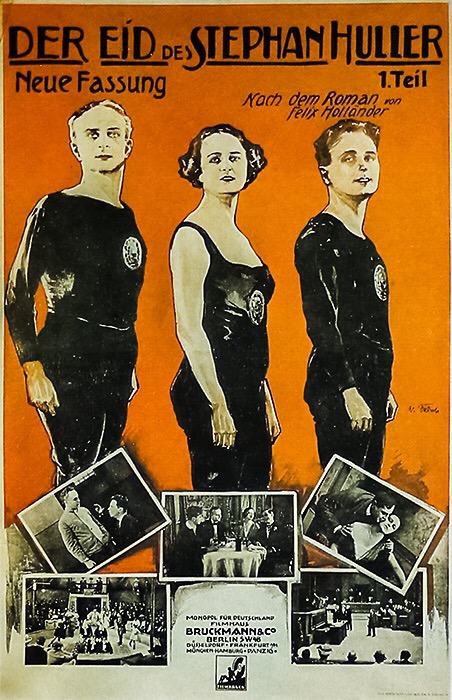
The Oath of Stephan Huller is a film that lingers in the mind like an unresolved chord, its themes of loyalty, sacrifice, and the corrosive nature of secrets refusing to dissipate. Directed with a meticulous eye by Reinhard Bruck, the film is a masterclass in visual storytelling, blending airtight pacing with atmospheric tension. The screenplay, co-authored by Bruck and Felix Hollaender, is a labyrinth of moral ambiguity, where every character’s agenda is as murky as the rain-slicked streets of its shadowy settings.
H. Leffler’s portrayal of Stephan Huller is nothing short of electrifying. Leffler balances stillness and intensity, capturing the toll of a man whose resolve is eroded by the weight of his own principles. In one particularly haunting scene, he stares into the abyss of a dimly lit mirror, his reflection fractured by flickering candlelight—a visual metaphor for his splintering identity. His chemistry with Hanni Weisse, who plays the enigmatic informant Lena, crackles with subtext; their exchanges are laden with unspoken betrayals and veiled promises.
Carl de Vogt’s antagonist, Franz Kessler, is a character of chilling elegance. De Vogt’s performance is a study in controlled menace, his every gesture calculated to unsettle. The film’s most memorable moment arrives in a tense exchange between Huller and Kessler, where words are weapons and silence is a language. The dialogue here is sparse but loaded, each line a chess move in a game where the stakes are nothing less than survival. This sequence echoes the espionage tautness of Die Stimme des Toten, though Huller’s narrative diverges through its focus on personal rather than political stakes.
Visually, the film is a feast of contrasts. Cinematographer Arthur Bergen employs deep focus and stark chiaroscuro to isolate characters within their environments, a technique that mirrors their emotional entrapment. The score, composed by Anton Edthofer, is a minimalist yet piercing accompaniment, its dissonant strings underscoring the tension in every scene. In a pivotal sequence set in a decaying opera house, the camera glides through decaying velvet curtains and fractured chandeliers, a visual allegory for the collapse of grand ideals.
The narrative’s third act is a masterstroke of narrative inversion. What initially appears to be a straightforward tale of espionage unravels into a meditation on the futility of absolute loyalty. The film’s climax, a silent confrontation between Huller and his estranged brother (played with quiet ferocity by Alexander Areuss), is a visceral punch of emotional catharsis. This scene, reminiscent of the raw familial tension in The Marriage of Molly-O, is elevated here by the use of negative space—the actors’ bodies framed against vast emptiness, emphasizing their isolation.
Supporting performances are uniformly stellar. Hugo Döblin’s turn as a morally ambiguous lawyer adds layers of complexity, while Max Pohl’s cameo as a jaded journalist provides moments of dry wit that cut through the film’s oppressive atmosphere. The ensemble’s cohesion is a testament to Bruck’s direction, which ensures every character feels integral to the intricate plot.
Thematically, The Oath of Stephan Huller interrogates the idea of sacrifice. Is duty to an oath a virtue or a prison? The film suggests the latter, as Huller’s adherence to his vow becomes both his identity and his undoing. This existential inquiry is woven into the fabric of the story through symbolic motifs—recurring images of chains, clocks, and broken mirrors that resonate with the film’s core thesis.
In terms of cinematic lineage, the film draws comparisons to A Favor to a Friend in its use of moral dilemmas, though Huller’s narrative is more introspective. Similarly, the film’s bleak fatalism aligns with the tone of The Brass Check, but its emotional core is distinctly more humanistic. The pacing, however, diverges from the frenetic energy of Fireman, Save My Gal! in favor of a more deliberate, almost glacial rhythm that allows the tension to simmer.
The film’s final act is a tour de force of ambiguity. In its closing moments, the camera lingers on a letter left on a table, its contents unknown. This refusal to provide closure is a bold narrative choice, inviting viewers to grapple with the film’s ethical questions long after the credits roll. It’s a fitting end to a story that thrives on uncertainty, much like the shadowy world it portrays.
In the pantheon of pre-war European cinema, The Oath of Stephan Huller stands as a singular achievement. Its blend of psychological depth, visual poetry, and narrative complexity cements its status as a modern classic. For those who have appreciated the existential brooding of Danger Within or the moral intricacies of A Mother’s Sin, this film is an essential watch.
IMDb 6.5
1926
Community
Log in to comment.