DbcultAccessing Vault...
3.7/10
Senior Film Conservator
A definitive 3.7/10 rating for a film that redefined the boundaries of cult cinema. The Padre remains a cornerstone of transgressive art.
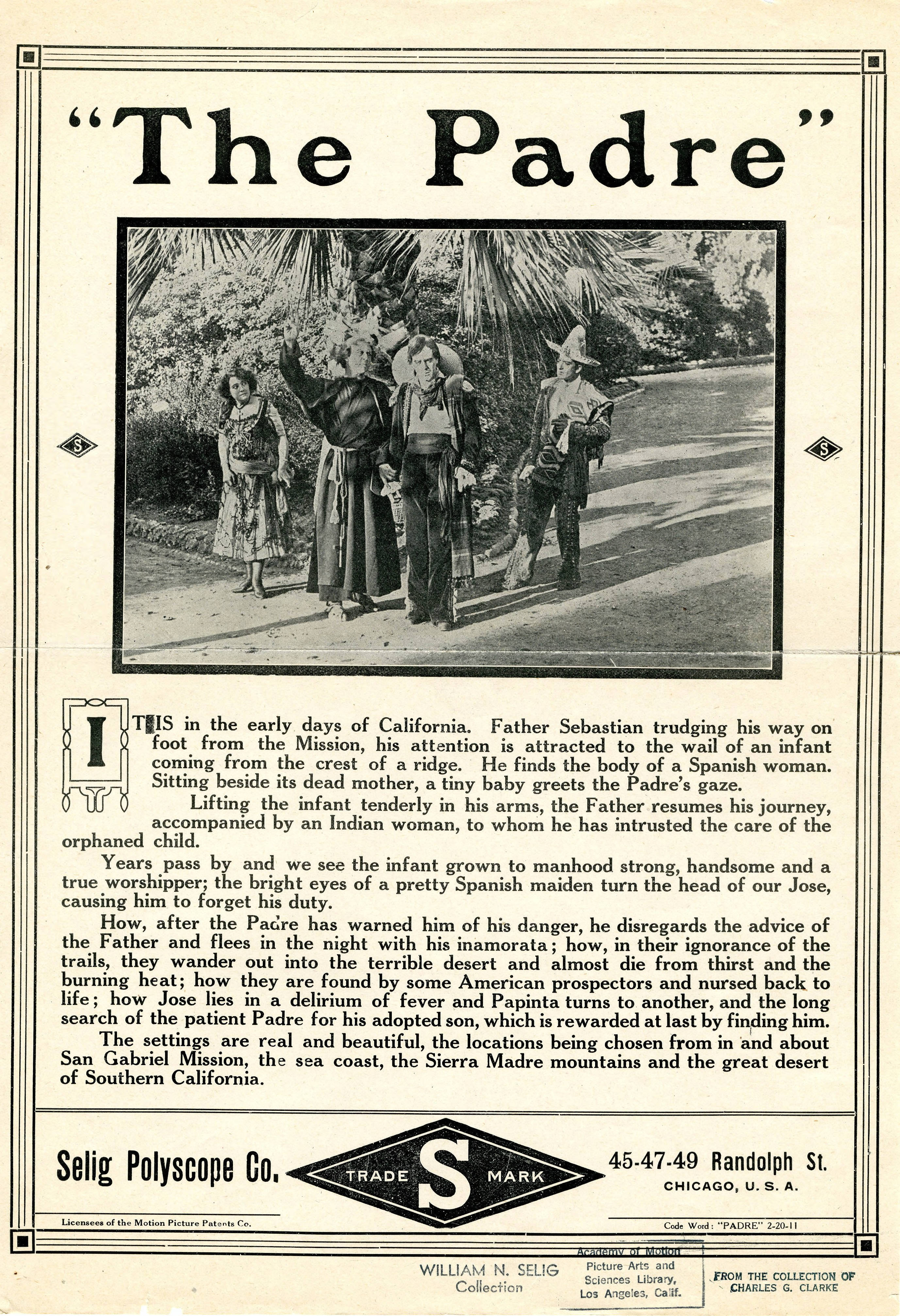
There is a moment—halfway through The Padre—when the camera simply lingers on a cracked earthenware jug as the last droplet of water evaporates under the desert’s vindictive sun. That jug is the film in miniature: an object of apparent insignificance that quietly becomes the axis between salvation and annihilation. Shot among the adobe arteries of San Gabriel Mission and the scorched immensity of the Southern California desert, Hobart Bosworth’s 1911 one-reeler distills the morality play into something close to myth, yet flecked with documentary grit.
We open on Father Sebastian’s silhouetted labor: a lone cassock scaling a chaparral ridge, the Pacific fog peeling back like parchment. The discovery of the infant—mother rigid in the blood-darkened dust—plays less like melodrama than like a fresco suddenly exposed to rain. Bosworth, also the lead, lets his shoulders speak the first dialogue: a tremor of awe, then the decisive hoist of the child against his breastplate. From that instant forward, the film’s grammar is established: gesture over title card, horizon over close-up.
Cut to a montage of years: grape arbors fatten, mission bells corrode from gold to liverish umber, the foundling Jose (played by Robert Z. Leonard with the feral grace of a young novitiate) grows into the frame. His catechism is intercut with shots of Papinta twirling a lace mantilla beneath the arcade arches—visual foreshadowing that desire will fracture the cloister’s symmetry. When the lovers bolt, the screen itself seems to rip: the mise-en-scène abandons cool cloisters for vistas where the sky is an unending bruise. Their trajectory across the Mojave becomes a Stations of the Cross told in eleven suffocating intertitles, each more parched than the last.
Do not mistake brevity for thinness. The film’s 15-minute running time is crammed with visual stratagems that wouldn’t become fashionable until the late silent era: backlit dust clouds that turn human figures into incandescent negatives; a dolly-in on Jose’s fever dream where the camera pirouettes 180°, flipping the horizon to the vertical axis so that the world itself appears to slide into the sky. The desert day-for-night scenes are achieved through amber filters and silver-painted cardboard moons—crude, yet they evoke Magritte’s future surrealism. Compare this to the static wide tableau of Birmingham (also 1911) and you realize how The Padre weaponizes mobility: the camera aches, sweats, thirsts.
Bosworth’s Padre is less a sermon incarnate than a cartography of doubt. Notice how his fingers stray to the child’s pulse even after the boy has grown—an involuntary reflex that betrays the terror of second loss. Leonard, meanwhile, embodies Jose with the kinetic restlessness of colthood: every glance toward Papinta is a small apostasy. Their chemistry combusts not in clinches but in chiaroscuro: a shared candle in the mission library, the flame guttering as pages of Aquinas curl in the heat.
And Papinta? The actress is uncredited, yet her arc from ingénue to pragmatic survivor anticipates the moral shapeshifting of von Stroheim’s later femmes. When she abandons the delirious Jose for the security of a prospector’s campfire, the film refuses judgment; the cut is simply a long shot of her shawl receding into copper dusk, a visual shrug that feels startlingly modern.
What resonates longest is the dialectic between interior and exterior wastelands. The California desert is not mere backdrop; it is the Padre’s dark night made silica and sagebrush. Each butte becomes a pulpit, each mirage a doubt. When Sebastian finally locates Jose—half-buried, lips cracked into a stigmatic grin—the rescue is filmed in one unbroken take: the priest drags the body across forty feet of blistering salt pan, the camera retreating in real time. No music, only wind and the faint clack of the rosary. It is as if the film itself is confessing.
Released the same year as the Jeffries-Johnson fight footage scandalized white audiences, The Padre traffics in a gentler racial optics: the native caretaker is unnamed yet pivotal, her presence a tacit indictment of mission paternalism. The American prospectors—gruff, secular—deliver the lovers from Catholic guilt into mercantile pragmatism. The film never sermonizes, yet the historical subtext sizzles: California itself is the orphan tugged between sacrament and speculator.
Editorial strategy anticipates Soviet montage: a 2-second insert of a lizard’s tongue flicking at dew precedes Jose’s first kiss, priming the viewer with predatory thirst. Later, three alternating shots—Padre’s boots in mission cloister, lovers’ footprints filling with windblown sand, Padre’s boots again—compress a 40-day Lenten search into eight seconds. The tempo is ecclesiastical yet electric.
Though released sans score, archival accounts mention exhibitors pairing the final reel with a muted organ adagio in D-minor. Modern silent-film festivals often screen it with a single sustained cello drone, letting the desert’s negative space resonate. Try watching it in a blackout with headphones feeding in distant mission bells; every intertitle becomes a benediction, every grainy tear in the emulsion a possible epiphany.
Where contemporaries like Dante’s Inferno (1911) aimed for spectacle and Dressing Paper Dolls peddled domestic frippery, The Padre chose the arid sublime. Its DNA reemerges in Trail to the West (1912) and even in von Stroheim’s Greed desert sequence, yet few descendants match its ascetic potency.
By the time the bell tolls over San Gabriel and Jose, gaunt but unbroken, genuflects once more beneath the crucifix, the film has already wandered beyond morality into something like geological time: centuries of adobe, salt, and prayer compressed into 900 feet of nitrate. Watch it not for narrative closure but for the tremor in Padre Sebastian’s palm as he lifts the chalice—an infinitesimal quake that hints the desert inside the human heart is vaster than any stretch of sand outside it.
Verdict: A sun-scorched miniature that punches above its celluloid weight, The Padre remains essential viewing for anyone mapping the fault line where American cinema’s civic conscience splits from its spiritual ache.
IMDb 5.9
1935
Community
Log in to comment.