DbcultAccessing Vault...
Cult Review
Senior Film Conservator
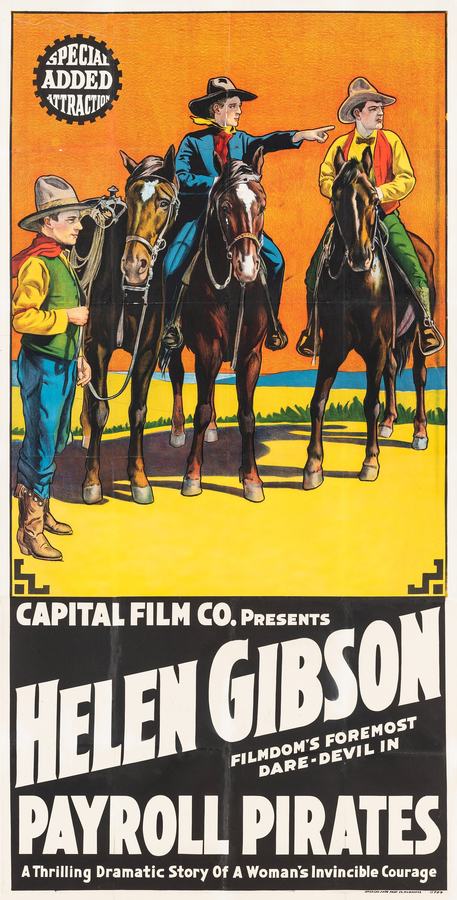
A crate of nitrate dreams, misfiled under "maritime miscellany," has cracked open to reveal a 1920 curiosity that turns wage slavery into blood-salted opera.
Picture the scene: title cards inked like ransom notes, each intertitle a paper-cut against the fat thumb of industrial plunder. The Payroll Pirates charts a mutiny led not by cutlass-swinging bravos but by ledger-leeches dizzy on compound interest. Helen Gibson—serial cliffhanger queen turned anarchist muse—storms aboard as Captain Meredith Vane, a widow whose husband’s death benefits were swallowed by corporate legerdemain. She swaps widow’s weeds for a pea-coat the color of burnt coffee, her eyes twin searchlights rifling through the gloom of boardroom perfidy.
The film’s first movement plays like a strike pamphlet soaked in brine: dockworkers stampede off a freighter when their paymaster coolly deducts "storm insurance" from already paltrous wages.
In the melee, a lone satchel of payroll chits—genuine legal tender in this micro-economy—topples into the drink, spiraling down past barnacled chains. The ocean rewrites those promissory notes into a manifesto: if money can vanish, so can the masters. Cue the pirates’ flag: a black sheet stenciled with a dollar sign split by a quill pen—accountancy as jihad.
Director Osgood T. Blakely, a name now reduced to library-card whispers, understood that silent cinema’s grammar was closer to incantation than narrative. He floods frames with chiaroscuro so thick you could butter bread with it. When Gibson’s crew boards the S.S. Solvency, moonlight drips through cargo slats like molten pewter, turning each seaman’s face into a walking coin—profiles of forgotten denominations.
Watch how the camera, hand-cranked yet preternaturally patient, lingers on a tar-stained balance sheet. The numbers bleed into seaweed shapes; a dissolve later they reappear tattooed on a sailor’s forearm. No subtitle clarifies this metamorphosis because none is needed: debt has already scarred flesh. Compare this corporeal bookkeeping to The Spider’s urban labyrinths, where ledgers stay trapped in steel vaults; here they metastasize into skin, sail, and spray.
Gibson’s athletic brio—once deployed to hop speeding trains—now pirouettes across tilting decks. She leaps from yardarm to yardarm, her boots drumming a Morse code of insurrection. Yet the performance’s marrow lies in stillness: a close-up where her pupils reflect the flare of a struck match, the flame curling like a question mark. In that second you grasp the whole tragedy—she is both avenger and actuary, tallying souls the way others tally doubloons.
Her rapport with the camera anticipates Scorsese’s kinetic portraiture by half a century. She angles her shoulder so the klieg light carves a sickle-shaped shadow across her throat—visual shorthand for the noose awaiting pirates who dare redistribute wealth. The gesture lasts three frames, but it brands the retina.
Though sonically mute, the film orchestrates a symphony of textures: the rasp of canvas against wrist irons, the thunk of a rubber stamp on parchment, the wet slap of waves mocking human solvency. Contemporary exhibitors were encouraged to distribute sacks of sand to patrons; when the on-screen pirates drag chests across the deck, ushers surreptitiously scraped bricks along metal troughs behind the screen, a proto-surround gimmick that left 1920 audiences gasping at the verisimilitude of timbered agony.
Such haptic ingenuity surpasses the digital whoosh of modern heist flicks. Where today’s blockbusters render plunder as glossy video-game XP, The Payroll Pirates insists you taste the grit of embezzled salt, feel splinters swarm under fingernails.
Forget tidy escalation. Blakely fractures chronology like a dropped abacus. We begin in media raid, vault back to the corporate boardroom where actuarial tables are sacra, leap forward to a maritime tribunal held inside a cavern lit by phosphorescent squid. The effect is less plot than tidal cycle: crest, crash, withdraw, repeat, until you’re barnacled to the characters’ fates.
Mid-film arrives a bravura set-piece worthy of Méliès on a rum bender: pirates strap a banker inside a diver’s barrel-cage, lower him into a moonlit trough, and force him to sign reparations using a quill attached to a narwhal tusk. The ink? Octopus melanin. The parchment? His own starched shirt. It’s restitution as aquatic performance art—too baroque for realism, too sincere for camp.
Set it beside The Lion’s Claws, another Gibson vehicle trafficking in predator metaphors. That film traps its heroine in safari machismo, lions as colonial capital; here the fauna is human, the savannah is the sea, and claws are contractual fine print. Or weigh it against Romance and Dynamite, where explosive sabotage is courtship ritual; Payroll Pirates treats dynamite as working-class vernacular—something you deploy when polite ledgers fail.
Even Sodoms Ende, Teutonic in its moral absolutes, shares this film’s apocalyptic bookkeeping: both insist debauchery of numbers precedes debauchery of flesh. Yet while German Expressionism tilts toward biblical doom, Blakely’s Americana opts for barnstorming redemption—salvation through piracy, absolution via mutiny.
Released two years after the Red Scare’s first convulsion, the picture smuggles radical pamphlets inside its adventure chassis. Note how the pirates’ manifesto—projected on a stitched-together sail—quotes Eugene Debs beside Blackbeard. The amalgation is cheeky yet chilling: labor agitation equated to high-seas terror in the eyes of capital. Censor boards from Boston to San Diego demanded excisions; surviving prints show jump-cuts where anti-capitalist aphorisms once flourished, creating staccato elisions that ironically echo the very missing wages that sparked the revolt.
Still, enough agitprop remains to scorch. When Gibson spits out the intertitle, "A ledger can be a coffin if you let it," 1920 viewers reportedly cheered themselves hoarse—an era when coffins for workers were indeed being built from corporate negligence.
Unlike Her Triumph, where feminine victory means marital conquest, Payroll Pirates lets its heroine seize the means of maritime production. Gibson’s crew includes a stowaway secretary (played with furtive brilliance by Marjorie Ellington) who evolves from timid typist to saber-wielding quartermaster. Their camaraderie bypasses the male gaze; when they share a hammock, the camera respects the silhouette, focusing on interlaced fingers rather than fetishized curves. In 1920, such restraint feels proto-feminist, a riposte to the cheesecake serials that once trussed Gibson in peril atop locomotives for ogling spectators.
Spoilers become irrelevant when history has already swallowed the film whole. Yet for the archival curious: the pirates succeed in redistributing the bank’s bullion to dockworkers via a fleet of rowboats christened with names like "Arrears" and "Overtime." A final iris shot closes on Gibson, alone at the helm, tearing a promissory note into confetti that drifts into the wake. Each scrap becomes a gull, each gull a promise that memory might outrun debt.
Then darkness—of projector, of era, of collective amnesia.
We live anew in the age of algorithmic wage theft—ghost workers, zero-hour contracts, digital time-cards that shave minutes into corporate coffers. The Payroll Pirates, nearly a century ahead of its time, dramatized these stealthy subtractions with Expressionist glee. To watch it today is to feel a century of labor battles vibrating in your marrow, to recognize that every payday app is merely a sanitized descendant of the satchel that sank in the film’s first reel.
So seek it out, fellow cine-marauders—whether in mildewed archive or projected on a bedsheet at a renegade cine-club. Let its nitrate ghosts board your senses, plunder your assumptions, and settle the balance in your own ledger of outrage. Because sometimes the grandest treasure a film can bestow is the realization that the real piracy never left the shore—it simply swapped cutlasses for spreadsheets.
IMDb 5.3
1934
Community
Log in to comment.