DbcultAccessing Vault...
Cult Review
Senior Film Conservator
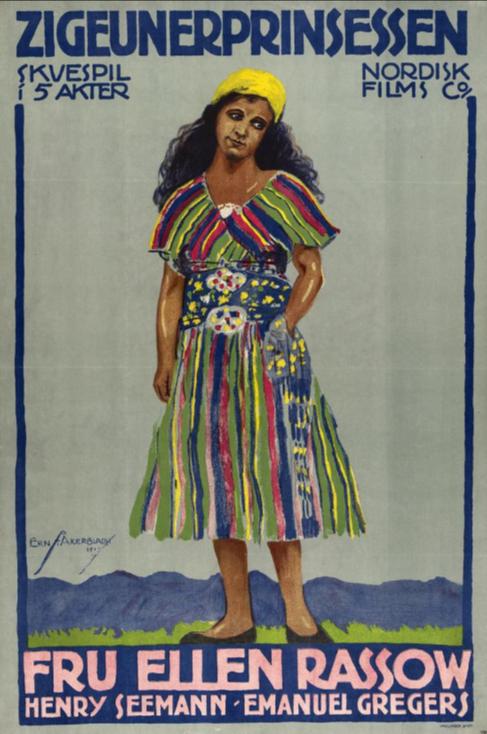
Strip away the intertitles and you still smell the kerosene: Gregers’ narrative is parchment scorched at the edges, a palimpsest where every erasure leaves a scar. The film opens on a heath whose horizon could swallow empires; a lone violin saws the cold dawn, and suddenly wagons crest the ridge like sun-spill. Raya—played by Ellen Rassow with the feral poise of a Modigliani come alive—steps forward, boots dusted with heather. Her coronation is wordless: a garland of rye, a blade pressed against her palm until blood beads like pomegranate seed, elders humming pentatonic prayers. Denmark’s flatlands become Raya’s iron crown.
Yet the true engine is friction: between itinerancy and cartography, between the King’s Danish and the Romani lilt that makes it foreign inside its own mouth. Charles Willumsen’s lieutenant believes maps pre-exist the world; Raya believes the world outruns every map. Their first encounter is a clash of geometries: his riding crop sketches invisible borders on air, her hip sways circles of non-compliance. Anker Kreutz’s bailiff—imagine Javert raised on Lutheran guilt—pursues the clan for unpaid tithes, but the camera keeps him dwarfed beneath cathedral-sized skies, a reminder that the Law is merely another caravan, heavier and slower.
Mid-film, Gregers stages a candle-lit tableau worthy of Munch: inside a barn draped in rye sheaves, Raya dances barefoot on a threshing floor, golden dust rising like cosmic glitter. The officer watches from a ladder; the bailiff watches through a knothole. Power becomes triangulation: each gaze tries to staple her down, yet the dance grows wilder, limbs spelling alphabets no state has ever legislated. It is here that the screenplay’s genius glints: the longer they attempt to possess her body, the more her spirit slips into myth, into rumor whispered across provinces. By the time the final reel burns, Raya’s very name has transformed into a pronoun for every Danish child who runs away with the fair.
Ellen Rassow carries the impossible burden of embodying both ethnographic specificity and archetypal wildness; she answers with eyes that toggle between invitation and indictment. Watch the micro-moment when the lieutenant first calls her “frøken” instead of “princess”: her pupils dilate like ink dropped in water, a silent declaration of war. Charles Willumsen, mostly known for stage melodrama, reins his theatricality into a coiled spring—you sense the saber rattling beneath civility, yet the restraint makes him magnetic. Henny Lauritzen, as matriarch Syeira, exudes smoky authority; every gesture feels auctioned off centuries of matrilineal memory. In smaller roles, Marius Egeskov and Holger Strøm provide charcoal-shaded humor, their double-act of drunken horsemen tipping the film’s tonal seesaw toward carnival.
Shot on orthochromatic stock that renders Nordic skies as slabs of ivory, the film exploits high-contrast imagery to sculpt emotion out of absence. Gregers’ frequent collaborator Henry Seemann (pulling double duty as actor and uncredited camera operator) frames Raya’s first solitary ride through moorland at magic hour—sun behind her, cloak billowing—so that she becomes a black cameo devoured by gold. Depth is achieved not via deep focus but via deep suggestion: a wagon wheel in foreground, a rider in distant mist, your imagination populating the middle ground with every story Denmark never told its colonies.
Textures flirt with symbolism: rye equals gold equals survival equals the Danish flag’s missing stripe. When fire consumes the camp in the third act, sparks swirl upward like illegitimate stars, and for a heartbeat the screen’s rectangular confines feel spherical—world without edge, sovereignty without surveyor.
Though originally accompanied by a live trio whose scores have vanished, the surviving print invites modern musicians to haunt it afresh. I viewed it with a Copenhagen ensemble who swapped violin for nyckelharpa and piano for harmonium; suddenly every flicker of leather or kiss of wind became rhythmic, as though the heath itself exhaled notes. Gregers’ editing anticipates this synesthetic marriage: cuts land on gestures—hand clap, foot stomp—like visual downbeats. The result? Silence becomes not absence but pregnant space, a canvas for the viewer’s acoustic ghosts.
Viewed today, Zigeunerprinsessen crackles with post-colstatic tension. The Romani are both exalted and othered, their mobility a threat to agrarian nationalism. Yet the film cannily inverts power: every time Danish authorities speak of “integration,” the camera pans to wagons rolling further into horizonless dusk. It’s a visual rebuttal that anticipates Homi Bhabha’s hybridity theory by six decades. Consider the lieutenant’s climactic breakdown: kneeling in rye, he barks orders to no one, while Raya watches from a hillside, silent as stone. Hierarchy implodes not through revolt but through refusal to translate.
Place Zigeunerprinsessen beside The Last Egyptian and you see opposite ethnographic gazes: the latter treats Egypt as museum, Gregers treats Denmark as mobile encampment. Against Little Miss Nobody’s urban orphanhood, Raya’s rootlessness feels chosen, aristocratic. And while The Strange Woman pathologizes female desire, here desire mobilizes geography itself.
The 2022 4K restoration by Danish Film Institute lifts a veil that never existed in 1919. Orthochromatic blues now shimmer sea-like; candle flames bloom tangerine. More crucially, tinting schemes were reconstructed using surviving censorship notes: amber for exteriors, viridian for interiors, rose for moments of corporeal peril. The result is a time-machine that doesn’t just show but immerses.
Because history is a wagon not a vault—because every time we fetishize roots we forget roads—because Zigeunerprinsessen argues monarchy is portable, carried in bone and ballad rather than marble and scepter. Because in an age when borders harden into walls, this film whispers that identity can still be a dance you invent one dawn and abandon the next dusk.
“We owned nothing but the horizon, and even that we gave away in song.” —Raya’s final intertitle
So queue it up, let the harmonium wheeze, let the campfire sparks settle in your coffee. Let Raya’s eyes judge your complicity in every border you’ve never questioned. And when the screen goes black, ask yourself which kingdom you carry in your pocket—and how quickly you could roll it away if dawn demanded.
IMDb —
1918
Community
Log in to comment.