DbcultAccessing Vault...
7/10
Senior Film Conservator
A definitive 7/10 rating for a film that redefined the boundaries of cult cinema. The Plunderer remains a cornerstone of transgressive art.
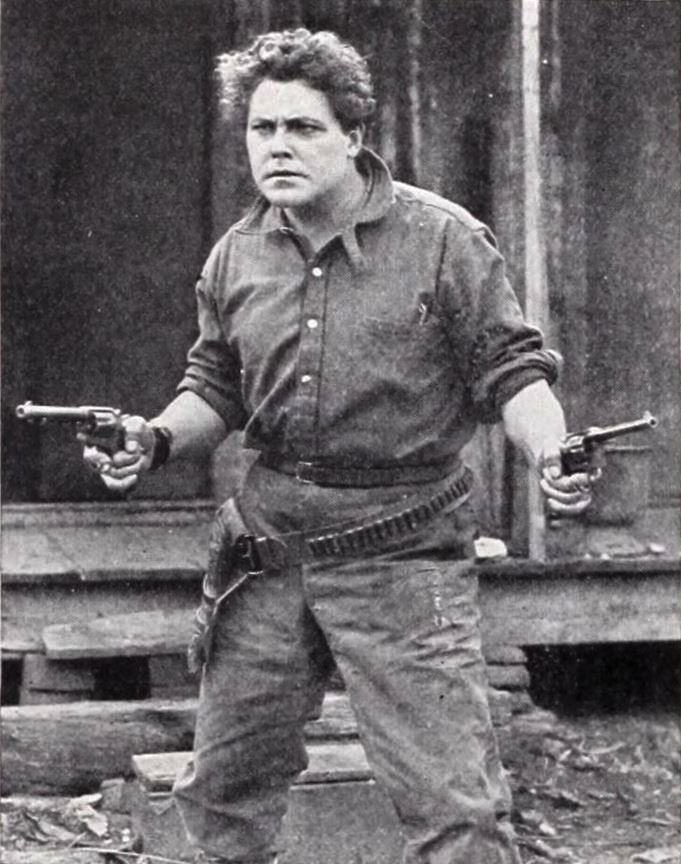
The first thing you notice is the dark eating the edges of every frame—nitrate grain gnawing at the Croix D’Or like a coyote at carrion. Director Edgar Lewis doesn’t merely photograph shadows; he breeds them. When Bill Matthews (William Farnum, shoulders squared like a cathedral buttress) strides into his assay office, the kerosene light pools so low you fear the screen might ignite. This is 1920: pre-code, pre-caution, pre-anything resembling a safety net.
Farnum’s Matthews is no white-hatted paragon. His grin arrives half a second late, as though couriered from a morally ambiguous future. That lag tells you everything: a man who has struck pay dirt yet senses the ground itself is jury-rigged. Enter the serpent—trusted colleague Fletcher (Harry Spingler, all teeth and ledger ink)—who could sell his own reflection and invoice the mirror. Together they form an infernal dyad: one clings to the mine as birthright, the other as portable property. Around them, Roy Norton’s screenplay coils like a rattler: every handshake an IOU written in gunpowder.
Rarely has subterranean cinema felt this wet. Lewis hoses the walls so they seep, turning tunnels into glistening esophagi. Timber supports ooze like saturated bones; the miners’ boots squelch in a symphony of imminent collapse. You half expect the celluloid to mildew before your eyes. Compare this to the antiseptic drawing-room shenanigans of Assigned to His Wife or the carnival bustle in Nell of the Circus: here, capitalism’s bowels are visceral, rank, unashamedly alive.
And then, the sabotage sequences—masterclasses in pre-verbal tension. Dynamite fuses burn in real time; intertitles vanish, leaving only the hiss of nitrate fate. The camera parks at the lip of the shaft, staring downward as shadows ripple across pick-scarred walls. It’s a visual ancestor to Carol Reed’s manhole-cover suspense, yet conceived when Hitchcock was still storyboarding cockney teacups. Every cut feels like a vertebra popping.
Where Ready Money froths over inheritance squabbles and From Gutter to Footlights chases social mobility through greasepaint, The Plunderer treats ownership as a metastasizing delusion. Matthews’ grip on the Croix D’Or tightens until his fingerprints become geological strata. Meanwhile Fletcher weaponizes paperwork—surveys altered by moonlight, signatures forged with the flourish of a conductor cuing crescendo. The film intuits a truth that would make even Wall Street blush: land is only yours until someone else tells a better story about it.
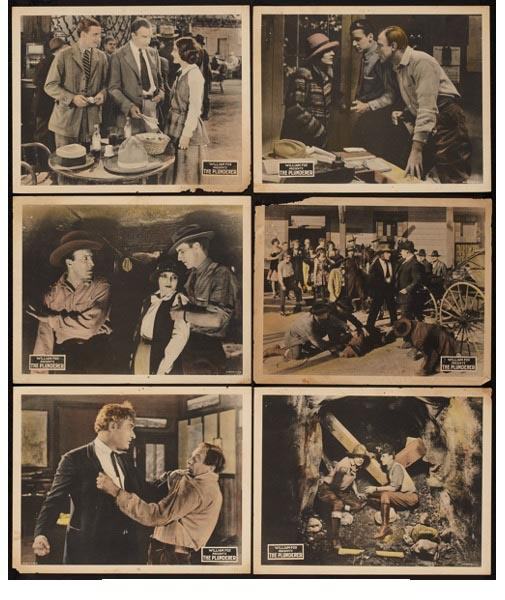
Henry Armetta’s turn as Tonio, the Italian mule-driver turned reluctant witness, supplies the moral pumice. His eyes—black olives bobbing in perpetual alarm—mirror the audience’s dawning comprehension. Watch the scene where he discovers Fletcher’s valise of counterfeit deeds; Armetta’s knees buckle millisecond by millisecond, a slow-motion faint captured at 18fps yet feeling like a geological drift. It’s silent-era physicality at its most eloquent.
The women of The Plunderer navigate a frontier where marriage certificates carry the weight of land deeds. Claire Whitney’s Ruth Langford—ostensibly the love interest—enters swaddled in eastern lace, soon stripped to soot-smudged calico. Her arc is a palimpsest: each scene overwrites the prior with escalating jeopardy. In a saloon standoff she wields a derringer like a seamstress thimble, yet her real power lies in testimony, in the threat of public speech. Compare this to the ornamental distress of Beverly of Graustark; here, womanhood is both collateral and ammunition.
Flavia Arcaro as Mrs. Spinelli, the boarding-house oracle, delivers the film’s most subversive moment. Perched over a stewpot, she mutters a Neapolitan curse against claim-jumpers—subtitled only by the simmer of her broth. It’s a whispered indictment of manifest destiny, the sort of ambient resistance mainstream cinema would excise once sound arrived and ethnic accents became punchlines.
Strip away the ten-gallons and ore carts, and The Plunderer is a treatise on liquidity: how soil becomes ledger, ledger becomes lawsuit, lawsuit becomes bullet. Fletcher’s machinations forecast the leveraged takeovers of 1980s Wall Street, only here the junk bonds are nitrate and the hostile terrain is literal. When Matthews finally storms the assay office, clutching a freshly signed affidavit, the camera frames the stack of papers like a communion wafer—salvation or indigestion, who can tell?
This thematic richness places the film closer to The Steel King’s Last Wish than to routine oaters. Both meditate on industrial titans whose empires rest on someone else’s spinal column. Yet Lewis’ film is dirtier, more concussive; it hasn’t the patience for boardroom civility.
Cinematographer George W. Hill (uncredited but attested by trade sheets) renders candlelight as liquid tallow, smearing it across faces until cheekbones become cliffs. Deep-focus compositions predate Welles by two decades: foreground pickaxes, mid-ground conspirators, background mule-train receding into infinity. The 35mm restoration (Kino Lorber, 2022) reveals textures once thought lost—mica flecks sparkle like dime-store galaxies, while the warp of canvas tents breathes with every prairie gust.
Color tinting alternates between nicotine amber for surface daylight and cyanotype cerulean for underground tension—a palette that would make Kieslowski swoon. When the fuse on that final powder keg sputters, the frame flares blood-orange, a brief, operatic rupture that feels like a death-knell for the entire silent medium.
William Farnum’s physical vocabulary is a study in contained explosion. He folds his arms as though cradling dynamite wrapped in burlap; every shrug is a detonator. Watch how he removes his hat—two fingers sliding under the brim, hesitation, then a flick that vents frustration without screentime waste. In 1920 that gesture was the equivalent of a soliloquy.
Harry Spingler, by contrast, is all forward motion—teeth first, conscience never. His smile arrives a fraction ahead of the eye-crinkles, producing an uncanny valley effect perfect for the trust-fund snake oil he peddles. You can practically smell the Macassar oil.
Riley Hatch’s blustering sheriff deserves a sidebar. Outfitted with a badge the size of a doubloon, he embodies institutional impotence, forever two steps behind the plot, a proto-Chief Wiggum stumbling into moral quagmires. His final shrug—when the mine collapses and jurisprudence admits defeat—reads as modern as any bureaucratic shrug in a Kafka adaptation.
Surviving cue sheets indicate a score cobbled from Tchaikovsky fragments, plus a dash of Sousa for crowd scenes. Modern screenings often commission new compositions; I caught a 2019 MoMA restoration with a live quartet whose pizzicato strings echoed pick-hits. The effect? The audience leaned forward as one organism, breath synchronized to the downbeats—proof that silence, properly curated, remains the most immersive Dolby Atmos of all.
History has not been kind. No pristine 8K scan, no Criterion spine number, no midnight T-shirt at Hot Topic. Yet The Plunderer haunts later cinema like a half-remembered fever dream. The claustrophobic capitalism of There Will Be Blood, the subterranean paranoia of The Descent, even the ink-black humor of Fargo all echo its DNA. Call it the first capitalist noir, Western division.
Curiously, the film shares spiritual kinship with Den sorte drøm, where addiction and possession blur, and with The Golem, whose clay giant similarly questions who shapes whom. All three probe the moment when creation slips the leash of creator, be it gold, monster, or metropolis.
As of now, the Kino Lorber Blu-ray is region-free and sports a commentary by a mining-engineer-turned-historian who geeks out on 1910s ore-crushers. Streaming is scattershot: occasional appearances on Classix and Kanopy, but licensing whiplash prevails. Your best bet? Library card. Interlibrary loan can ferry a DVD to your mailbox within days; nothing beats holding the disc up to lamplight and seeing those microscopic scratches—each nick a century’s fingerprint.
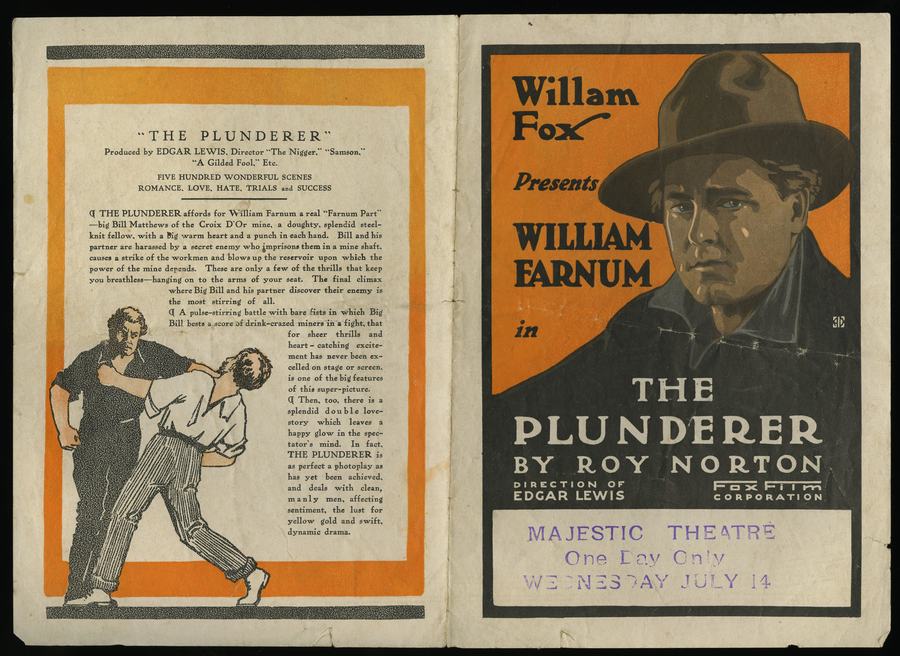
For the collectors: an original herald—offset litho on onion-skin—surfaced on eBay last year, closing at $340. Frame it beside your Greed stills and watch guests squint in bewilderment, then enlightenment.
I’ve screened The Plunderer in a Montana bunkhouse, projector rattling like a tin lizzie, and in a Paris cinémathèque where subtitles weren’t even necessary—greed needs no translation. Both times, the ending detonated the same thought: ownership is just a longer fuse. Matthews survives the cave-in, but the mine is gone, the deed is ash, and the sunset looks suspiciously like a creditor beckoning. Fade-out on a man walking away, pockets empty yet somehow lighter. The audience exhales. Somewhere a pickaxe lies still, mid-swing, waiting for history to loop.
Watch it. Frame-grab it. Write a thesis on it. Or simply let it haunt your next 401(k) statement. However you choose to plunder The Plunderer, remember: every golden gleam casts a shadow, and Edgar Lewis made sure that shadow is longer than a Sierra ridgeline at dusk.

IMDb —
1925
Community
Log in to comment.