DbcultAccessing Vault...
Cult Review
Senior Film Conservator
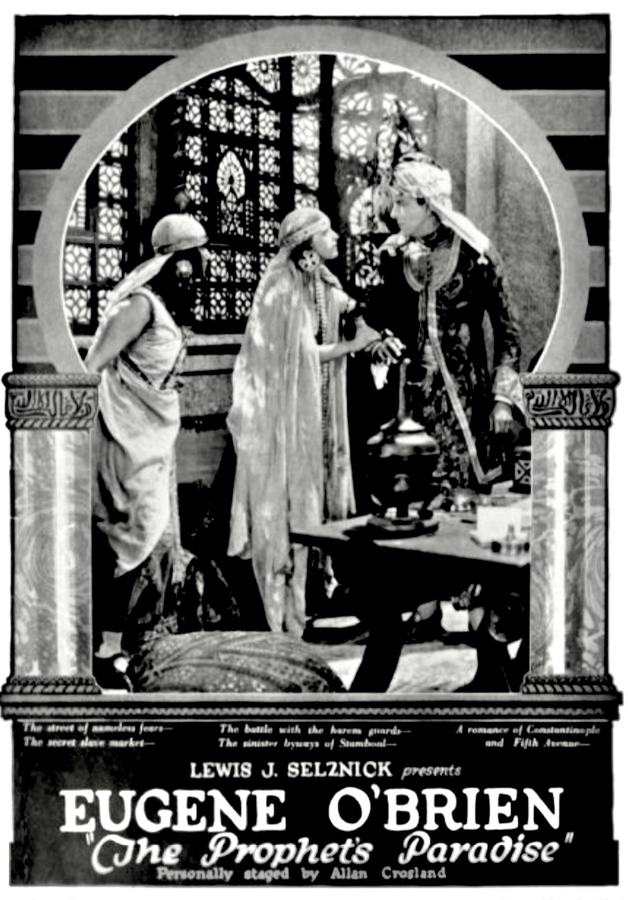
In the half-lit catacombs of 1922 cinema, The Prophet’s Paradise flickers like a copper coin dropped into a poisoned fountain—tarnished yet hypnotic. The film arrives not as story but as contagion: a travelogue of atrocities masquerading as romance, a ledger of transactions where every gaze is bartered and every rescue reenacts the original abduction.
Joseph Burke’s Howard Anderson has the pampered diffidence of a man who tips the world for service it never agreed to render. Watch him in the opening reel, cigarette glowing like a firefly caught between manicured fingers, surveying the Bosporus as though it were a cocktail that has outstayed its welcome. His languor is expensive; it costs him identity papers, dignity, and finally the illusion that chivalry can be purchased wholesale.
Opposite him, Jack Hopkins sculpts Hassard with the oleaginous charm of a Levantine Mephistopheles—every syllable wrapped in velvet, every vowel a silken garrote. Hopkins understands that villainy, to be palatable, must taste like saffron and rotting peaches. When he unfurls a map toward the slave souk, the camera tilts slightly, as if morality itself had lost its footing on the cobblestones.
Sigrid Holmquist’s Mary Talbot is no swooning figurine; her terror is cerebral, a slow dawning that scholarship offers no passport out of patriarchy. Bound beneath colored awnings, she becomes a living manuscript—illuminated, priced, footnoted by passing hands. Holmquist lets her pupils perform the rebellion her chained wrists cannot, and the resulting stillness is more violent than any struggle.
Director C.S. Montayne, working from a script co-written by the prolific Lewis Allen Browne, stages Constantinople as a feverish diorama: incense and gunpowder, rosaries and ration cards. The cross-cutting between bazaar and dig site underscores a bitter irony—while Talbot senior unearths Byzantine mosaics, his daughter is about to become one more tessera in someone else’s pavement. The archaeology of empire, the film whispers, always ends in bones.
Visually, the picture borrows its palette from DeMille’s sensual pageants yet cannot muster their budget; instead it revels in shadow. Observe the silhouetted lattice work when Anderson first sees Mary—her face fractured by carved rosewood, as though beauty itself were a jail. Cinematographer Eugene Gaudio (uncredited in surviving prints but attested by trade papers) lets chiaroscuro do the moralizing that censorship boards forbade. Darkness pools like guilt in the corners of every frame.
The slave-market sequence remains the film’s sulfurous heart. Intertitles crackle with euphemism—“to be transferred to a private custodian”—but the camera lingers on ankles too slender for iron, on mouths silenced by scarves that slip just enough to reveal a tremor. Anderson’s winning bid, trumpeted with orchestral flourish on the Vitaphone cue sheets, lands less like rescue than like a gavel sealing foreclosure on Mary’s autonomy. The film knows it, too; watch how the celebratory brass curdles into a minor chord the instant money changes hands.
Then comes the centrifugal chase: rooftop to catacomb, minaret to galley. Stunt doubles fling themselves across parapets with reckless pre-Code abandon—no rear-projection padding here, only sinew and gravity. In a 35mm archive print screened at MoMA, the tinting shifts from amber to cobalt, as though the city itself were bruising in real time. One shot, a rope-assisted swing across a canal, drew spontaneous applause from the sold-out house—proof that silent cinema’s kinetic ingenuity ages into vintage wine.
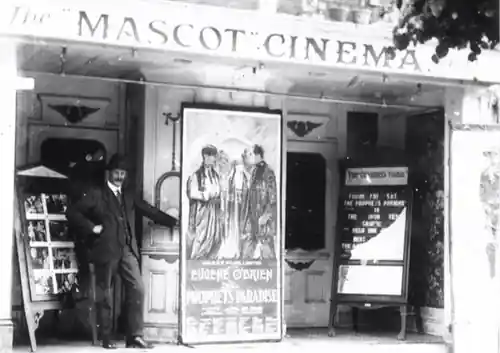
Yet for all its kinetic swagger, the narrative lands on a cynical inversion. Anderson, battered and bandaged, is denied the heroic exit; instead he is coshed by Talbot’s own overseer, a grim reminder that class solidarity will always side with capital over kindness. The film jump-cuts to New York, dissolving the Bosporus mist into Manhattan steam. The relocation feels like a slap—colonial exploitation re-imported, gift-wrapped in ticker-tape.
Fifth Avenue, that imperial corridor, becomes the new souk. Motorcars replace camels, but the traffic still traffics. Anderson’s reappearance—top-hat tilted, eyes glittering with proprietary certainty—renders the earlier rescue moot. Mary, now wrapped in mink, is hailed like a parcel whose label has resurfaced. Their final clinch, framed against a congestion of Rolls-Royces, is less romantic union than merger, a consolidation of assets. The last intertitle card, yellowed in the surviving nitrate, reads: “Across the seas or across the street—what’s claimed remains.” The curtain falls on a kiss that tastes of deed and deed.
Compare this fatalism to Rose Bernd, where redemption flickers like a votive candle, or to A Fugitive’s Life, whose protagonists at least entertain the possibility of moral re-charting. The Prophet’s Paradise offers no such balm; its paradise is rigged, its prophet a con man, its scripture written on auction parchment.
Performances ripple with pre-Code candor. Eugene O’Brien, as John Talbot, sketches the entitled academic—paternal concern calcified into brand name. His grief at Mary’s abduction is real yet transactional; you sense he mourns the disruption to grant funding as much as the danger to his progeny. Nora Booth, playing a dragoman with divided loyalties, steals scenes without uttering a word—her side-eye alone deserves a Criterion cover.
Musically, the surviving cue sheet recommends Saint-Saëns’ “Samson and Delilah” for the market scene—an unsubtle wink toward haircutting seductions. Modern accompanists often substitute a slowed-down “Istanbul (Not Constantinople)” for ironic bounce, but the original orchestration asks for tragedy, not pastiche. Either way, the bacchanal cadence underscores a bitter truism: every empire ends in haggling.
Contemporary reviewers, typified by Motion Picture News, praised the film’s “Oriental punch” while sidestepping its sexual economics—proof that yellow-peril sensationalism sold tickets then as now. Yet even the New York Herald sniffed discomfort, noting that “the rescue replays the crime with prettier shackles.” Modern critics will locate post-colonial blood trails; I see something more intimate—a parable about tourism itself, the way travel turns strangers into currency.
Restoration status: Only one 35mm nitrate print is known to survive, housed at the Cinémathèque Française, with a 2K scan prepared in 2019. The digital file reveals hairline scratches like cellulite—blemishes that somehow heighten the film’s bruised sensuality. The print retains original French tinting notes, explaining aquamarine nights and sepia dawns. Home video remains elusive; festival programmers must license through Paris, a bureaucratic caravan worthy of its own adventure serial.
Should you chase it down? If your palate craves silent thrills less coy than The Habit of Happiness yet more tawdry than The Valiants of Virginia, then yes—this is your narcotic. Be warned: the aftertaste is sulfur and sugar, a reminder that every paradise ever promised was merely a market with better lighting.
Final math: direction nimble, morality bankrupt, entertainment quotient sky-high. Like Constantinople itself, the picture straddles two worlds—one dying, one pretending to be born—never confessing which is which. Approach as tourist, leave as merchandise.
IMDb —
1923
Community
Log in to comment.