DbcultAccessing Vault...
6/10
Senior Film Conservator
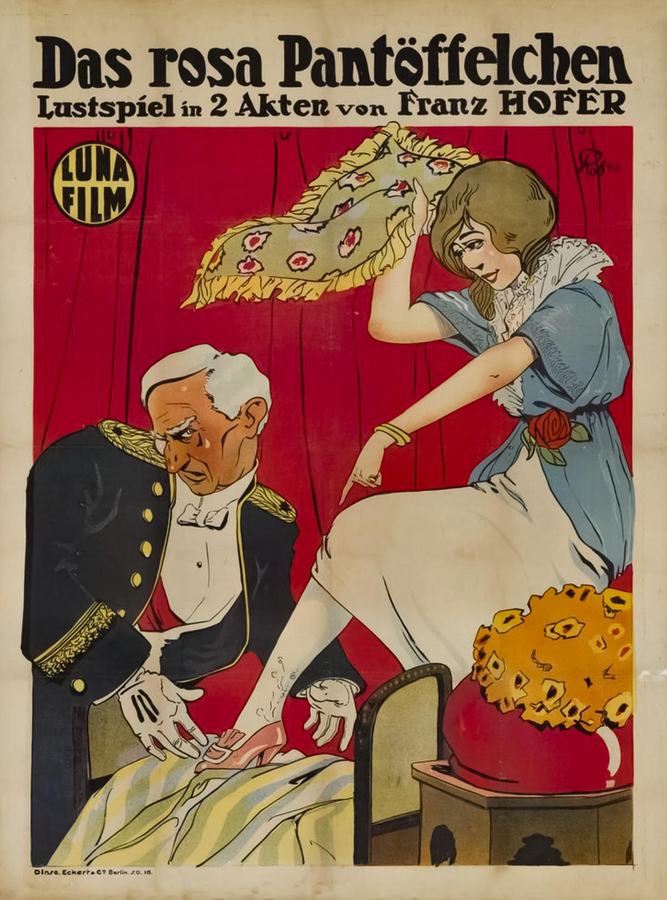
A definitive 6/10 rating for a film that redefined the boundaries of cult cinema. Das rosa Pantöffelchen remains a cornerstone of transgressive art.
Franz Hofer, that incorrigible Viennese provocateur who once hawked Glacier National Park travelogues to alpine honeymooners, pivoted in 1913 to a different snow job: urban ennui lacquered in petal-pink satin. Das rosa Pantöffelchen—literally The Pink Slipper—is a 42-minute whirlwind whose reputation survives only in sprocket-scarred negatives buried for decades in the Bundesarchiv. Yet the moment the first tinted frame flickers you realise Herr Hofer smuggled a stick of cinematic dynamite inside what looks like a featherweight farce.
The plot, if one dares reduce perfume to chemistry, concerns a millinery girl named Lisel (Weixler) who misplaces one half of her favourite footwear on a rattling Berlin tram. That’s it. But Hofer treats the lost slipper like the Maltese Falcon in kitten heels: every character who brushes against it is infected with a libidinal fever that exposes the fault lines of a society limping between imperial swagger and republican vertigo.
Shot entirely in the Grunewald studios and on winter streets still reeking of coal smoke, the film’s Berlin is a fever dream stitched from lacquered cafés, anarchist pamphlets, and the first electric billboards humming like cicadas. Hofer’s camera—wheeled on a repurposed bakery cart—glides through this carnival with the languid hunger of a somnambulist. Watch how he frames the slipper’s first close-up: a single velvet toe emerging from a policeman’s evidence drawer, the surrounding objects (a sabre, a rosary, a bottle of cocaine eye-drops) arranged like vanitas symbols in a Baroque still life.
Compare this tactile fatalism to the open-air pageantry of With Our King and Queen Through India or the biblical hieratics of From the Manger to the Cross, both released the same year. Where those travelogues and passion plays reassure audiences with imperial pomp or salvific certainty, Hofer gives us a metropolis where transcendence arrives only as static shock—brief, bright, ludicrously pink.
Dorrit Weixler—Germany’s answer to Florence Lawrence—had a face the camera wanted to protect and punish in the same breath. Here she underplays, letting her saucer eyes do the pleading while her mouth stays buttoned in proto-Garbo stoicism. Opposite her, Kurt Busch’s bankrupt Baron Roderich von Stumpf is all cracked porcelain aristocracy: his monocle flashes like a semaphore distress signal, yet the waistcoat beneath is shiny from pawnbroker dust.
Carl Fenz, the strong-man from a travelling waxworks show, bulges out of every shot like an allegory of the coming Freikorps. When he lifts a horse trough to impress Lisel, Hofer cuts to a low angle that makes his shadow sprawl across half the street—Berlin’s first intimation that brute strength might soon replace inherited titles. Meanwhile Franz Schwaiger’s opium poet, credited only as The Rhyming Corpse, delivers intertitles in rhyming couplets that drip with decadent nihilism: „Ein Staubkorn Liebe, eingeschnappt im Licht—genug, das Herz in Stücke zu vernichten.“ (A speck of love, caught in the light—enough to shatter the heart to shards.)
Forget the garish hand-tinting that turned The Life and Passion of Christ into a stained-glass peepshow. Hofer’s colourist, the legendary Anneliese Würfel, limited her palette to three hues: arterial crimson, bruise mauve, and that scandalous pink. Every time the slipper appears, the frame is bathed exclusively in blush tones—other colours drained to a ghostly cyan. The effect is not quaint but uncanny; the object seems to irradiate the screen, turning spectators into radium-painted watch-dials glowing in the dark.
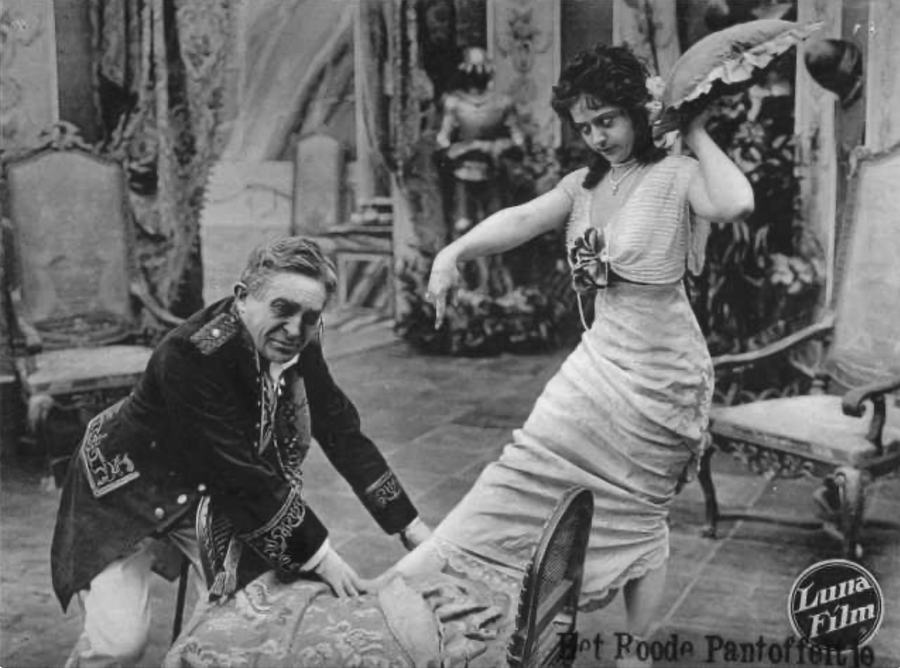
In 1913 continuity editing was still a glint in the eye of a few American upstarts. Hofer slices his narrative with the reckless glee of a stock-market ticker. A match-cut whisks us from Lisel’s cramped garret to a champagne-cellar orgy without warning; a flash-forward intertitle—„Zwei Monate später: Hungerblumen wachsen auf dem Kurfürstendamm“—drops us in the aftermath of war rationing two years before the hostilities even began. The film’s temporal vertigo anticipates the convulsive montage of Strike by over a decade, yet Hofer’s purpose is not agitprop but ironic premonition: history itself has lost its slipper and hobbles bloody-footed toward apocalypse.
Weixler’s Lisel never begs for rescue; instead she weaponises pity. Mid-film she barges into a gentlemen’s club where financiers bet entire shipping lines on a single hand of baccarat. Wearing the surviving slipper and brandishing its twin like a pistol, she auctions the right to „escort her home“—only to vanish with the kitty, leaving the Baron, the strong-man, and the poet clutching empty air and unpaid tabs. It’s a gendered hustle worthy of What 80 Million Women Want, yet Hofer refuses to moralise; his camera lingers on the faces of the fleeced men, their expressions oscillating between humiliation and relief at finally encountering something—anything—that cannot be bought.
Of course there is no synchronous score; instead, German cinemas of 1913 often hired a Kapellmeister to grind out Schumann and the occasional foxtrot. Contemporary accounts from the Berliner Börsen-Courier describe patrons stamping their feet in time with the slipper’s on-screen migrations, as if the tiny shoe were a metronome conducting civic hysteria. One breathless reviewer complained of „ein süßlicher Gestank von verbranntem Zelluloid“—a sickly stench of burning celluloid—wafting from the projection booth during the climactic bonfire scene. Whether metaphor or literal nitrate flare, the image is irresistible: art so incendiary it singes the very air.
Within months of release, the film vanished—bounced by distributors who feared censors might lump its anti-militarist undercurrents with the socialist pamphlets flooding the Spree. A nitrate print surfaced in 1992 inside a GDR potato crate, decomposing like a love letter in the rain. Restoration stills reveal ghostly double-exposures: Lisel’s face super-imposed over marching soldiers, the pink slipper hovering like a absent halo above Kaiser Wilhelm’s parade route. The footage is too fragile to project more than once; archivists compare the experience to „watching a snowflake melt on 16mm.“
Yet influence leaks through the cracks. You can detect its DNA in the fetishised cigarette case of The Cheat, the lethal high-heels of Balletdanserinden, even the way the ruby slippers throb in a certain 1939 Technicolor tornado. More crucially, Hofer’s Berlin—equal parts operetta and abattoir—prefigures the cabaret nightmares of Die Büchse der Pandora and the rubble chic of post-war rubble films.
Because history is littered with masterpieces that survive only in footnotes, and each glimpse rewires your synapses to recognise absence as a form of presence. Because Das rosa Pantöffelchen teaches us that consumer desire can be as explosive as any revolution, and that the smallest objects—a shoe, a vote, a tweet—can tip empires into ash. Because watching what remains of Weixler’s smile flicker through chemical decay feels like receiving a postcard addressed to someone you might have been in 1913, warning you not to laugh too loudly at the absurdity of wanting what you cannot possess.
Seek it out at the next archival pop-up, the kind where a bespectacled curator threads the film through a hand-cranked 1908 Ernemann and the audience holds its breath as if leaning over a cradle. When the pink slipper finally dances across the screen—tattered, incandescent, impossibly alive—you will understand why some silents refuse to stay silent. They scratch at the inside of your skull, demanding you remember that modernity began not with the roar of cannons but with the hush of satin sliding across cobblestones in the half-light of a city that never knew it was already doomed.
IMDb —
1925
Community
Log in to comment.