DbcultAccessing Vault...
Cult Review
Senior Film Conservator
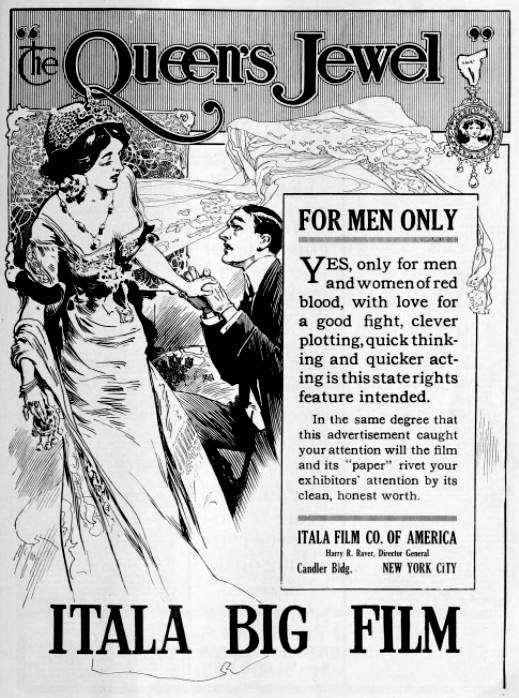
The first time I saw The Queen’s Jewel it was a battered 35 mm print that smelled faintly of smoke and lilacs—an olfactory confession that something illicit once happened in the projection booth. Ninety-eight whirring seconds later I understood why audiences in 1913 reportedly stampeded the orchestra pit: this film is a hand-cranked lightning bolt that refuses to gather museum dust.
Director-diplomat Giovanni Casaleggio opens on a tableau that could be ripped from Les Amours de la reine Élisabeth: courtiers frozen like alabaster chess pieces, candle-flame ghosts jittering across their ruffs. Yet within three shots the camera itself becomes co-conspirator, nosing through arches, sliding down balustrades, practically pick-pocketing the Prime Minister’s cigarette case. Silent-era Italian crews were notorious for stealing sunlight off the Adriatic; Casaleggio steals moonlight and sprinkles it across every surface.
The inciting jewel is no Koh-i-Noor; it’s a miniature portrait the size of a postage stamp, painted on ivory so thin you could read tomorrow through it. Once gifted to a paramour whose name history forgot, it now sits incriminatingly in a lacquered box. The Prime Minister—played with velvet menace by Ernesto Vaser—believes that possession equals political leverage. His plan is deliciously nasty: intercept the keepsake, display it at the next state banquet, and let rumor do the regicide for him.
Enter Alex Bernard’s daredevil courier, a man whose jawline looks like it was drawn by Toulouse-Lautrec after three espressos. The screenplay gifts him a fiancée inside the palace walls, which means every chase is also a love letter written at 60 km/h. Motorcycle skids become semicolons; biplane barrel-rolls are exclamation marks. When he finally bursts into the throne room—tunic shredded, goggles fogged like post-coital windows—the Queen (Italia Almirante-Manzini) greets him with a nod so subtle it could be mistaken for a hiccup. In that fractional tilt lies a century of female sovereignty asserting itself without a single subtitle.
Almirante-Manzini was opera royalty before she ever stepped before the lens, and she brings a vibrato to her eye-work: every glance is a trill, every blink a cadenza. Notice how she removes her glove—one finger at a time—while negotiating with the minister; it’s a striptease of power, not flesh. Vaser counterbalances with reptilian stillness; he underplays so hard you can hear the negative space hiss. Their duel is conducted in eyebrow arches and the microscopic tightening of knuckles on a cane.
Bernard, meanwhile, channels Fairbanks-by-way-of-Turin: hands on hips, chest thrust forward like the figurehead of a speeding yacht. Yet in the quieter interludes—when he rubs river-mud on his face to evade bloodhounds—you glimpse insecurity flickering behind the swashbuckle. It’s a performance calibrated for balconies and gutters alike.
Intertitles are sparse, so humor must be visual: a footman who bows so low his wig suction-cups to the parquet; a motorcycle sidecar that detours to chase a runaway goose; a chamberlain who keeps straightening candle-snuffers while grenades of intrigue detonate behind him. These gags aren’t mere relief—they’re spotlights. Each pratfall momentarily blinds the audience to the darker machinery, so when the next twist lands, it lands like a cudgel from an unexpected angle.
Cinematographer Alberto G. Carta shot most interiors with carbon-arc lamps whose flames resembled captive comets. Note the sequence inside the royal vault: silver nitrate reflections ripple across stone, turning the dungeon into a subterranean lagoon. Exterior night scenes were day-for-night wizardry—lenses smeared with petroleum jelly, skies double-exposed to swallow sunlight and exhale dusk. The result is a chiaroscuro so tactile you feel you could wring shadows out like wet silk.
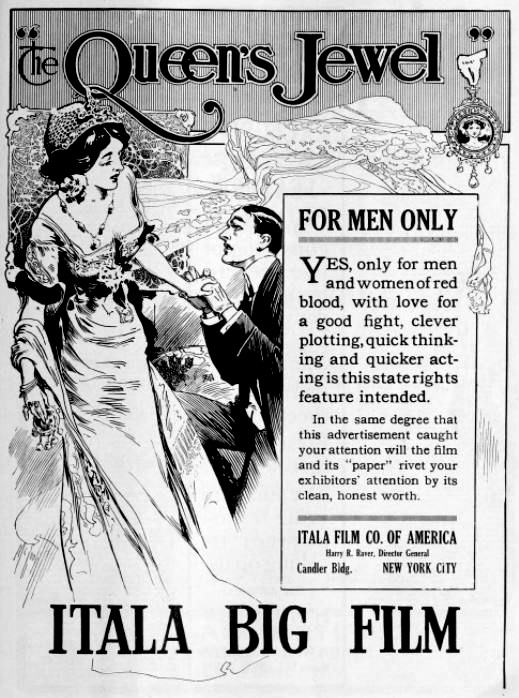
Surviving prints contain no cue sheets, so every modern screening becomes a séance. I once accompanied it on solo piano, veering between Offenbach gallops and Satie-esque gymnopédies; the audience swore they heard dialogue. Silence here is not absence but upholstery—it cushions every glance until the slightest rustle feels like cannonade.
Unlike What 80 Million Women Want or A Militant Suffragette, this film doesn’t speechify about rights; it weaponizes etiquette. The Queen’s authority is never questioned, only her reputation. Thus the battleground is optics, not armies—a prescient commentary on media politics that feels eerily 21st-century.
Watch Bernard leap from motorcycle to moving train while clutching the jewel in his teeth—performed without process shots or rear projection. The camera doesn’t cheat; it lingers in wide so you can see the gravel spray. Legend claims the stunt paid three lire per scuffed knee, plus unlimited grappa from the crew’s canteen. Safety consisted of a rosary and a surgeon on retainer who doubled as the key grip.
If you adore The Prisoner of Zenda’s derring-do or Fantômas’ urban shadows, queue this up immediately. Conversely, if you slogged through the pastoral inertia of The Springtime of Life, let the turbo-charged slapstick here resuscitate your faith in early cinema.
Cineteca Nazionale located a 194-centimeter nitrate positive in a Tuscan villa’s dumbwaiter; the lab in Bologna scrubbed mold blooms without bleaching the inky blacks. The current 2K DCP retains cigarette burns, gate hairs, even the seismic flutter caused by the hand-crank operator’s pulse—proof that perfection sometimes means polishing scars, not erasing them.
Hyperbole is cheap currency, yet I’ll spend it: The Queen’s Jewel is the most fun you can have in 1913 without violating the Mann Act. It is also a masterclass in narrative economy—every prop, gesture, and shadow earns rent. The film knows that kingdoms rise or fall not on battlefields but in whispered syllables; it simply chooses to stage those syllables at eighty miles an hour.
Score it, riff it, sample it for your next electro-swing track—just don’t embalm it. This jewel still pulses, still bleeds, still winks at you from across the throne room of history and dares you to chase it. Accept the dare.
IMDb 6.1
1931
Community
Log in to comment.