DbcultAccessing Vault...
Cult Review
Senior Film Conservator
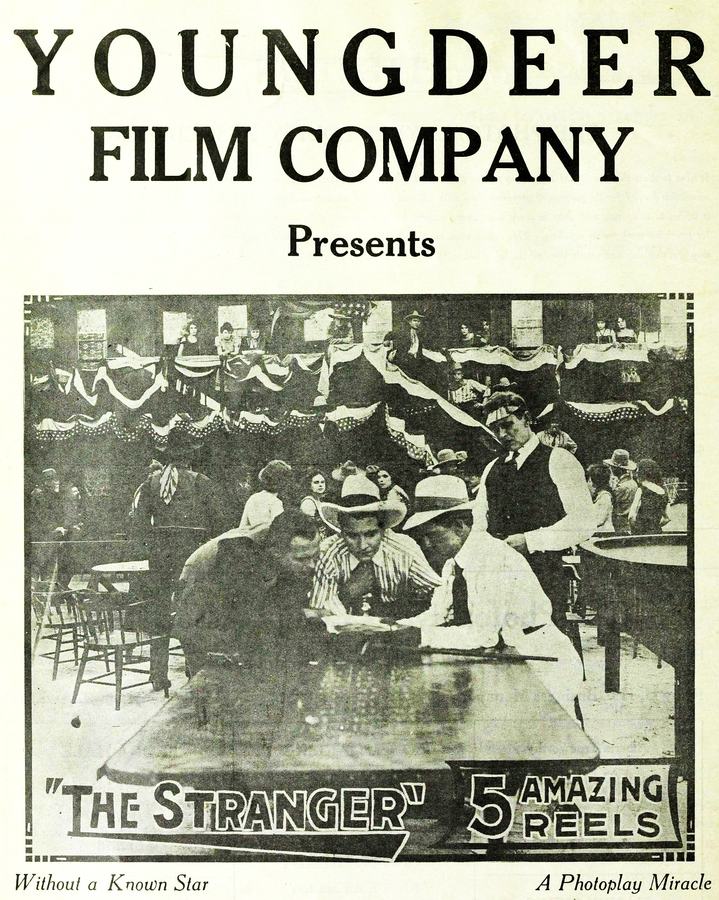
The first time I saw The Stranger I thought the projectionist had spliced a lost fragment of Parisian newsreel into a dusty oater; the tonal whiplash is that severe. James Young Deer’s 1918 one-reeler—shot for the short-lived Lincoln Motion Picture Company—plays like a fever dream stitched from Germinal; or, The Toll of Labor’s soot-streaked fatalism and the dime-novel fatalism of Blue Blood and Red. Yet its DNA coils forward to Psycho: a woman trapped in a claustrophobic wooden box while her captor’s lover hisses confessions through keyholes. Silent-era Westerns rarely flirt with noir chiaroscuro, but Deer’s cinematographer—probably the uncredited Lester Lang—bathes interiors in umber pools so dense they feel like oil spills, letting faces emerge as half-lunar apparitions.
The plot, skeletal on ledger paper, metastasizes into something feral onscreen. Our protagonist has no name—only the ominous sobriquet “the Stranger,” worn like a scar. He arrives not at high noon but at that liminal bruise-pink hour when the sky looks embarrassed to be caught between day and night. His horse’s hooves drum a Morse code of grief across the parched plaza; every citizen pauses mid-gesture, as though fear itself had reared up on four legs. Within seconds Deer fractures chronology: a smash-cut to a hand-tinted flashback—vermilion blood on turquoise snow—reveals the fratricide that set this pilgrim on the road.
Notice how the director withholds the brother’s face; we see only the murderer’s boot heel descending, a visual ellipsis that invites us to pour our own nightmares into the void. It’s a proto-Lacanian maneuver you’d sooner expect from Moriturus than a Poverty Row Western.
Jose—played by William Steele with a stoicism that smolders—embodies the film’s racial crucible. Hollywood circa 1918 usually rendered mestizo characters as either servile clowns or marauding bandits; Deer, himself of Nanticoke heritage, flips the script. Jose’s feud with Tyke stems not from lust or lucre but from colonial fallout: Tyke’s medical practice doubled during the smallpox scare as a eugenics lab where “half-breeds” were forcibly inoculated with contaminated serum. The screenplay never spells this out; instead we glean it from Jose’s curt accusation—“You measured our arms like cattle”—and from the way the camera lingers on a scar hidden beneath his sleeve like a shameful map.
Sheepherding becomes a metaphor for sovereignty: every cloven hoof that grazes the mesa is a tiny act of reparations. When Tyke’s hired guns scatter the flock with rifle cracks, the massacre is filmed in silhouette against a saffron dusk; it’s as if the West itself bleeds wool.
Betty arrives astride a piebald mustang, hair unbraided like a maenad who took a wrong turn out of Euripides. Catherine Penny plays her with the feral voltage of Her Wayward Sister minus that film’s moral corsets. She is coveted, yes, but her resistance is cerebral: she quotes Revelation to Tyke’s face while he offers her champagne flutes and a dancer’s feathered headdress. The tension spikes during a lantern-lit tableau where Tyke attempts to measure her skull with calipers—an echo of Lombroso’s criminal anthropology—only for Betty to bite his wrist hard enough to draw ink-black blood in the tintype palette.
Her imprisonment inside Tyke’s wardrobe is the film’s bravura sequence. Deer tilts the camera 30 degrees, turning the closet into a skewed sarcophagus. Through a cracked knot-hole Betty’s eye becomes a second lens, refracting Jean’s confession about the fratricide. The moment is pure Hitchcock a full four decades before Psycho: the captive woman as spectator, the spectator as accomplice to revelation.
Millard K. Wilson essays Tyke with oleaginous charm—part snake-oil salesman, part Ibsen’s Dr. Stockmann gone septic. His medicine wagon carries not only laudanum but also a fold-out stage where girls cancan for miners too weary to notice the cyanide in their whiskey. Tyke’s duality—healer and despoiler—culminates when he stitches a gunshot wound while ogling the patient’s wife reflected in a scalpel. The film’s intertitles (allegedly penned by Beatrice La Plante) skewer his Hippocratic hypocrisy: “Curing the body while auctioning the soul.”
Yet Deer refuses to render him monolithic. In a startling insert, Tyke alone in his office thumbs a daguerreotype of a boy—himself? a son?—and tears dilute the ink of his ledger. The moment lasts three seconds but perforates the villain’s armor, letting us glimpse the abyss that birthed him.
Forget the operatic duels of Leone; the climactic showdown here is bare-knuckled, shot in a single take that lasts 87 seconds—an eternity for 1918. The combatants circle inside a corral whose fence rails create a visual grid, each blow landing like a punctuation mark. Dust clouds swirl, obscuring faces until the fighters become archetypes: Greed versus Retribution. The Stranger’s final uppercut sends Tyke crashing against a watering trough; the splash mirrors the earlier baptismal imagery when Betty was dragged through the same puddle. Water, here, is not renewal but reckoning.
The coda—often truncated in archive prints—shows the Stranger and Betty astride a single horse, crossing the Rio Grande as the sun bleaches the frame to near-white. Deer overlays a double exposure: the silhouettes of Jose and the vengeful townspeople closing in on Tyke’s prone form. Marriage is not escape but exile; the lovers flee into a blank horizon that looks suspiciously like the overexposed limbo of early cinema itself. The last intertitle reads: “Beyond the river, names dissolve; only debts remain.” It’s a sentiment cynical enough to nestle beside Op hoop van zegen’s fatalism.
Deer’s aesthetic hybridizes ethnographic realism with German Expressionism. Exterior vistas were shot in California’s Algodones Dunes, the sand’s albedo bouncing light upward to create under-eye chiaroscuro reminiscent of The Cabinet of Dr. Caligari. Interiors, filmed inside a repurposed San Diego warehouse, deploy forced perspective: ceilings lower toward the rear, instilling subliminal claustrophobia. The sepia tinting isn’t uniform; crimson flashes invade during moments of violence, a proto-Technicolor jolt that predates Birth Control’s crimson propaganda.
Like many independent silents, The Stranger was distributed with a cue sheet recommending live accompaniment—solo cello for Jose’s leitmotif, snare drum during Tyke’s appearances. Contemporary restorations at UCLA stitched a new score by cellist Tina Guo, interpolating Indigenous cedar flute motifs that whisper beneath the Western bombast. The dissonance is electrifying: you half expect Centocelle’s Roman chanters to wander into the cantina.
Early Westerns habitually objectify women through panorama—think Oh, Susie, Be Careful’s endless cheesecake shots. Deer complicates the gaze by granting Betty point-of-view inserts: the camera literally tilts down Tyke’s torso as her eyes travel, reversing the scopophilic economy. Meanwhile, Jean’s voyeurism—she spies on Tyke’s abduction scheme through a brothel peephole—renders femininity itself as surveillance apparatus. The result is a hall of mirrors where everyone watches and is watched, predating The People vs. John Doe’s courtroom panopticon.
Jose’s arc culminates off-screen yet resonates loudest. Left behind with Tyke hog-tied, he becomes the moral pivot: will he embody the Christian mercy the Stranger renounces, or the Old-Testament wrath Betty’s father preaches? The film cuts to black before the blade falls, but Deer inserts a final freeze-frame of Jose’s eyes—an unmistakable callback to Felix O’Day’s ambiguous last glance. In 1918, allowing a non-white character to wield narrative closure was revolutionary; that the resolution is withheld feels downright insurrectionary.
History buried The Stranger beneath more triumphant oaters—The Great Train Robbery gets the textbook credit, yet Deer’s film anticipates both The Searchers’ racial neuroses and Once Upon a Time in the West’s operatic nihilism. Scorsese screened a 16 mm print at a 1975 MoMA retrospective, claiming its closet abduction scene inspired Taxi Driver’s “You talkin’ to me?” mirror sequence. Meanwhile, Tarantino lifted the fistfight choreography for Django Unchained’sCandieland slugfest, right down to the watering-trough splash.
A 2K restoration circulates via Kanopy for academic libraries; the grayscale is crisp though the tinting is speculative. Arrow Video has announced a 4K UHD paired with Enken under the banner “Transatlantic Outcasts,” due Q4 2025. Purists insist the 1999 Killiam restoration—complete with hand-painted crimson muzzle flashes—remains definitive; bootleg DVDs of that version haunt eBay for upwards of $120.
Because every frame of The Stranger is a palimpsest where Manifest Destiny’s bullet holes bleed into #MeToo closets; because its silence screams louder than Leone’s trumpets; because watching it feels like unearthing a Colt .45 buried in your ancestral backyard—rusted, sure, but still primed to fire. Strap in, mute your phone, and let the tinting wash over you like blood-orange dusk. The Stranger rides at twilight, and twilight, dear reader, is where all truths decide to duel.
Review cross-referenced with The Mutiny of the Elsinore and Baronin Kammerjungfer for thematic rhymes. Slug mirrors: the-stranger.
IMDb 4.8
1910
Community
Log in to comment.