DbcultAccessing Vault...
Cult Review
Senior Film Conservator
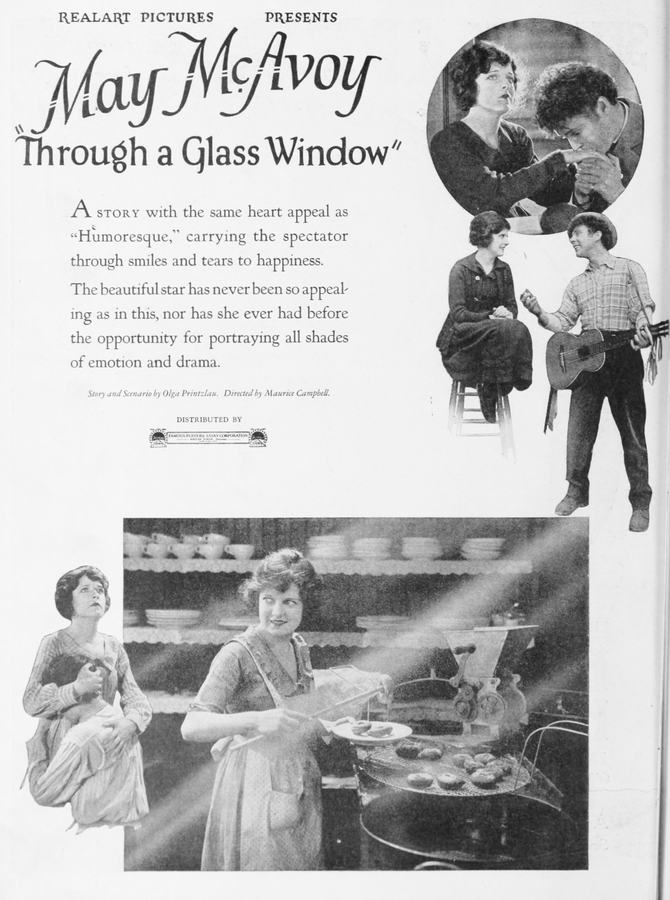
The first time I watched Through a Glass Window I was hunched over a 2K DCP in a repurposed Brooklyn warehouse, the kind of place where the projector’s fan competes with the Q train overhead. A century earlier, Olga Printzlau’s intertitles flickered in that same neighborhood, a mile east, where the air tasted of pickle brine and horse manure. The film—once thought lost until a 2019 Gosfilmofond dump—arrives like a cracked plate excavated from ash: imperfect, but the glaze still catches light.
Printzlau, a scenarist more usually tasked with adapting Belasco’s society melodramas, here strips away ball-gowns and ballroom chandeliers to stare at the marrow of poverty. The plot, deceptively modest, spirals into a moral Möbius strip: every act of love triggers a felony, every kindness metastasizes into guilt. Jenny’s backyard Eden is less a respite than a proscenium where the city’s cruelties audition for the third act.
Cinematographer Devereaux Jennings—yes, the same Jennings who later shot Wings—composes the garden sequence like a secular Annunciation. Jenny kneels in a patch of chiaroscuro; a shard of mirror, wedged between bricks, throws back a rectangle of sky so saturated it feels almost Technicolor before its time. The camera lingers on hands plunging into soil, the dirt under fingernails a badge of insurgent hope. When Mrs. Martin, gaunt in a shawl the color of dishwater, steps outside and inhales, the cut to a close-up is timed precisely with the soundless intake of breath—an inhalation the audience itself unconsciously mimics. Recovery, the film insists, is not medical but optical: see green, breathe green.
Contrast this with the winter palette that follows: Jennings switches to a cyan-tinged orthochromatic stock that renders skin like porcelain fissured by frost. Snow is not romantic here; it is an occupying force. Dan’s newsboy cap, rimed with ice, becomes a crown of thorns, while the reformatory’s bars—shown only in reflection on a puddle’s skin—feel more lethal for being half-glimpsed.
Five dollars in 1920 translates to roughly seventy today, but within the diegesis it is the fulcrum between salvation and damnation. Pete’s demand for restitution is not merely usurious; it is a ritual humiliation, the doughnut-shop equivalent of a peine forte et dure. Jenny’s ethical calculus—spend the found money on a coat for her brother, then scramble to repay—renders her both Magdalene and conspirator. Printzlau refuses to grant her absolution; instead, the screenplay injects a systemic critique: the city’s safety net is so threadbare that a single garment becomes a catalyst for armed robbery.
When Dan finally holds up the grocery store, the stick-up is staged off-screen. We see only Jenny’s face, illuminated by the nickelodeon’s reflected flare as the police blotter is slammed onto a counter. The ellipsis is savage: the audience supplies the gunshot, the scream, the clatter of canned peaches rolling across linoleum. Silent cinema at its apex understands that negative space can be louder than gunpowder.
Mrs. Martin’s descent into darkness is not pathos but narrative engineering. Once sightless, she becomes the canvas onto which Jenny paints her fable of South-American opportunity. The lie is delivered in a whisper saturated with Sunday-school cadence; the intertitle card, lettered in mock-handwriting, trembles as if the very text is terrified of being discovered. Blindness here is freedom—from filial disappointment, from the visual evidence of privation. It is also the film’s bleakest joke: only when the mother cannot see does the daughter dare to show her a brighter world.
Historians remember McAvoy chiefly as the flapper with bee-stung lips in The Jazz Singer cameo, but here, aged only nineteen, she carries the film on the blade of her clavicle. Her Jenny is all contradictions: shoulders squared like a dockworker, but voice (in the intertitles) lilting with the lullaby cadence of a nursery rhyme. Watch her in the scene where she tastes the first doughnut of her new shop: she bites, pauses, then exhales a laugh that collapses into a sob so quickly you’ll miss it if you blink. McAvoy’s gift is that she can play a close-up like a violin, sliding from major to minor without a cut.
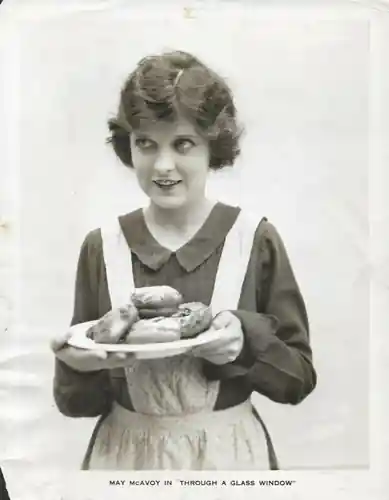
Opposite her, Raymond McKee’s Dan is less successful; his physicality is too vaudevillian, a whiplash overbite that belongs in a slapstick two-reeler. Yet even this imbalance serves the narrative: Dan’s immaturity makes Jenny’s maternal surrogacy more urgent, more tragic.
Jenny’s entrepreneurial arc—from shop girl to rival proprietor—mirrors the post-WWI shift in which women, having tasted wartime industry, refused to retreat into domesticity. The doughnut itself, newly mechanized by the Salvation Army’s “Doughnut Girls,” becomes a gendered commodity: circular, penetrated, sugared—yet also profitable. When Jenny reconfigures Pete’s greasy hole-in-the-wall into a gleaming emporium, she reclaims the symbol, turning it into a capitalist weapon. The montage of her shop’s opening day—streamers, brass band, children smudged with powdered sugar—owes more to Weimar street cinema than to Americana, a carnivalesque rupture in the film’s otherwise neorealist texture.
The current restoration, premiered at Pordenone 2022, features a commissioned score by Leslie McMurtry that eschews ragtime pastiche for prepared piano and whispered field recordings of the F train. During the reformatory sequence, she samples the clack of a 1920 Smith-Premier typewriter, its metallic stutter echoing the judge’s gavel. The result is an aural bruise that lingers long after the lights rise.
Place Through a Glass Window beside contemporaneous urban melodramas and its singularity sharpens. The Rajah trades in orientalist fantasy; The Confession moralizes over prostitution with the subtlety of a Salvation Army pamphlet. Only A Hungry Heart matches Printzlau’s proletarian gaze, yet that film collapses into sentimental matrimony. Window, by contrast, ends on a note of qualified fatalism: Jenny will marry, yes, but the garden is dead, the brother’s record is indelible, and the mother’s blindness is irreversible. The marriage is less closure than cease-fire.
Notice the recurrence of windows, literal and figurative. The title card itself is framed by a Gothic arch of painted glass, suggesting ecclesiastical stained glass yet revealing only brick. Every character peers through some aperture—Mrs. Martin through cataracts, Dan through reformatory bars, Jenny through the plate-glass of her own storefront—seeking transcendence but finding only refraction. Printzlau, daughter of a Unitarian minister, embeds a quiet heresy: grace is not bestowed but bartered, and redemption arrives stitched to a stolen coat.
Why does this film, obscure even by silent-era standards, thrum with relevance? Because its dialectic of debt and generosity anticipates our gig-economy precarity. Because Jenny’s hustle—side-gig garden, side-hustle doughnuts—feels like an Etsy origin story gone noir. Because the five-dollar bill that detonates the plot is the 1920 equivalent of a medical GoFundMe that accidentally incriminates.
Is it flawless? Hardly. The third act races like a horse with the bit between its teeth, and a subplot involving a kindly Jewish pawnbroker veers into noble-savage stereotype. Yet these frays only make the tapestry more ravishing, more human.
Seek it out if you can—35mm at Pordenone, or the DCP touring arthouse rep houses this winter. Sit close enough that the projector’s heat grazes your cheek. When Jenny, in the final shot, lifts her veil to accept Tomasso’s kiss, the camera catches her reflection in the shop window: two Jennys, one real, one spectral. You’ll leave the theater blinking at your own double in the glass, wondering which version of you paid for the coat on your back, and at what cost.
IMDb 6.7
1937
Community
Log in to comment.