DbcultAccessing Vault...
Cult Review
Senior Film Conservator
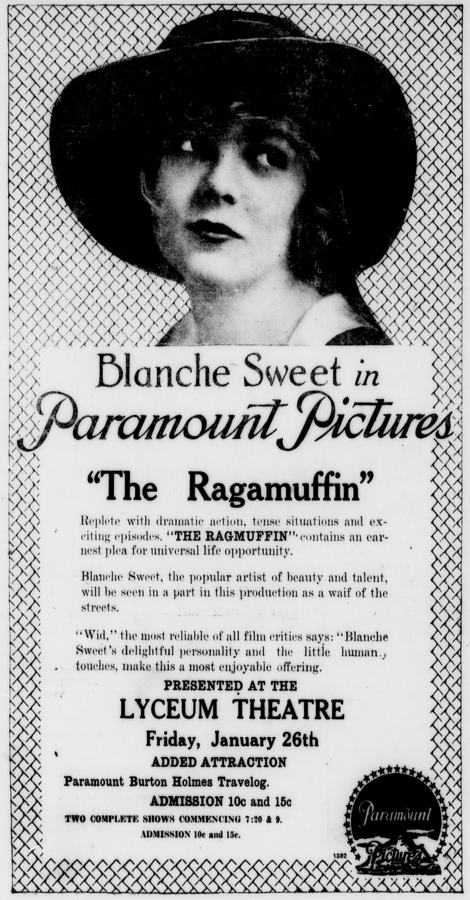
The city exhales soot and possibility in equal measure; William C. de Mille captures that carbon-black breath and freezes it on celluloid so we may still taste 1916 on our tongues a century later.
The Ragamuffin is not content with the comfortably digestible dichotomy of rich=vice, poor=virtue. Instead, it stages a moral steeplechase where every hurdle is splintered by human frailty. From the first iris-in on a silk-canopied cradle, the film announces its thesis: circumstance is the cradle, but character is the hand that rocks it.
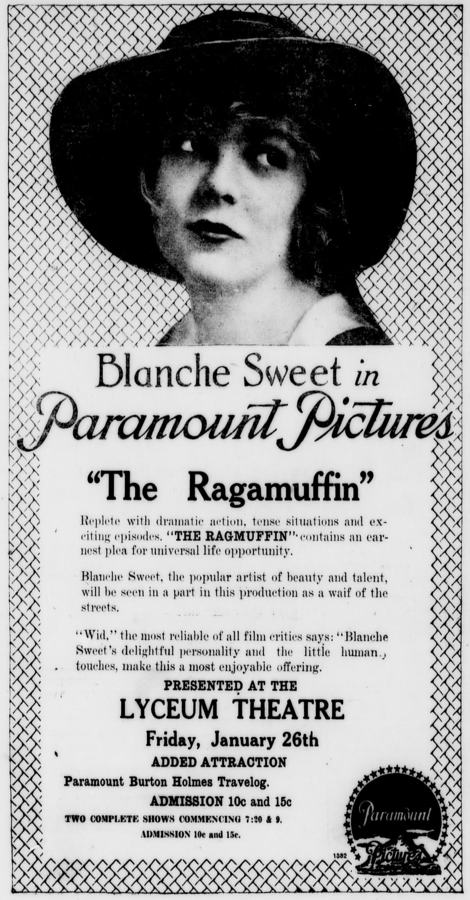
Blanche Sweet’s Jenny arrives like a Degas sketch that has bled through the paper: angular, wary, yet luminous with unspent tenderness. Her performance is a masterclass in micro-gesture—note how she flinches not at the clang of a patrol wagon but at the softer clink of a silver teaspoon, the sound of a world that has always belonged to others.
Opposite her, Tom Forman’s Bob Van Dyke begins as a man-shaped vacancy tailored in white flannels, a Gatsby without the conviction to chase even a single green light. Forman allows the character’s fecklessness to seep through the pores: every time he pockets his fountain pen, you sense him borrowing gravity from objects because he lacks internal ballast.
De Mille and cinematographer James Neill frame New York as a palimpsest. Washington Square’s symmetrical rose-brick façades loom like custodians of genealogical scripture, while the Bowery’s warped clapboard leans as if listening for the next fistfight. A single cut jolts us from marble balustrades to a basement where rats scurry like animated capital letters spelling out destitution. The metropolis becomes an accordion—expand it and society’s gaps yawn; compress it and classes rub raw against one another.
Objects in this universe carry a sacramental mass. The apple Jenny steals at three is waxed so brightly it could be a forbidden planet; Bob’s abandoned fifty-dollar bill on the table glows like a secular seraph; the photograph Jenny refuses to pilfer becomes a portable conscience she folds inside her threadbare coat. When she leaves her own paltry coin in trade, the transaction feels as radical as Luther nailing his theses—only here the door is not a cathedral but a mahogany entry in Washington Square.
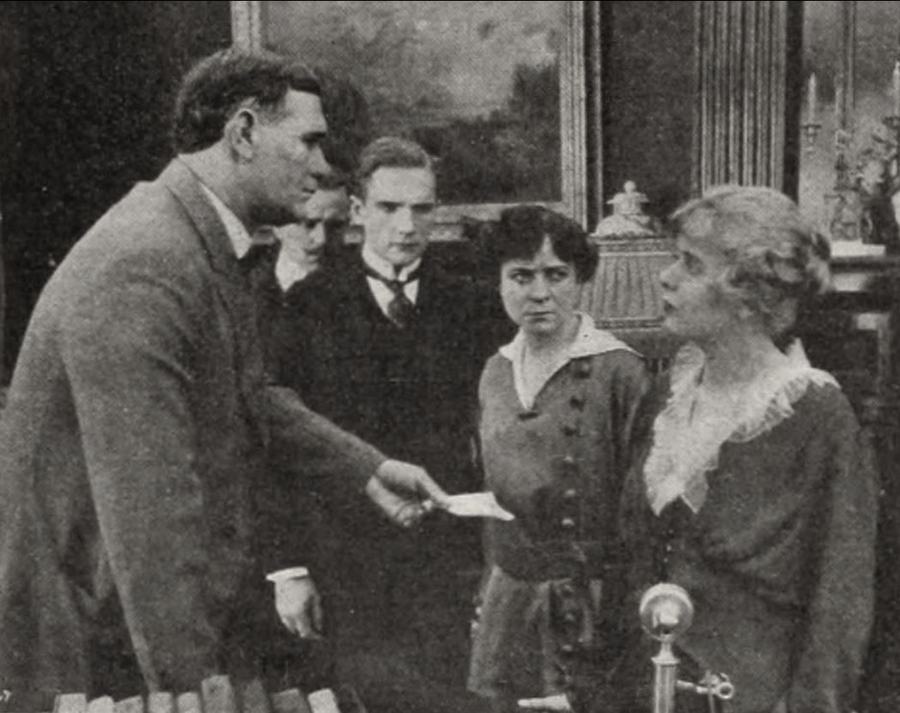
Note the chiaroscuro when Jenny later confronts the safe: iron jaws ajar, its interior a cavernous black that seems to inhale morality itself. De Mille withholds light as if to say, here be the edge of the map where conscience falls off.
Jenny’s arc detonates every “fallen woman” cliché the era hoarded. Salvation is not handed down by male magnanimity; it is pick-pocketed, stitched, bartered, and ultimately earned through an act of criminal self-sacrifice. Meanwhile, Bob’s education flows in reverse: he must unlearn entitlement, sliding down the social ladder rung by rung until he lands in a Harlem flat where wallpaper peels like old affidavits. The film insists that downward mobility can be the most righteous escalator of the soul.
Silent cinema lives in the interstice. Title cards supply nouns and verbs, but adverbs of emotion are outsourced to the spectator. When Jenny hesitates at the photograph, the film withholds a card; we must furnish her tremor with our private archive of longings. That participatory vacuum converts viewers into co-authors, a democratic storytelling rarely matched even by today’s interactive media.
The two-year ellipsis is a narrative gambit that would feel audacious in a 2020s indie. De Mille simply burns time—no montage, no expositional grease. One cut and Jenny is no longer urchin but artisan; we infer nights blistered under gaslight, fingers pricked until blood spots resemble the very polka dots she sews. The absence of process paradoxically dignifies labor: craftsmanship is distilled to its essence—survival transmuted into art.
When the dress factory shutters, the film anticipates Italian Neorealism by three decades: unemployment is not a statistic but a close-up of eviction notices slapped onto a tenement door, a child’s marble rolling across bare floorboards. Jenny’s rescue of the newsboy doubles as class solidarity; she shields the next generation from the same penal pipeline that once funneled her toward Dugan’s cohort.
In 1916 forensic science was fresh tabloid mythology. By making fingerprints the hinge of Jenny’s martyrdom, de Mille drags nascent modernity into the moral arena. The detective’s powder-dusted brush across the safe is filmed like a priest administering ashes—an irreversible rite that brands the protagonist thief even as her intent is guardian angel. The film thus indicts not just personal ethics but a society that confounds intent with outcome, poverty with perfidy.
Bob’s final trek uptown reverses the archetypal Broadway trajectory. Instead of aspirational northward migration toward the Ritz, he descends into Harlem’s fog, divesting himself of the last vestige of caste. Their closing clinch is shot against a brick wall blistered by posters—advertisements for future erased by rain, implying that time itself has signed off on class suicide.
Minnette Barrett’s Beth Van Dyke flickers between flapper insouciance and orphan panic, her cigarette holder functioning like a metronome counting down solvency. William Elmer’s Dugan exudes the avuncular menace of a Fagin who has read Nietzsche—his paternal patter always half a syllable from menace. Watch him coach Jenny in larceny: the scene is blocked like a catechism, two heads bowed over a lock-pick as if parsing psalms.
Though monochromatic, the film persists in coloristic memory. Jenny’s stolen apple glows red in collective retina; Bob’s waistcoat conjures a bruised violet; the sea-blue Hudson at dawn becomes a baptismal font. De Mille’s chiaroscuro engrains these hues into the mind, proving that black-and-white is merely a philosophical stance—the world is never colorless, only morally grayscale.
Modern screenings with live accompaniment reveal how fragile the film’s equilibrium is. A jaunty Wurlitzer can undercut the pathos; a somber string quartet can over-milk the melodrama. Ideally, a minimalist piano should limp along two beats behind the action, like a conscience perpetually tardy.
Surviving prints languish in 16mm at MoMA and Bologna’s Cineteca; a 4K restoration众筹 campaign winks on the horizon. Seek it. In an era when billion-dollar blockbusters recycle origin myths, here is an origin myth of the moral muscle—proof that cinema’s infancy sometimes outwitted its adolescence.
Final verdict: The Ragamuffin is a lantern swung over the potholed road of American social mobility, its flame guttering yet defiant. Let it light your next encounter with so-called meritocracy; you will feel the burn.

IMDb 5.4
1918
Community
Log in to comment.