DbcultAccessing Vault...
Cult Review
Senior Film Conservator
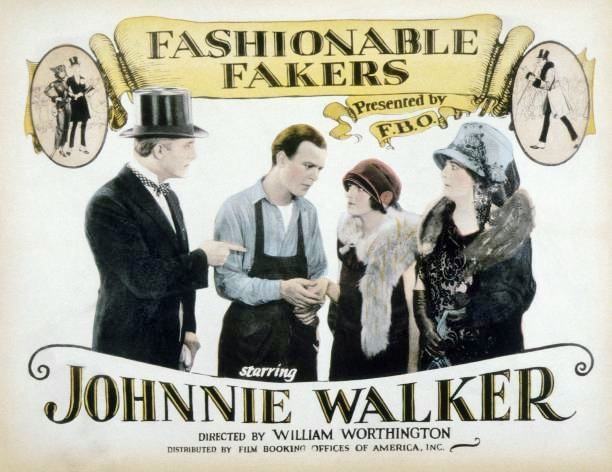
Fashionable Fakers
arrives like a forgotten scroll from the vaudeville era, its narrative threads frayed yet brimming with the strange alchemy of early cinema. Robert Balder’s Thaddeus Plummer is a creature of contradictions: a craftsman of lies whose trade involves drilling holes into furniture to mimic the patina of centuries, yet who is ultimately outmaneuvered by a rug that bends reality. The film’s central paradox—the fakery of antiques clashing with the authenticity of magic—is not merely thematic but structural, a duality etched into every frame.From the outset, the film establishes a world where illusion is currency. Plummer’s nickname, 'The Worm,' is both a physical and moral descriptor; he burrows into objects, hollowing them out to pass as treasures, much like the hollow promises of the era’s speculative boom. His employer, Pat O’Donnell (J. Farrell MacDonald), plays a dual role as both the shopkeeper and the rogue Abdul Ishmid, a detail that hints at the performative nature of identity. When Plummer purchases an Oriental rug, only for O’Donnell to dismiss it as worthless, the moment feels like a rebuke—not of the object itself, but of Plummer’s myopic vision. This rug, as it turns out, is no ordinary textile but a portal to caprice, its hidden powers a metatextual wink at the audience’s own desire for narrative satisfaction.
The rug’s magic operates on a logic of absurd pragmatism. Plummer’s first wish—to see Clara Ridder—is granted with the cinematic efficiency of a well-oiled machine. Here, the film’s slapstick roots emerge: Clara (Lillian Lawrence) is not conjured like a genie but materializes in a continuity error of sorts, her entrance so seamless it feels like a production trick. The humor is dry, the stakes low, yet the moral undertones are sharp. By granting Plummer’s desires, the rug does not elevate his character but amplifies his selfishness, a critique of the era’s consumerist ethos. When he wishes for $1,000, the sudden acquisition of wealth is not portrayed as a triumph but as a transactional exchange, the price of which remains ambiguously unpaid.
Critics of the silent film era often note the visual literacy required to parse narratives without dialogue, and Fashionable Fakers exemplifies this. The rug’s powers are visualized through a series of chiaroscuro close-ups, its patterns pulsating with a life that contrasts the static decay of the 'authentic' antiques Plummer peddles. The film’s set design, with its heavy drapes and shadowed corners, creates a stage where illusion is both spectacle and subtext. When Plummer finally buys the antique shop, the camera lingers on the rug, now a central motif, its once-mysterious patterns reduced to the wallpaper of his new life—a quiet irony that no spoken line could capture.
Comparisons to contemporaneous films like In the Heart of a Fool are inevitable, as both films explore the folly of ambition through a comedic lens. Yet where In the Heart of a Fool leans into romantic farce, Fashionable Fakers is more existential, its magic serving as a metaphor for the American Dream’s seductive lies. The wish-fulfillment arc is undercut by a persistent unease, a suggestion that Plummer’s success is as hollow as the furniture he defaces. This tension is heightened by the casting of Johnnie Walker as a comic foil, his physical comedy a counterpoint to Plummer’s more subdued moral conflict.
The film’s pacing is brisk, a reflection of the economic anxieties of the early 1920s. Scenes transition with the urgency of a man running out of time, yet the script’s dialogue (subtitled with the precision of a poet) invites reflection. The writers, Melville W. Brown and Frederick Stowers, show a nuanced understanding of character, particularly in Clara’s arc. Rather than a passive object of desire, she is a quiet force of moral gravity, her presence a reminder of the human consequences of Plummer’s choices.
Technically, the film is a marvel of practical effects. The rug’s magic is achieved through a combination of double exposure and clever editing, techniques that, while rudimentary by modern standards, imbue the narrative with a tactile sense of wonder. The scene in which the $1,000 materializes is particularly effective: the money appears in a burst of light, the framing suggesting both revelation and violation. This visual language speaks to the film’s broader theme—the duality of creation and corruption.
Thematically, Fashionable Fakers resonates with modern audiences in its exploration of artificiality in a digital age. Just as Plummer’s furniture is a counterfeit of history, today’s deepfakes and virtual realities challenge our perceptions of authenticity. The film’s critique of this impulse is not overt but woven into the very fabric of its storytelling. The rug, after all, is the ultimate meta-object: a prop that is both literal and symbolic, a tool of the narrative and a commentary on it.
The film’s conclusion, in which Plummer marries Clara, feels less like a resolution than a suspension of disbelief. There is no redemption, only the suggestion that his new life is built on unstable ground. The final shot lingers on the shop, the rug now a mundane floor covering, its magic presumably spent. It is a bittersweet coda, a reminder that wishes, like illusions, eventually fade.
For cinephiles, Fashionable Fakers is a time capsule of early Hollywood’s experimental spirit. Its blend of comedy, fantasy, and moral inquiry is as refreshing as it is prescient. While it may lack the polish of later studio productions, its raw, unvarnished charm is part of its appeal. In an age where AI-generated content is redefining authorship, this film’s human touch—its flaws, its quirks—feels more vital than ever.
For further exploration of wish-fulfillment narratives, consider Dead Easy, which similarly interrogates the cost of luck. Or delve into Swat the Crook for a contrasting take on moral ambiguity in the pre-code era. Each film, in its own way, grapples with the tension between desire and consequence—a conversation that remains urgently relevant.
Final thoughts: Fashionable Fakers is not merely a forgotten film but a mirror held up to its time—and ours. Its magic may be simple, but its questions are profound. In the end, the rug is not the story’s secret but its lesson: that to wish is to deceive, and to deceive is to wish.
IMDb —
1920
Community
Log in to comment.