DbcultAccessing Vault...
Cult Review
Senior Film Conservator
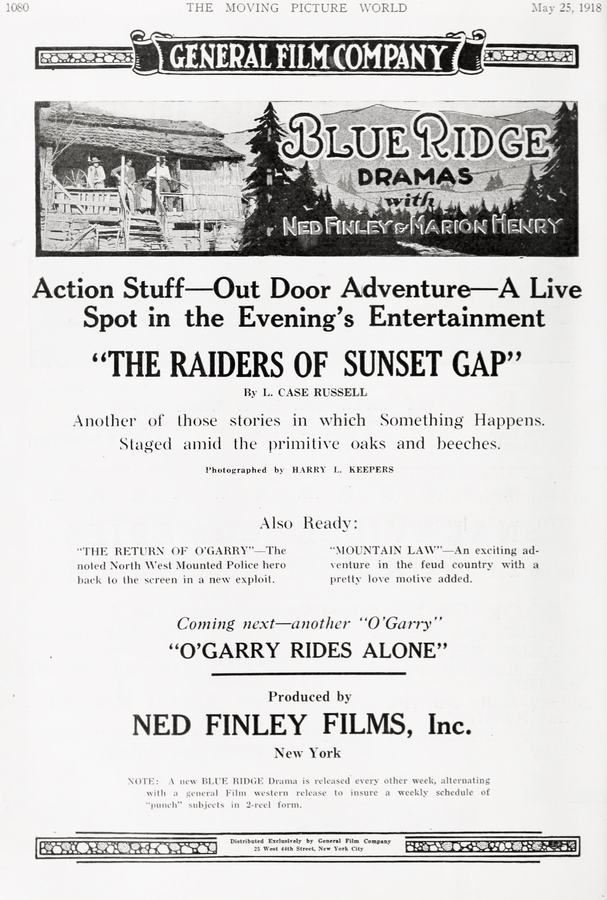
The opening frames of The Raiders of Sunset Gap unfurl like a sepia‑tinted map, each contour of the Appalachian ridge whispering of hidden wealth and buried grudges. Buck Lane, portrayed with a stoic gravitas by Harry Hammill, is not merely a countryman; he is a conduit for the film’s central paradox—progress versus tradition. When a stranger arrives, clutching a sack of dynamite as if it were a holy relic, Buck’s curiosity ignites, setting the narrative in motion. The stranger’s ambition to chart a course to Sunset Gap, a locale shrouded in mythic reverence, mirrors the era’s fevered quest for mineral fortune, a motif that resonates throughout the early 20th‑century Western canon.
The film’s ensemble operates as a living topography. Bud, rendered by Ned Finley, functions as both guide and gatekeeper, his warnings about the moonshiner‑infused unrest echoing the region’s volatile history. Lem Gill, embodied by Richard Neill, returns from the wilderness like a cartographer revisiting a familiar yet altered terrain; his suspicion toward Bud is less personal vendetta and more an instinctive read of the shifting political currents. Marion Henry’s Farley matriarch, though scarcely given dialogue, embodies the lingering specter of illicit trade that has long sustained the community’s economy. Each performance is calibrated to convey a slice of the Appalachian psyche, a technique reminiscent of the character layering seen in Spellbound (though that film dwells in psychological thriller territory, the meticulous character mapping is comparable).
Cinematographer Bert Gudgeon employs chiaroscuro lighting to accentuate the stark dichotomy between the luminous promise of copper and the darkness of moonshiner oppression. The camera lingers on the glint of dynamite fuses, their orange flare a visual motif that recurs whenever greed threatens to eclipse morality. In the climactic explosion, the frame swells, capturing the momentary burst of light that briefly turns the night sky a searing #C2410C, before the blackness reasserts itself—a visual metaphor for the fleeting triumph of ambition over the immutable forces of nature.
The screenplay, penned by Lillian Case Russell, constructs its narrative with the precision of a mining survey. The early act establishes the stakes: a land rich in copper, a community rattled by moonshiner raids, and a stranger whose fatal injury underscores the peril inherent in the quest. Bud’s decision to inherit the stranger’s purpose is a pivotal pivot, akin to the narrative handoff in The Master Crook, where a secondary character assumes the mantle of the protagonist’s mission. The middle act, dominated by Lem’s investigative maneuvers, is a cat‑and‑mouse game that heightens tension without resorting to melodramatic excess.
When Bud plants the charge beneath the Farley still, the film transcends mere action and ventures into allegory. The dynamite, a tool of industrial progress, simultaneously serves as an instrument of destruction, eradicating the illicit still while unearthing a vein of copper—nature’s own hidden treasure. This duality mirrors the broader American narrative of the 1930s, where industrialization promised prosperity but often obliterated traditional ways of life. The explosion’s visual palette—flames rendered in #EAB308 against the night’s #0E7490 hue—creates a striking tableau that lingers in the viewer’s memory.
Harry Hammill’s Buck Lane is not a flamboyant hero; his restraint speaks volumes. In the scene where he watches the stranger limp back, Hammill’s eyes convey a blend of empathy and foreboding, a silent commentary on the cost of ambition. Ned Finley’s Bud, on the other hand, oscillates between opportunistic schemer and reluctant guardian, a complexity that adds layers to the film’s moral canvas. Richard Neill’s Lem Gill delivers a measured performance, his measured cadence reflecting the disciplined resolve of a man returning to a homeland altered by time and lawlessness.
At its core, The Raiders of Sunset Gap interrogates the intersection of law enforcement and personal gain. The officers, representing state authority, are depicted as both protectors and potential exploiters, a duality that resonates with contemporary discussions about governmental overreach. Bud’s negotiation with the officers—claiming ownership of the newly discovered copper—underscores the fluidity of legal ownership when wealth is at stake. Lem’s eventual acquiescence signals a pragmatic compromise, suggesting that community cohesion can be restored only through shared economic benefit.
While the film stands alone in its period, its motifs echo across decades. The tension between illicit trade and legitimate enterprise is a recurring theme in Fantomas: The Mysterious Finger Print, where clandestine operations fuel narrative suspense. Moreover, the film’s focus on mineral exploitation prefigures the environmental undercurrents present in modern Westerns such as Atlantis, where the extraction of natural resources becomes a catalyst for societal upheaval.
Production design merits particular commendation. The set pieces—weather‑worn cabins, creaking wooden bridges, and the clandestine still nestled in a moss‑covered ravine—are rendered with an attention to detail that immerses the audience in the era. The use of natural lighting, filtered through the canopy of towering pines, creates an atmospheric authenticity that rivals the meticulous set construction seen in Old Hartwell's Cub. The film’s soundscape, punctuated by the distant clang of mining equipment and the soft murmur of the mountain stream, further grounds the narrative in its geographical context.
Russell’s script balances colloquial vernacular with lyrical phrasing. Lines such as “The earth’s got secrets, and the devil’s got a dynamite to pry ’em open” encapsulate the film’s blend of rustic charm and existential gravitas. The dialogue never feels forced; each utterance serves to deepen character motivations while advancing the plot. This restraint is reminiscent of the tight scripting in His Royal Highness, where brevity is wielded as a narrative weapon.
The musical accompaniment, though modest, employs a string quartet that weaves a plaintive melody throughout the film’s quieter moments. The score’s tonal shifts—from the low, rumbling drones accompanying the dynamite scenes to the bright, hopeful motifs that underscore the discovery of copper—mirror the emotional ebb and flow of the narrative. The subtle use of percussive elements during the explosion sequence accentuates the visceral impact, making the audience feel the reverberation of the blast.
Set against the backdrop of the Great Depression, the film reflects the desperation that drove many Appalachian communities toward moonshining as an economic lifeline. The raids that incite the townsfolk’s unrest are not merely plot devices; they echo the real‑world enforcement campaigns that sought to curtail illicit alcohol production. By embedding these historical realities within its storyline, The Raiders of Sunset Gap transcends entertainment, offering a sociocultural commentary that remains pertinent.
Although the film did not achieve blockbuster status, its nuanced portrayal of moral ambiguity and its deft interweaving of action with thematic depth have earned it a modest cult following among Western aficionados. Scholars often cite it as an early exemplar of the “resource‑driven Western,” a sub‑genre that examines how natural wealth reshapes societal hierarchies. Its influence can be traced in later works that explore similar motifs, such as the mining‑centric narratives of The Victoria Cross.
In sum, The Raiders of Sunset Gap is a meticulously crafted piece of cinema that rewards attentive viewing. Its layered characters, atmospheric cinematography, and thematic resonance coalesce into a film that feels both of its time and timeless. For viewers seeking a Western that balances action with introspection, this film offers a compelling journey through the shadows of the Appalachian hills, illuminated by the flickering flame of ambition.
IMDb 6.1
1921
Community
Log in to comment.