DbcultAccessing Vault...
Cult Review
Senior Film Conservator
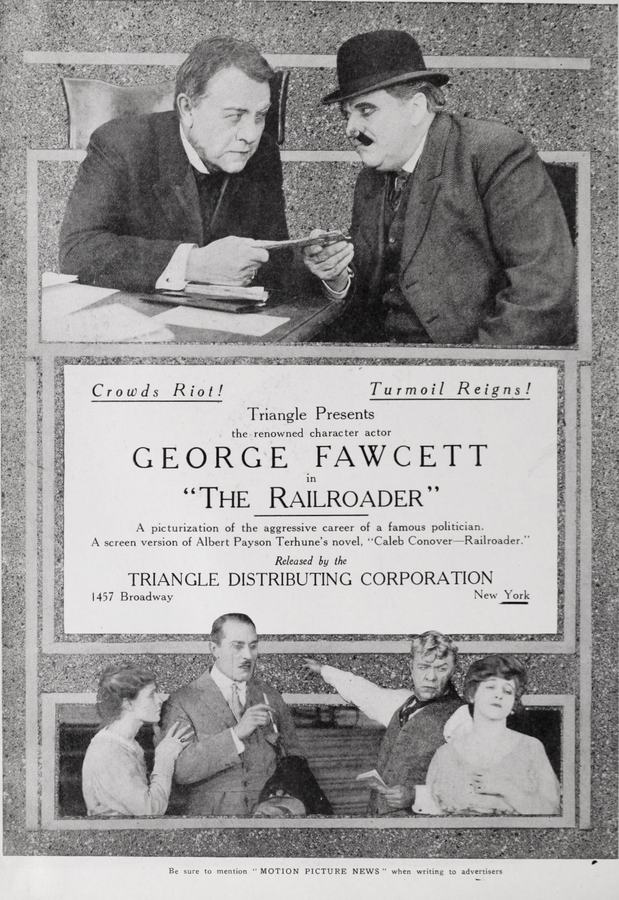
Ah, the silent era! A time when narratives unfolded through grand gestures, expressive visages, and the evocative power of intertitles. It was an epoch of raw storytelling, often tackling themes that resonate with surprising contemporary relevance. Among these cinematic relics, The Railroader emerges as a compelling, albeit stark, examination of unchecked ambition and its corrosive effects on the human spirit and the familial unit. This isn't just a film; it's a social commentary etched in celluloid, a testament to the era's fascination with the self-made man – and his potential for self-destruction.
At its core, The Railroader presents us with Caleb Conover, a character embodied with formidable intensity by Tom Santschi. Santschi, a stalwart of early cinema, brings a palpable, almost primal energy to Conover. From his initial portrayal as a rugged railroad section boss, there's an undeniable magnetism, a sense of an engine of will barely contained. His rescue of Letty, played by Virginia True Boardman, from the clutches of street harassment in a bustling, perhaps menacing, Italian neighborhood, is not merely a romantic overture. It's a foundational act of assertion, a demonstration of his capacity for decisive action that underpins his subsequent ascent. This moment, framed with the dramatic flair characteristic of the period, serves as a microcosm of Conover's entire philosophy: identify an obstacle or a perceived weakness, and conquer it with unyielding force. Letty, a woman of higher social standing, becomes not just a wife, but a symbol of his upward mobility, a trophy in his relentless campaign against his own humble origins.
Conover's transformation from a mere section boss to the corrupt political boss of his county and, eventually, the railroad president, is depicted with a chilling efficiency. The film doesn't shy away from illustrating the brutal pragmatism that fuels his rise. It's a narrative of pure, unadulterated will-to-power, a Machiavellian journey where every relationship, every decision, is a calculated maneuver in the grand game of dominance. One might draw parallels here with the thematic undercurrents found in films like The Cave Man, which also explored the raw, often uncivilized, instincts that drive individuals in their pursuit of societal standing, albeit often with a more comedic or satirical lens. Conover's ruthlessness, however, is played for stark drama, highlighting the moral compromises inherent in his path.
The film excels in painting a portrait of a man who becomes synonymous with the very institutions he controls. The railroad, once merely his workplace, transforms into an extension of his personal empire, a symbol of his industrial might. His political machinations are similarly all-encompassing, weaving a web of influence that stifles dissent and rewards loyalty, however ill-gotten. George Fawcett, likely portraying a key political or business adversary, would have offered a counterpoint to Santschi’s dominant presence, though the plot suggests Conover’s power is largely unchallenged until the very end.
Yet, the very foundation of Conover's success – his family – proves to be the most vulnerable point in his armor. His son, Gerald, a character of evident weakness and moral vacuity, stands in stark contrast to his driven father. Gerald's refusal to work, his embrace of idleness, and his entanglement with a chorus girl (Goldie Colwell, perhaps?) who is transparently after his money, represent a profound failure of Conover's legacy. This chorus girl, retaining her former lover even as she ensnares Gerald, is a classic silent film trope of the 'vamp' or the 'gold-digger,' designed to highlight the moral decay lurking beneath the surface of newfound wealth. This familial disillusionment echoes themes explored in other dramas of the era, where the children of powerful men often struggled to find their own purpose, or succumbed to the temptations of inherited privilege. It's a familiar narrative device, but one that feels particularly poignant here, given Conover's own humble origins.
The return of Conover's daughter, Vera (Fritzi Brunette), from Europe, ostensibly married to a prince, further illustrates the family's detachment from reality. Conover, blinded by a desire for social validation, throws an elaborate reception, a spectacle of his own making, to celebrate this fabricated grandeur. His drunken nomination of himself for governor at this very event is a moment of supreme hubris, a public declaration of his insatiable appetite for power, even as his personal world teeters on the brink of collapse. Brunette's portrayal of Vera would have been crucial here, conveying the veneer of sophistication that masks a deeper deception. The film subtly critiques the superficiality of social climbing and the dangers of living a lie, themes that were often explored in films like John Petticoats, which also delved into societal expectations and the performance of identity.
The introduction of Anice Lanier (Velma Whitman), Conover's trusted secretary, injects a new layer of complexity and moral reckoning into the narrative. Anice, to whom Conover is clearly attracted, represents a different kind of strength – one rooted in integrity rather than brute force. Her affection for Clive Standish, a lawyer immune to Conover's corrupting influence, sets up a direct ideological conflict. Standish, the clean-cut champion of justice, is the antithesis of everything Conover represents. This dynamic, a clash between the entrenched, corrupt power and the burgeoning force of moral rectitude, is a classic dramatic setup, often seen in films like Southern Justice, which frequently pitted an individual against a powerful, unjust system.
Anice's eventual betrayal, stealing compromising letters Conover wrote to his broker, is a pivotal moment. It’s not merely an act of disloyalty but a calculated move rooted in a deeper, personal vendetta. The revelation that Anice is the daughter of a man Conover had previously ruined adds a layer of karmic retribution to the plot. This twist elevates Anice from a mere love interest or a catalyst for Conover's downfall to an agent of poetic justice, embodying the long-simmering consequences of his past misdeeds. Whitman's performance here would have required a delicate balance, conveying both her hidden pain and her unwavering resolve.
The final, devastating blow to Conover's empire comes from an unexpected source: his wife, Letty. Her confession that Vera's 'prince' was untitled, the marriage illegal, and that their daughter is now starving in Paris, shatters the last vestiges of Conover's self-deception and pride. This revelation is more than just personal humiliation; it’s the ultimate indictment of his misplaced priorities. He built an empire, yet failed to secure the genuine well-being and happiness of his own flesh and blood. The dramatic irony is palpable: the man who could conquer industries and political landscapes is undone by the very family he sought to elevate.
The cumulative effect of these betrayals and revelations is the extinguishing of Conover's formidable drive. The plot explicitly states, 'his drive now gone,' a phrase that speaks volumes about the psychological toll of his downfall. The very engine that propelled him to power, his unyielding ambition, is suddenly, irrevocably broken. This internal collapse precedes his external defeat, making his loss of the gubernatorial election to Standish not just a political setback, but the physical manifestation of his spiritual demise. Santschi's ability to convey this internal devastation without dialogue would have been a masterclass in silent film acting, relying on subtle shifts in posture, gaze, and facial expression to communicate the profound loss of purpose.
The film's resolution, with Conover's defeat, offers a moralistic conclusion typical of many silent era dramas. It reinforces the idea that corruption, no matter how powerful, eventually succumbs to integrity. Clive Standish, the incorruptible lawyer, emerges as the victor, not through force or manipulation, but through an adherence to principle. This contrast between the old guard of corruption and the new wave of ethical leadership provides a hopeful, albeit perhaps simplistic, vision of justice prevailing. This thematic thread can be seen in other films of the period that grappled with societal ills and the triumph of good, such as Sunlight's Last Raid, which often depicted clear moral lines and definitive victories for the virtuous.
Beyond its narrative, The Railroader, under the direction of a skilled filmmaker (though not specified in the prompt, the quality of storytelling implies a capable hand), would have relied heavily on visual storytelling techniques. The use of dramatic lighting, expressive close-ups to convey emotion, and carefully composed wide shots to establish power dynamics or scenes of urban grit, would have been paramount. The contrast between the rough-and-tumble Italian neighborhood and the opulent reception, for instance, would have been visually striking, emphasizing Conover's journey across social strata. The performances, particularly Santschi's, would have been characterized by the broad, yet nuanced, physicality required for silent cinema, where every gesture and expression carried significant weight.
Albert Payson Terhune's screenplay, even in its summarized form, showcases a keen understanding of dramatic structure and character development. The plot is tightly woven, with each event building logically towards Conover's inevitable downfall. The moral lessons, while clear, are delivered through character actions and consequences, rather than heavy-handed exposition. This narrative sophistication ensures that the film transcends mere melodrama, offering a thoughtful critique of the American Dream when pursued through morally dubious means. It's a testament to the power of early screenwriting that such complex themes could be conveyed effectively without spoken dialogue.
In a broader context, The Railroader stands as a valuable artifact, reflecting the social and political anxieties of its time. The era was marked by rapid industrialization, the rise of powerful, often corrupt, political machines, and significant social mobility – both upward and downward. Films like this served as both entertainment and a mirror to society, allowing audiences to grapple with these complex issues through the lens of dramatic storytelling. It's a reminder that the struggles for power, the temptations of corruption, and the disintegration of family bonds under pressure are timeless themes, making The Railroader as relevant for critical discussion today as it was upon its release.
Ultimately, The Railroader is a poignant tragedy of ambition unbound. Caleb Conover’s story is not just a tale of a man’s rise and fall, but a cautionary fable about the true cost of power and the emptiness of a life devoid of genuine connection and integrity. It reminds us that even the most formidable empires can crumble from within, brought down not by external enemies, but by the very flaws of their architect. The silent screen, with its capacity for grand, visual metaphors, was perhaps the perfect medium to convey such an epic, yet deeply personal, saga of human triumph and profound failure.
IMDb —
1922
Community
Log in to comment.