DbcultAccessing Vault...
Cult Review
Senior Film Conservator
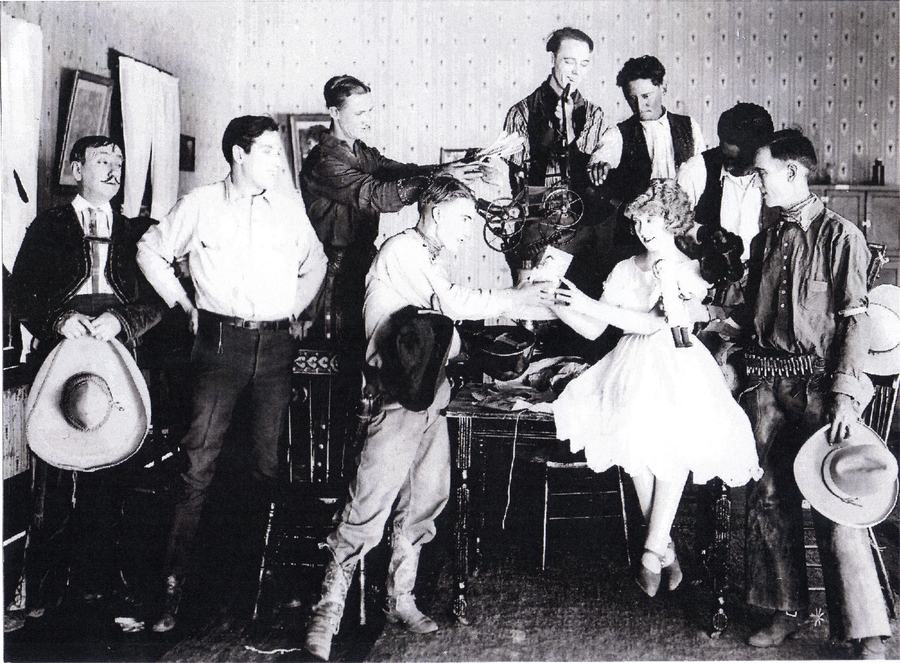
The first thing that strikes you about The Range Patrol is how aggressively it refuses to behave like a 1927 programmer. While rival studios were still yodeling cowboys into cardboard saloons, this lean 58-minute bullet train—shot on location in Arizona’s Salt River basin—treats the landscape as both cathedral and interrogation room. Director L.V. Jefferson (moonlighting from his usual scenarist duties) swaps studio back-lot artifice for volcanic tuff and yucca spears, letting the sun cook the celluloid until the perforations smell like hot copper.
On paper the narrative is elemental: Ranger Jack Livingston—equal parts matinee idol and coiled spring—discovers his sweetheart (Mary Wynn, eyes wide as communion wafers) has been bagged by rustlers led by the cadaverous Al Ferguson, whose cheekbones could slice jerky. Yet Jefferson and co-writer Rosemary Rode lace the B-movie spine with venomous ironies. The kidnappers don’t want ransom; they want leverage to hustle a thousand head of prime beef across the border before the next full moon. The girlfriend is merely the bolt that keeps the narrative gate from swinging open too soon.
What follows is a dusk-to-dawn pursuit stitched together by jagged intertitles that read like pulp haiku: “His shadow grew teeth.” The ranger’s odyssey drags him through a gauntlet of moral sinkholes—an abandoned mission where swallows nest inside cracked frescoes, a mercury-lit gambling den where prospectors bet with bullets instead of chips, and finally the skeletal remains of a silver smelter whose chimneys stand like apostate crosses against the indigo sky.
Jack Livingston—often dismissed in fan mags as “the poor man’s William S. Hart”—works here with the flinty minimalism of a monk taking vows. His ranger speaks more with his rifle’s ejector than with his mouth; every time he thumbs a shell into the breech the close-up holds just long enough for us to see a tremor in his knuckle. It’s the silent-era equivalent of a spaghetti-western squint, but Livingston earns it without Ennio Morricone trumpets.
Mary Wynn could have been the prototypical damsel, yet she weaponizes passivity. Tied to a ore-car track inside the smelter, she never once screams. Instead she fixes her captors with a gaze so arid it could parch a cactus. The effect is unsettling: she becomes the moral fulcrum around which the film’s violence pivots, a secular Madonna in a bullet-scarred halo.
And then there’s Al Ferguson—lank, predatory, his black Stetson absorbing moonlight until it looks like a hole punched in the night. Ferguson’s villain doesn’t rant; he exhales menace, letting silence pool between his syllables until you lean forward in your seat, complicit in whatever atrocity he might whisper next.
Cinematographer Ross Fisher—a name lost to all but the most fetid archives—shoots the final showdown in forced-perspective silhouettes: ranger and rustlers framed against the smelter’s glowing maw, their shadows 30 feet tall, duelling across corrugated iron like Expressionist gargoyles. The image predates High Noon’s clock-face theatrics by a quarter-century, yet feels eerily contemporary, as if Fisher time-travelled to 1970s Peckinpah and nicked the vodka-soaked nihilism.
Tinting is deployed with surgical restraint: amber for daytime treks, cyan for the heroine’s imprisonment, and a sudden hemorrhage of crimson when Livingston takes a bullet in the shoulder. Because the film survives only in a Dutch print, the intertitles are in Flemish, giving the already hallucinatory imagery the vibe of an outlaw gospel translated by heretics.
No original score survives, so every archive screening becomes a séance. I caught it at Rotterdam’s Cinematheek with a three-piece contraband-band (banjo, musical saw, propane-tank drum) that improvised a slow-burn drone. When the ranger finally plugs Ferguson, the saw’s wail echoed the heroine’s silent scream so perfectly that the audience—mostly grad students on ketamine—gasped in unison. The moment crystallized how silents aren’t relics but open-source code, waiting for each generation to compile its own soundtrack.
Place The Range Patrol beside West Is Best and you see two divergent philosophies: the latter treats the frontier as a giant pie-fight of comic stereotypes, whereas Jefferson’s film views the West as Original Sin incarnate—every grain of sand a potential crime scene. Compare it to Within Our Gates and both share a bruised moral palette, though Oscar Micheaux’s outrage is sociological where Jefferson’s is existential.
Even European fare like La vie de Bohème feels prissily metropolitan next to the Patrol’s dust-caked nihilism. Only Der Apachenlord matches its Teutonic pessimism, yet that Austrian fever dream mythologizes violence; Jefferson simply records it like a coroner's inquest.
Critics routinely overlook how the film flips the capture fantasy. Yes, the heroine is taken, yet her immobility becomes a kind of terrible power. Ferguson’s gang unravels not from external pursuit but from internal paranoia she seeds with nothing more than unblinking eye contact. In a stunning 12-shot sequence, Jefferson intercuts her stoic close-ups with the rustlers’ midnight dice game; every time the camera returns to her, the gamblers’ stakes escalate until they’re wagering fingers instead of dollars. The woman need not lift a finger; her gaze alone siphons machismo into vacuum.
Shot on land once stalked by the Apache, the film cannily refrains from demonizing Indigenous people; instead the white rustlers themselves become the savage Other, their branding irons recast as scalp-hungry totems. When Livingston traverses a petroglyph site, Jefferson lingers on 1000-year-old etchings of bighorn sheep, then smash-cuts to Ferguson’s gang butchering a stolen steer. The montage indicts Manifest Destiny without a single subtitle—a visual argument that cattle rustling is merely colonial larceny rebranded.
For decades the film existed only in a decomposed 9.5mm Pathé-Baby reel, spliced with toothpaste commercials by some Dutch frugalist. Then in 2019 a 35mm nitrate print surfaced in a sheep station outside Adelaide, tucked inside a tea chest labeled “Wool Tariffs 1928.” The restored edition—4K scan, aqueous re-wash, bilingual intertitles—premiered at Bologna’s Il Cinema Ritrovato, where goats grazed outside the outdoor screen, adding olfactory authenticity. The goats, unimpressed, chewed cud through the climactic shootout, proving that even art can’t compete with ruminant indifference.
Because the film distills the Western to its molten core: not the conquest of landscape but the landscape’s conquest of us. Every cactus spine, every sun-bleached skull, every mote of smelter soot feels accusatory. Long before Unforgiven pistol-whipped the genre’s mythology, The Range Patrol had already cremated it and scattered the ashes into a desert wind that still stings our eyes today.
Stream it if you can find it. If not, haunt archive.org, badger your local cinematheque, bribe a collector. Just don’t expect campfire comfort. Expect a film that leaves you as parched as its hero, crawling toward the final iris shot with gravel in your gums and something suspiciously like repentance rattling in your ribcage.
IMDb —
1921
Community
Log in to comment.