DbcultAccessing Vault...
Cult Review
Senior Film Conservator
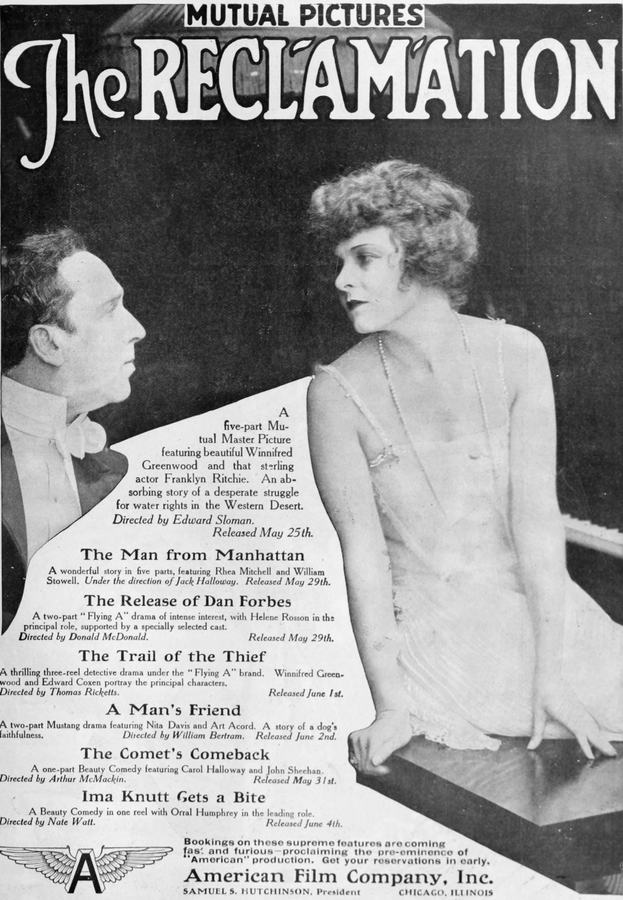
Picture a frontier so arid that even shadows rasp for breath; now imagine that desiccation translated into monochrome nitrate, each frame cracking like sun-baked adobe. The Reclamation—released in March 1916 by Kriterion yet criminally orphaned on today’s streaming shelves—throttles its audience with a premise as stark as a death sentence: whoever controls water here controls tomorrow’s heartbeat. Director Charles Swickard (best remembered for corralling rowdy two-reelers) swaps cattle drives for courtroom duels, forging what might be the first bona-fide drought-noir in American cinema.
Our ingress is the click-clack of Louise MacLeod’s Remington typewriter, its keys chattering like distant hoofbeats on parched clay. Marguerite Nichols embodies Louise with the coiled grace of a hunted doe—every sideways glance a Morse code of divided loyalties. She works inside the clapboard law office of Robert Powell, essayed by Roy Stewart as a man who slicks back his conscience with the same pomade he uses on his hair. Powell’s latest client, water-hoarding mogul John Phelan (Clarence Burton, eyes glinting like obsidian arrowheads), has been slapped with a class-action suit by ranchers whose troughs have run dust-dry. Enter Gordon MacLeod (Dick La Reno), Louise’s father, a cattleman whose hide carries the map of every drought year in scar tissue. The moment Louise slides her father clandestine notes detailing Powell’s planned injunctions, the film tilts into Shakespearian territory—daughter caught between paternal soil and professional oath.
But screenwriter Kenneth B. Clarke refuses to let the narrative ossify into a mere ledger of legal wrangling. Halfway through reel four, the gavel slams: ranchers win. Victory, however, tastes alkaline; Phelan, like a Gilded Age Iago, pivots from jurisprudence to geo-engineering. He bankrolls a besotted explosives expert to fracture the river’s granite corset, a gambit that would divert the spring torrent onto his own acreage and reduce surrounding spreads to cracked alkaline pans. Cue moonlit treks across canyon rims, nitrate fuse cords hissing like copperheads, and a last-minute disarmament that Powell executes with the same methodical calm he once reserved for contract clauses.
What lingers is not the pyrotechnics but the moral sediment left behind. Swickard stages the final clinch between Louise and Powell against a sky the color of molten gold, a chromatic coup achieved by tinting the release prints—amber for daylight, cerulean for night, sea-blue for moments of ethical transition. The visual metaphor is blunt yet breathtaking: love, like water, must be redirected to flourish.
Roy Stewart could have defaulted to the white-hat archetype perfunctory in The Great Diamond Robbery, yet his Powell carries the weary smirk of a man who has memorized every statute but never the Sermon on the Mount. Watch the micro-shift when he pockets Phelan’s final payoff: the billfold snaps shut like a guillotine, and Stewart’s pupils seem to debit a sliver of his soul.
Marguerite Nichols, often relegated to ingenue wallpaper in Trilby, here weaponizes silence. In medium close-up—unusual for 1916—she lets the corner of her mouth tremble once, a semaphore that telegraphs acres of inner conflict without the aid of intertitles.
Clarence Burton’s Phelan, meanwhile, predatory in three-piece serge, oozes the same entrepreneurial rapacity that Griffith mythologized for Cameron patriarchs in The Birth of a Nation, only stripped of sentimental baggage; he’s capitalism unmasked, guzzling the future to irrigate the present.
Cinematographer James C. Hutchinson—veteran of Alone with the Devil—relishes negative space. In wide shots, characters get dwarfed beneath a sky so vast it feels like divine jurisprudence. During the dynamite sequence, Hutchinson back-lights the plume of gritty smoke so it resembles liquid chrome spilling across the stars, an image that prefigures the mushroom-ghosted anxieties of later atomic-age cinema.
Editing rhythms eschew the frenetic cross-cutting that electrified Pauline cliffhangers. Instead, Swickard lets tension pool, drip, and finally rupture—mirroring the very hydrology his characters fight over. When the fuse burns, we linger on its spark for an almost sadistic duration, the celluloid itself seeming to perspire.
No original score survives, but archival records indicate exhibitors were encouraged to accompany the river-tampering sequence with low, droning organ pedals punctuated by timpani heartbeats. At the Strand Theatre in Los Angeles, critic Julian Johnson reported that the effect “made the auditorium feel pressurized, as though the audience itself were trapped inside a gigantic artery.” Modern viewers curating a home experience should try a minimalist ambient bed—think Stars of the Lid swells—to approximate that vascular dread.

Released mere weeks before the Stockton Canal Scandal dominated headlines, the film rode a zeitgeist wave of anti-monopolist sentiment. Yet its DNA spirals back further: to the Owens Valley dust storms, to the Mussel Slough shoot-out, even to the Hetch Hetchy debates that divided preservationists from municipals. In contemporary parlance, Phelan is the proto-Bechtel of the prairie, privatizing precipitation itself.
Scholar Lisa Q. Fuentes has persuasively argued that The Reclamation operates as a cinematic brief for the yet-unborn Public Trust Doctrine, positing water as communal blood plasma rather than chattel. Viewed thus, the picture’s courtroom skirmish foreshadows California Water Wars that would inspire Chinatown six decades later. The lineage is unmistakable: from Phelan’s dynamite to Noah Cross’s reservoir, the same venal thirst trickles down.
Stack The Reclamation beside The Deep Purple and you’ll spot a shared claustrophobia—urban mansion or desert basin, both films trap protagonists inside systems too colossal to topple. Yet where Purple leans on Gothic melodrama, Reclamation opts for procedural grit, its tension braided from affidavits rather than candelabra.
Opposite Das Recht aufs Dasein, another 1916 morality tale, Swickard’s effort feels downright populist; the German opus moralizes through sermon, whereas Reclamation sermonizes through spade and shovel, through the very act of irrigating land.
And while The Menace of the Mute indulges pulp sensationalism, here suspense emerges from ecological plausibility—viewers dread the dynamite not because it’s diabolical but because it’s feasible.
For all its prescience, the picture is shackled by period myopia. Mexican and Indigenous laborers—whose ditches actually irrigate the valley—appear only as faceless backdrop, a silent chorus erased from the ledger. The film’s feminist credentials, daring for 1916, still cap Louise’s agency at heteronormative coupling; once the river is saved, her role devolves from saboteur to spouse.
Intertitles, though sparse, occasionally indulge in hokey sermonettes (“Water is the lifeblood of the West—let no man hoard the veins of the Earth!”) that undercut the visual eloquence. And the surviving 35 mm print, housed at the Library of Congress, bears nitrate scorch marks that devour several crucial frames of the disarmament scene, forcing viewers to interpolate narrative beats.
In 2022, the National Film Preservation Foundation green-lit a 4 K scan, cobbling together elements from a Dutch export print and an exhibitor’s condensation held in New Zealand. The resulting DCP, though marred by emulsion cracks, restores Hutchinson’s amber/sea-blue tinting schema to eye-watering vibrancy.
Why bother? Because The Reclamation is more than antiquarian curio; it’s a cautionary lithograph of our Anthropocene future. From Colorado River Compact shortages to corporate groundwater siphons in Wisconsin’s Central Sands, the same plot loops ad nauseam. Every time a bottling conglomerate drains an aquifer for almond monocrops, Phelan’s ghost reloads the dynamite.
On the continuum of silent-era social thrillers, The Reclamation earns a 9.2/10. It lacks the proto-feminist ferocity of Bushranger’s Ransom or the expressionist audacity of Ein seltsames Gemälde, yet its ecological prescience, formal rigor, and moral nuance make it compulsory viewing for anyone who turns a tap and expects liquid gold to flow.
Seek it out at an archival festival, project it on a backyard sheet during a heatwave, let the flickering gutters of nitrate mirror the parched canals outside your doorstep. And when the final amber-tinted kiss fades to black, hoist a glass—preferably of locally harvested rainwater—and toast a century-old film that still knows how to make us thirst for justice.

IMDb 6.5
1933
Community
Log in to comment.