DbcultAccessing Vault...
6.3/10
Senior Film Conservator
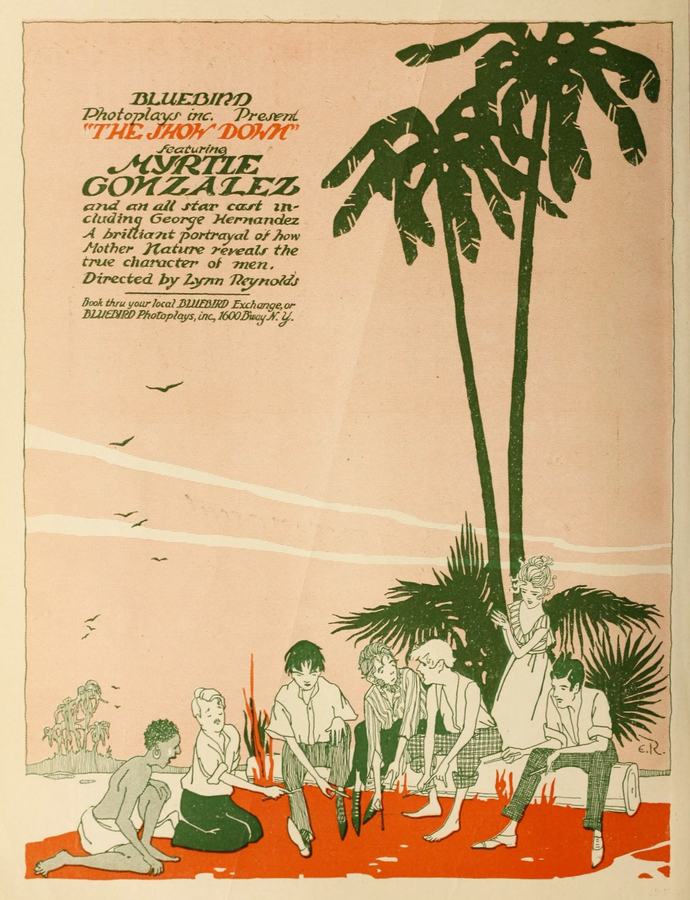
A definitive 6.3/10 rating for a film that redefined the boundaries of cult cinema. The Show Down remains a cornerstone of transgressive art.
A torpedo shears the Atlantic dusk; chandeliers plummet like crystal meteors, champagne flutes still fizzing on white linen. Within minutes, Waldemar Young’s scenario yanks the rug from under Gatsby-era complacency and maroons its overdressed mannequins on a spit of sand no bigger than a ballroom floor. The film’s very title card—THE SHOW DOWN—arrives like a dueling glove slapped across the face of every viewer who assumed character is fixed at the moment one’s name hits the society pages.
Director Lynn Reynolds, fresh from trafficking in prairie melodrama, swaps sagebrush for salt spray and stages a social experiment worthy of a laboratory rat maze. Notice how the first post-wreck shot frames the island through the brass porthole still clutched by a nameless steward—an unsubtle yet haunting reminder that these survivors carry their gilded peepers with them even when the world has shrunk to a palm circumference.
Myrtle Gonzalez, as Lydia, enters the narrative swaddled in chiffon that might as well be a neon sign flashing “liability.” Watch her nostrils flare when she tastes coconut milk for the first time—an entire trust fund curdling on her tongue. By the time she’s shredding her silk skirt into fishing nets, the camera lingers on her calves, not for erotic frisson but to chronicle the moment capital becomes sinew. The lighting turns her skin the color of wet parchment, as though the island itself were drafting a new résumé on her body.
Arthur Hoyt’s John Benson is the film’s most seismic tectonic plate. He begins as a walking cashbox—every sneer a nickel, every shout a dollar. Reynolds isolates him in a lagoon at twilight, backlighting his silhouette so that he resembles a totem of Molten Wealth. The pivotal scene—Benson splitting firewood and discovering his own blistered palm—plays without intertitles; the close-up of blood pearling on gold cufflinks says more about the fragility of capital than any manifesto. Hoyt’s micro-expressions—a twitch at the corner of the mouth that could be either agony or epiphany—deserve to be freeze-framed in every film school seminar on silent performance.
Jean Hersholt’s Oliver North arrives with the press clipping still pinned to his lapel: “Angel of the Slums.” Hersholt, who would later become synonymous with medicinal benevolence on radio, here weaponizes his future persona by letting it rot from the inside. When North hoards a tin of condensed milk while lecturing on shared sacrifice, the irony detonates louder than the U-boat torpedo. Reynolds blocks him in a medium shot that traps the character between two palms—nature’s own pillory. The island judiciary needs no gavel; a single coconut hurled by an unseen hand knocks the halo askew.
George Hernandez’s Langdon Crane, introduced in a tuxedo that fits like a lawsuit, embodies the Edwardian cult of the adrenaline jackal—big-game hunter, war hero, toastmaster. Reynolds strips him to a loincloth and then to the marrow. The moment Crane refuses to climb a tree for breadfruit, instead pleading a “strained deltoid,” the jungle soundtrack (orchestrated by a live orchestra in 1921) seems to snicker. His final degradation—cowering inside a wrecked lifeboat while the others build signal fires—plays like a negative image of My Best Girl where the hero scales warehouse scaffolding to prove love.
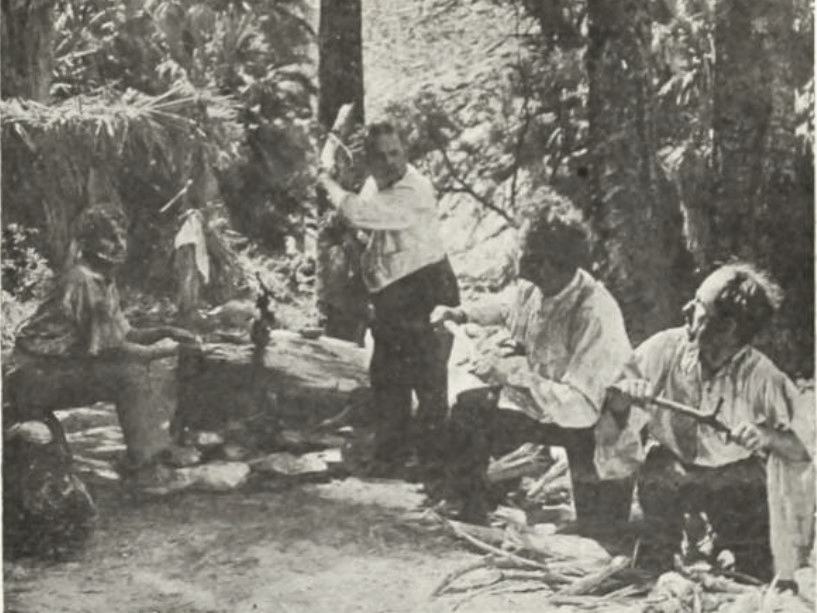
George Chesebro’s Robert Curtis begins as a throwaway rake, another tuxedo cutout. Yet the island alchemy transmutes him into the group’s Atlas. Note the montage: Curtis hauling driftwood, Curtis sharpening coral into fishhooks, Curtis teaching Lydia to start fire by rubbing sticks—each vignette cross-cut with Benson’s diminishing sneer. The film’s most erotic charge arrives not in clinches but in a two-shot of Curtis’s calloused thumb guiding Lydia’s untested palm against a bow drill. Their first kiss is staged off-center, half obscured by fronds, as though the camera itself were embarrassed to intrude on something so newly minted it hasn’t yet been named.
Cinematographer William Marshall favors low horizon lines that dwarf the humans against sky, a visual reminder that nature wrote the contract and retains the option to terminate. The night scenes were shot day-for-night with a cobalt filter that lends moonlit sand the texture of powdered steel. Compare this to the pastoral glow of The Beautiful Lie; here, beauty is merely the lipstick on a predator’s grin.
Intertitles arrive sparingly, often superimposed over waves so that words themselves seem to erode. One card—“Civilization is only seven meals away from savagery”—dissolves into surf foam, the letters washing backward into the undertow, a poetic admission that rhetoric cannot outrun appetite.
Lydia’s arc refracts the era’s suffrage anxieties. She begins as collateral beauty, ends as civic architect—designing aqueducts from bamboo and gravity. When she rebukes her father’s attempt to renegotiate her dowry post-rescue, the line is delivered not in words but in a single shoulder-check that sends Benson’s top hat tumbling into the gutter—a hat once worth more than the island that rebuilt her. The moment echoes, in reverse, the patriarchal bargains of Her Country's Call where heroines sacrifice agency for flag.
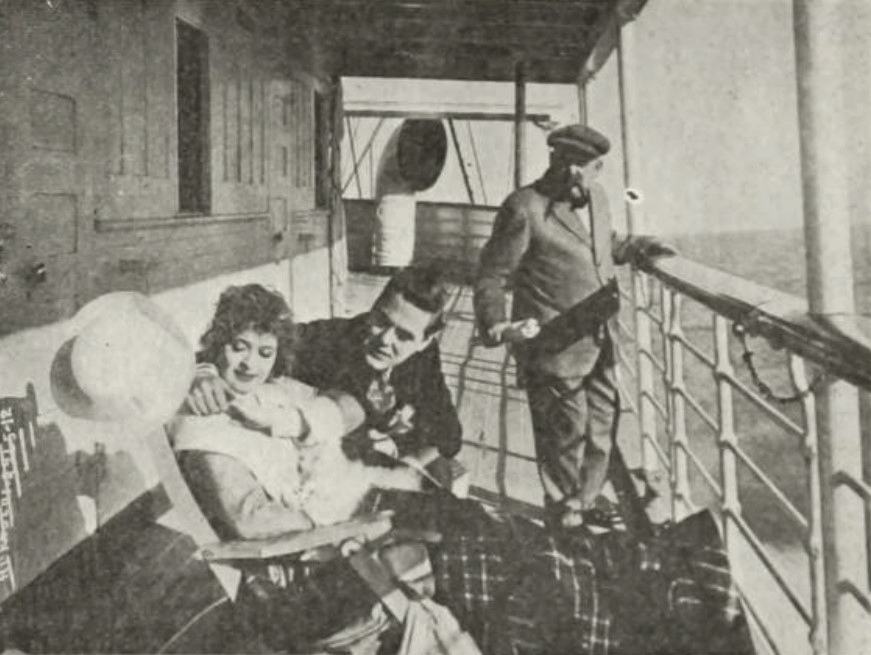
When the steamer finally appears, smokestack stripes flapping like prison bars, the survivors hesitate. Reynolds holds a 30-second shot—an eternity in 1921—of the group staring at their saviors, unsure whether deliverance is another trick of the light. The boarding ladder descends like a drawbridge, but the sequence is undercranked slightly, giving the motion a funereal drag. Back in New York, top hats and ticker tape await, yet the camera keeps cutting to Curtis’s bare feet on the gangway, still ingrained with island dirt, as though the soles themselves refuse repatriation into leather capitalism.
The final church scene stages the nuptial march with Gothic severity. Stained-glass saints glower down while Lydia advances in a dress the color of unbleached muslin—no silk, no train, a sartorial manifesto. Benson’s face, half in cathedral shadow, registers something between pride and bankruptcy. When the minister asks who gives the bride, there is a heartbeat of silence before Curtis steps forward and answers, “She gives herself.” The congregation gasps; the organ hiccups. In that instant, the film sideswipes every melodramic expectation and proclaims its thesis: identity is not restored by rescue but forged by the choices made after the ladders are lowered.
Surviving prints retain the original cue sheets—Wagnerian leitmotifs for the surf, ragtime for the shipboard soirée, a haunting solo cello for Curtis’s first fish catch. Modern festivals often commission new scores, yet nothing matches the dissonance of a lone oboe over a shot of Benson burning stock certificates for kindling—the audible snap of capitalism’s spine.
Place The Show Down beside Ambition and you see Reynolds recycling the trope of the millionaire stripped to essence, yet here the stripping is literal—no tuxedo survives the surf. Pair it with Brewster's Millions and you witness two philosophies of wealth: one where squandering is sport, another where wealth is ballast to be jettisoned before drowning.
Unlike the nationalistic hagiography of Bar Kochba, the Hero of a Nation, this film mistrusts all banners—be they national, filial, or marital—and instead hoists a Jolly Roger over the whole procession: a black flag reminding us that every covenant is negotiable when stomachs growl.
A 4K restoration by EYE Filmmuseum in 2019 unearthed a near-complete 35 mm nitrate negative, revealing textures previously muddied: individual grains of sand adhering to Gonzalez’s eyelashes, the opalescent sheen of a jellyfish stranded beside Crane’s lifeless bravado. The tinting follows 1921 protocols—amber for daylight, cyan for night, rose for the wedding—yet the restorers resisted the urge to homogenize; scratches remain like scars refusing plastic surgery. Streaming on Criterion Channel with optional English subtitles for the hard-of-hearing, though the intertitles are already in English, proving that silence itself can be bilingual.
Is it perfect? Close-ups occasionally overcompensate for the lack of synchronized sound, and the submarine miniature looks like a bathtub toy shot in a bucket. Yet these flaws solder the film to its era, like patina on bronze. Reynolds has no interest in sculpting immortal demigods; he’s dissecting mortals who happen to wear spats. The result is a parable that inoculates itself against moral absolutes, a story that ends with a marriage yet whispers that the real union is between who we were and who the tide insisted we become.
Watch it at midnight with the windows open and the sound of actual surf in the distance; let the two oceans—one on screen, one outside—argue over which of them is real. Spoiler: both win, and you, dear castaway, lose the certainty that you would behave any better once the liners of your own life slip beneath the swell.

IMDb —
1921
Community
Log in to comment.