DbcultAccessing Vault...
Cult Review
Senior Film Conservator
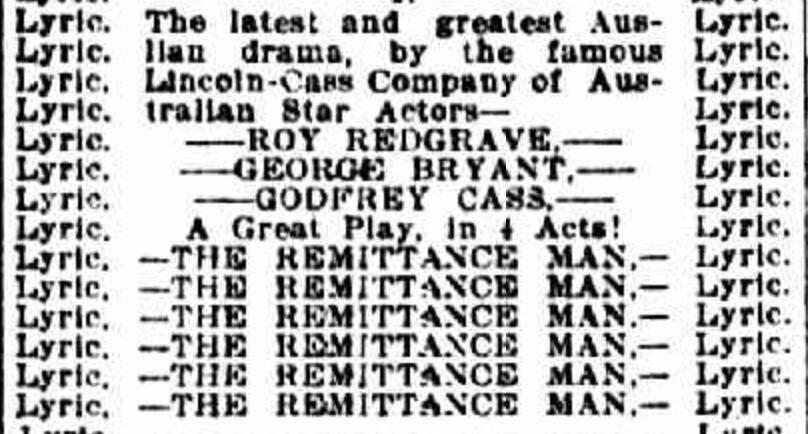
Aristocratic exile has rarely looked so infernally bright. Directors of the period usually smeared Vaseline on the lens and called it moonlight; here the camera squints directly into the white ball of the Australian sun until the celluloid itself seems to blister. That scorched clarity is the film’s first coup: it turns the landscape into a moral crucible rather than a picturesque backdrop. Every gum tree is a potential gallows, every shimmer on the horizon a reminder that the empire’s chequebook can stretch only so far before the desert reclaims its own.
George Bryant, face flickering between hauteur and hangdog hunger, arrives by steamer with a single trunk, a pair of cracked patent-leather shoes, and the unmistakable stink of disgrace. The colonial press labelled such men remittance men: younger sons whose gambling debts or bedroom scandals embarrassed the manor, and who were therefore paid to disappear overseas. Bryant’s character never utters his scandal aloud—silence being the etiquette of shame—but the performance is eloquent: a tic in the left cheek each time money is mentioned, fingers that drum a waltz on the tabletop when he lies. Close-ups were still experimental in 1911, yet cinematographer Edwin “Ted” Richards risks tight framing, allowing Bryant’s pupils to become twin black opals of panic.
Into this powder-keg of pride steps Roy Redgrave’s bushranger, a rangy predator who treats the outback as a private theatre. Redgrave was the actual patriarch of the acting dynasty; watching him is like witnessing the birth of a certain antipodean swagger later refined by Errol Flynn and, much later, Russell Crowe. His costume—slouch hat pinned rakishly, red scarf at the throat—could have been lifted from Sidney Nolan’s later Ned Kelly paintings, but the performance is pure campfire raconteur: limbs loose, voice (via intertitles) salted with sardonic humour, eyes always calculating the easiest exit. The bushranger’s proposition to the remittance man is simple: “Ride with us and you’ll never again wait for a London draft.” The irony, never spoken, is that both men live off other people’s labour; only the method differs.
Godfrey Cass’s squatter, by contrast, embodies the legalised plunder of settler capitalism. He has already carved a sheep run the size of Kent from Aboriginal land, and now seeks a “civilised” overseer—someone who knows Latin verbs and can police the convict shearers without flogging them into insensibility. Cass plays the squatter like a slab of granite learning to smile: spine ramrod straight, moustache bristling with frontier eugenics, yet capable of a surprisingly delicate gesture when offering a glass of port. The moment he hires the remittance man, the film tightens its ethical screws: will our displaced aristocrat choose the lawful tyrant or the romantic outlaw?
For a while he tries both, double-tracking through a series of cross-cut sequences that prefigure Griffith’s moral montages. In the morning he rides boundary with the squatter, learning to brand cattle; at night he shares damper and rum with the bushrangers while they plot the overland mail robbery. The intertitles—hand-lettered, jittering—grow shorter, as though language itself were dehydrating. One night a dust storm smothers the campfire; in the reddish half-light the remittance man sees his own face superimposed onto the bushranger’s, a proto-dissolve that must have startled 1911 audiences accustomed to static theatrical framing. From that hallucination he bolts, horse flanks flecked with foam, towards what he hopes is absolution.
Absolution, however, carries a heavier price than crime. The squatter demands he lead a posse against his former mates; refusal means instant dismissal and the cessation of quarterly remittances. Acceptance turns him into Judas with a British passport. Bryant registers the dilemma with a slow, almost geological crumbling: shoulders curve inward, eyes retreat into shadow. When the final shoot-out erupts on the blinding saltpan—horses wheeling, rifles spitting white smoke—the camera adopts a vertiginous high angle, transforming men into chess pieces on a cracked board. One bullet ricochets with a soundless ping; the bushranger clutches his chest, grins as if at some cosmic jest, and topples. The squatter tips his hat, satisfied that order is restored. The remittance man stands alone, purse intact, soul in arrears.
Historians sometimes claim Australian cinema was born with The Story of the Kelly Gang (1906), that myth-making juggernaut that turned a cop-killer into nationalist mascot. The Remittance Man refuses that romance. Its bushranger dies without hymns or iron armour; its authorities are not bumbling British redcoats but home-grown oligarchs who wield legality like a whip. In that sense the film belongs more to the lineage of Robbery Under Arms and Captain Starlight, novels where the outback is less a stage for rebel heroics than a profit margin measured in acres of wool and pints of Aboriginal blood.
Yet the film’s true ancestor may be From the Manger to the Cross, another 1911 release that likewise understood landscape as theology. Where the biblical epic used Palestinian sands to meditate on sacrifice, The Remittance Man uses the blistering interior to ask a secular question: can a man bought and sold by distant cheque ever purchase his own conscience? The answer is left suspended in the final shot: our protagonist, back turned, stares across an opal mine whose rainbow-coloured gouges mirror his fractured identity. Fade to white—not the usual iris-out—suggesting overexposure rather than closure.
Technically the picture is patchy miracle. Sections of the fifth reel show acid damage—bubbling emulsion that resembles crawling insects—yet the survival rate for Australian silents is so perilous that even scars feel like historiographic fingerprints. The tints, restored by the National Film and Sound Archive, oscillate between amber for daytime interiors and cobalt for night exteriors, approximating the temperature of guilt. More startling is the use of location sound proxies: intertitles describe the “thud of hooves on baked clay,” the “mosquito whine in the wattles,” prompting the viewer to hallucinate audio where none exists. It’s a reminder that silent cinema was never truly silent; it collaborated with the spectator’s imagination to produce an acoustic mirage.
Performances vary in register: Redgrave’s theatrical swagger harks back to 19th-century barnstorming, whereas Cass’s minimalist restraint anticipates the psychological realism that would flower in the 1920s. Bryant, caught between eras, channels both—sometimes flicking his glove with melodramatic flourish, sometimes letting a single tear blot the dust on his cheek. That inconsistency is historically apt; 1911 was the year acting began to tilt from declarative to introspective, and the film preserves the pivot like a fossil captured mid-metamorphosis.
Gender politics, inevitably, are era-specific. Women appear chiefly as off-screen bargaining chips: the squatter’s daughter, mentioned but never seen, is promised to whoever brings the bushranger to justice; the Aboriginal stockboy, listed in credits only as “Tracker Jim,” functions as exotic scenery despite steering the posse through inhospitable terrain. Contemporary viewers will bristle, yet the omissions themselves reveal how colonial power distributed visibility. That the film still manages to indict parasitic masculinity—aristocratic, criminal, or capitalist—feels no small achievement for a country that, in 1911, was busy mythologising its own rugged manhood.
Critics seeking stylistic fireworks should temper expectations. There are no rapid Soviet-style cuts, no Germanic angles, no Parisian surrealist superimpositions. The aesthetic is stolid, workmanlike, occasionally illuminated by flashes of visual poetry: the mirage that transforms a pursuing constable into a wobbling stick figure; the moment a cloud’s shadow races across the plain like a moral eclipse. Those images lodge in memory precisely because they emerge from, then retreat back into, the prosaic grammar of early narrative cinema.
Comparison with 'Neath Austral Skies proves instructive. Both films were shot around the Blue Mountains, both trade on bushranger iconography, yet where the latter opts for comic bravado and last-minute rescues, The Remittance Man ends in moral stalemate—its protagonist alive, solvent, and spiritually eviscerated. The film refuses to gratify the audience with catharsis, perhaps because early Australian audiences, living under the same imperial economic structures, recognised that catharsis was another imported luxury they couldn’t afford.
Archival luck has spared the picture the fate of so many nitrate ghosts, yet it remains commercially unavailable on Blu-ray, circulating only in low-resolution digital scans peppered with Dutch intertitles—an accidental reminder that empires export not only remittance men but linguistic detritus. Even so, the emotional voltage surmounts subtitle barriers. When Bryant’s remittance man finally pockets the quarterly envelope—now stained with bushranger blood—his tremor of revulsion needs no translation.
Is the film a masterpiece? By auteurist metrics, no. Its authorship is corporate, its style uneven, its politics mired in the very hierarchies it critiques. Yet as a cultural artefact it radiates the uncanny frisson of a country watching itself being invented frame by frame, aware that the camera is both witness and accomplice. The outback becomes not scenery but ideology baked into soil, and every hoof-print writes a clause in the social contract of a settler colony.
For viewers fatigued by post-modern cynicism, the film offers something increasingly rare: a moral universe where choices carry irrevocable weight, where complicity cannot be tweeted away, where the sun itself keeps accounts. Watch it at midnight with the windows open; let the cicadas outside merge with the phantom hoofbeats onscreen. You will feel the temperature drop, though you can’t decide whether it is the chill of dawn or the shadow cast by your own uneasy privilege.
And when the final white-out hits, ask yourself the question the film refuses to answer: in a world remade by remittances—of money, of guilt, of narrative—who among us is not waiting, chequebook in trembling hand, for the next instalment of forgiveness?
— archive-razed, sun-scorched, still unpaid
IMDb 1.8
1926
Community
Log in to comment.