DbcultAccessing Vault...
Cult Review
Senior Film Conservator
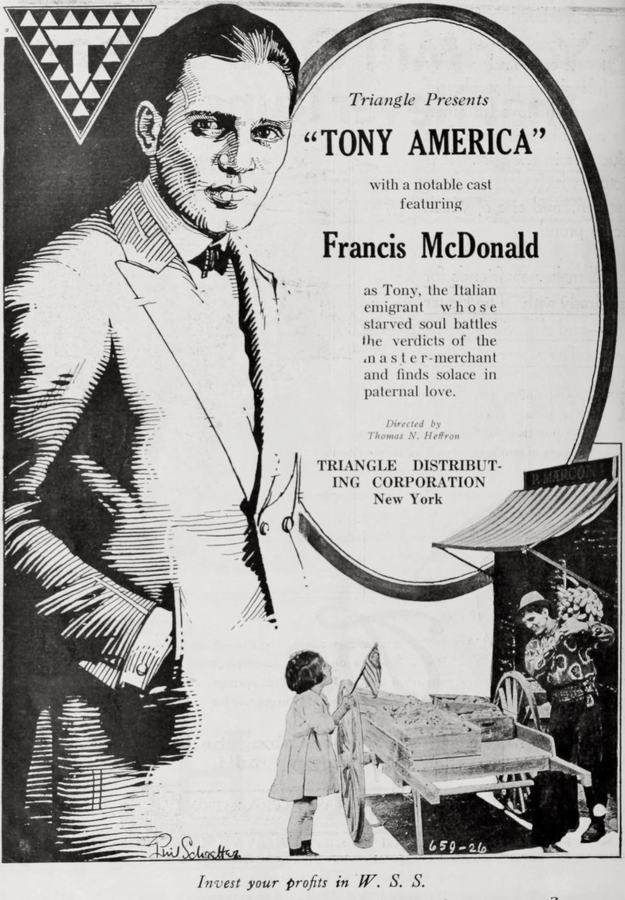
Every third frame of Tony America feels soaked in Atlantic brine; you can almost taste the steerage-class despair crystallizing on the projector bulb. Director William Parke, armed with a scenario by Evelyn Campbell and intertitles sharpened by Doris Schroeder, turns what could have been a dime-novel morality play into a feverish palimpsest of early‐twentieth‐century anxieties—xenophobia, predatory capitalism, and the terrifying moment when matrimony mutinies into marketplace.
The film opens with a shot that modern viewers might misread as expressionistic excess: Tony’s silhouette, back-lit by the dawn glow of an unseen harbor, appears to drag the entire ocean behind him like Marley’s chains. In truth, the effect is practical—Parke simply double-exposed the negative with a slow pan across water—but the symbolism lands so cleanly that you forgive the trick its transparency. We are witnessing not merely an arrival but an indenture, a re-enslavement dressed up as passage.
Dorothy Giraci’s Rosa is introduced in a convent garden, pruning roses while reading a scandalous serialized romance hidden behind a hymnal. One cut later she’s in the cramped Picciano parlor, her parents bartering her virtue for a dowry large enough to secure passage for a cousin. Giraci plays the moment with micro-rebellions: a toe tapping out of frame, a blink held half a second too long. You sense she already sees marriage as a raft; any groom will do, so long as the shore is freedom.
Tony—embodied by Ludwig Lowry with the wary grace of a man forever counting exits—never stands a chance. Their wedding supper is staged like a last supper in miniature: a single bulb swinging over a plank table, wine served in chipped coffee cups, the padrone seated at the head performing grace with the theatrical solemnity of a Mephistopheles. Parke lets the camera linger until the laughter dies and the debtor’s arithmetic becomes the unspoken fourth course.
Here the film pivots from sociological sketch to chamber noir. Rosa’s indifference calcifies into contempt; she flaunts silk stockings purchased with Tony’s blood-money wages. Lowry’s eyes—huge, glassy—reflect every humiliation yet refuse to spill into the histrionic gestures that silent cinema so often mistook for depth. Instead he redirects his yearning toward Giulia, a puck-faced miracle played by four-year-old Marie Pavis, whose on-screen rapport with Lowry is so uncanny projectionists swore the actor took the child home between matinees.
Parke and Campbell stage fatherhood as sacrament and sedition: Tony steals overtime pay to buy a wooden horse, then spends the night carving the child’s name along its flank, whispering lullabies in dialect while Rosa entertain her lover in the next room. The cross-cutting achieves a visceral tension that anticipates Hitchcock’s Man Who Knew Too Much by a dozen years. You feel the moment when love, deprived of any legitimate outlet, becomes clandestine religion.
The divorce trial—engineered via a fabricated assault charge—unfolds in a set that resembles a cathedral stripped for profanity. Shadows of balustrades stripe Rosa’s face like prison bars; the judge’s gavel slams in sync with flashbulbs, prefiguring the tabloid circus that would later devour real-life immigrant scandals. Alice Davenport, as Rosa’s mother, delivers a testimony so venomous Variety allegedly refused to print the entirety of her intertitle quote: “He kissed the child with the same lips that struck my daughter.” Censors in Pennsylvania excised the scene entirely, leaving that print incomprehensible.
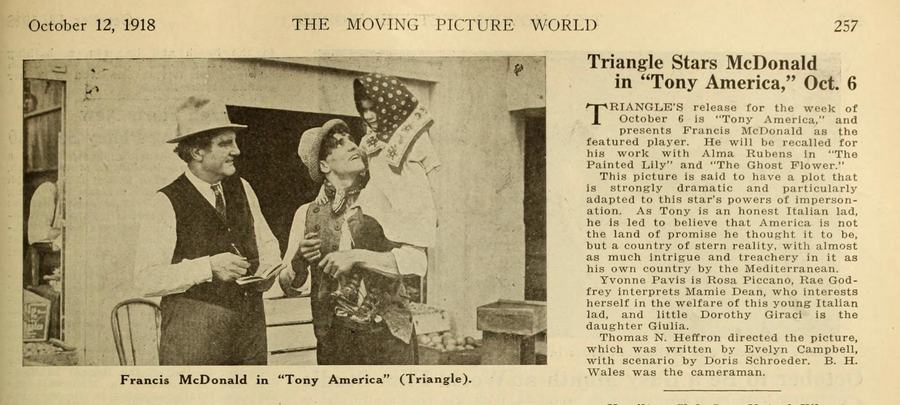
Yet the film’s boldest gambit arrives post-verdict. Tony, now legally “morally unfit,” kidnaps Giulia not by absconding into the night but by walking into the mother’s parlour at teatime, lifting the girl while Rosa watches paralyzed by social propriety. The abduction is framed in a single 90-second take: no music on the surviving MoMA restoration, only the creak of floorboards and the child’s giggle echoing like distant artillery. It is one of the most unsettling sequences I have encountered in silent cinema precisely because it is so gentle.
What follows could have descended into dime-store revenge. Instead, the screenplay engineers a moment of almost unbearable restraint. Rosa, discovering Tony and Giulia in a Lower East Side flophouse, prepares to summon the police. Giulia—still politically voiceless—performs the film’s most radical act: she places her rag-doll between her parents, a mute petition for truce. The gesture stops Rosa as surely as any bullet.
Parke resists both patriarchal fantasy (Tony doesn’t “tame” Rosa) and maternal essentialism (Rosa isn’t suddenly sanctified). The couple’s final parting is negotiated like a business dissolution: shared custody, no alimony, an agreement scrawled on the back of Tony’s naturalization papers. The last shot shows father and daughter on a ferry deck, Manhattan receding, sunrise gilding the harbor—an image echoed decades later in Those Without Sin, though that film swapped innocence for irony.
Ludwig Lowry, a Viennese character actor imported via the 1812 stock company, never broke into major stardom—his accent relegated him to ethnics and villains—but here he achieves the kind of interiority that cameras in 1923 were just learning to register. Watch his hands during the courtroom sequence: they open and close in cycles of prayer and assault, a silent aria of impotent rage.
Dorothy Giraci, usually typed as flapper comic relief in Pretty Mrs. Smith and The Bachelor’s Romance, weaponizes her kewpie-doll visage. She lets the camera discover cruelty in the curl of a smile, then undercuts it with a flicker of self-disgust so brief you wonder if you imagined it. The result is a villainess who never calcifies into caricature; she is the product of systems rather than archetypes.
Among the supporting cast, Francis McDonald as the padrone deserves special mention. He plays the role like a Wall Street harvest-god in spats, swirling brandy while reciting accounts receivable as if they were psalms. His final comeuppance—stripped of citizenship and led away by federal agents—was added after pressure from immigrant aid groups, yet Parke shoots it with such perfunctory triumph that you sense the director’s heart isn’t in retribution.
Cinematographer Harold Rosson (future lenser on The Wizard of Oz) employs chiaroscuro so tactile you feel you could strike matches on the shadows. Tenement walls bleed grime; courtroom pillars gleam like tombstones. For the dream sequence—Tony imagines Giulia adrift on an inverted American flag—Rosson bleached select frames then re-tinted them amber, creating a negative-afterglow that anticipates the solarized nightmares in De lefvande dödas klubb.
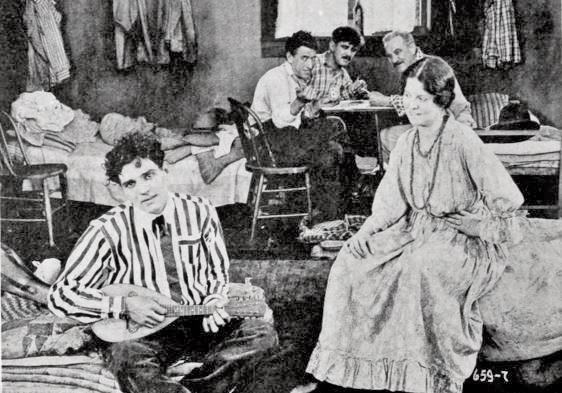
Meanwhile, the editing rhythms flirt with Soviet-style montage without abandoning classical continuity. Note the immigration-hall montage: boots ascending gangways, steam whistles, officials stamping papers—each shot lasts exactly four frames fewer than the previous, generating an accelerando that mirrors Tony’s heartbeat. It’s the sort of kinetic sophistication historians more readily ascribe to Eisenstein, yet here it is, nestling anonymously inside a Poverty Row potboiler.
Viewed today, the film vibrates with uncomfortable resonance: debates about anchor babies, mail-order brides, the weaponization of family courts. Rosa’s manipulation of domestic-violence statutes feels chillingly contemporary, and the screenplay’s refusal to brand her absolute villain anticipates the moral murk of Alma de sacrificio. Conversely, Tony’s stoic endurance skirts the martyr complex that plagues immigrant narratives from Burning the Candle to Father John; or, The Ragpicker of Paris.
Some feminist critics have argued the film punishes Rosa’s sexual autonomy. I’d counter that the text indicts the structures that equate womanhood with transaction; Rosa’s tragedy is that she can imagine freedom only through leverage, never through solidarity. Her final concession—shared custody—reads less maternal awakening than strategic retreat, and the film offers no assurances she won’t weaponize Giulia again.
For decades Tony America languished on the Library of Congress’s “7” list—films known only via copyright deposits. Then, in 2018, a 35mm nitrate positive surfaced in the decommissioned monastery of San Diego’s Mission Basilica, mislabeled as In the Stretch. The reel-to-reel smelled of almonds and incense; lab technicians joked about exorcism. Restoration by the Academy Film Archive yielded a 2K scan, though two sequences remain truncated: the padrone’s flogging of Tony (censored by New York’s Board of Rating) and a brief tableau of Rosa bathing Giulia, deemed too suggestive for 1923 Kansas City.
The current restoration tours with a new score by Ana Ɖorđević, performed on accordion, prepared piano, and sampled ship engines. Critics at Pordenone likened it to “watching someone else’s memories through salt-stained glass,” a description so apt I resisted the urge to top it.
Masterpiece-adjacent. Parke’s film marries social exposé to proto-noir aesthetics, yielding a work that feels simultaneously of its age and outside any epoch. Its insights into debt peonage remain startlingly relevant; its emotional heft rests on performances of such granular honesty they transcend the mugging conventions of early silent melodrama. If third-act pacing wobbles—thanks to studio-demanded moralizing—the film rights itself in a finale whose mercy feels earned rather than imposed.
For cinephiles tracking the genealogy of immigrant narratives, Tony America demands placement alongside The Pool of Flame and The Runaway. For silent-era aficionados, it offers a Rosetta Stone for how much psychological nuance could be smuggled past studio censors under the guise of moral instruction.
Seek it out whenever the archive carousel brings it near. Bring tissues, but more importantly, bring questions: about borders, bodies, and the price we still extract for the audacity of arrival.
IMDb 6.5
1923
Community
Log in to comment.