DbcultAccessing Vault...
Cult Review
Senior Film Conservator
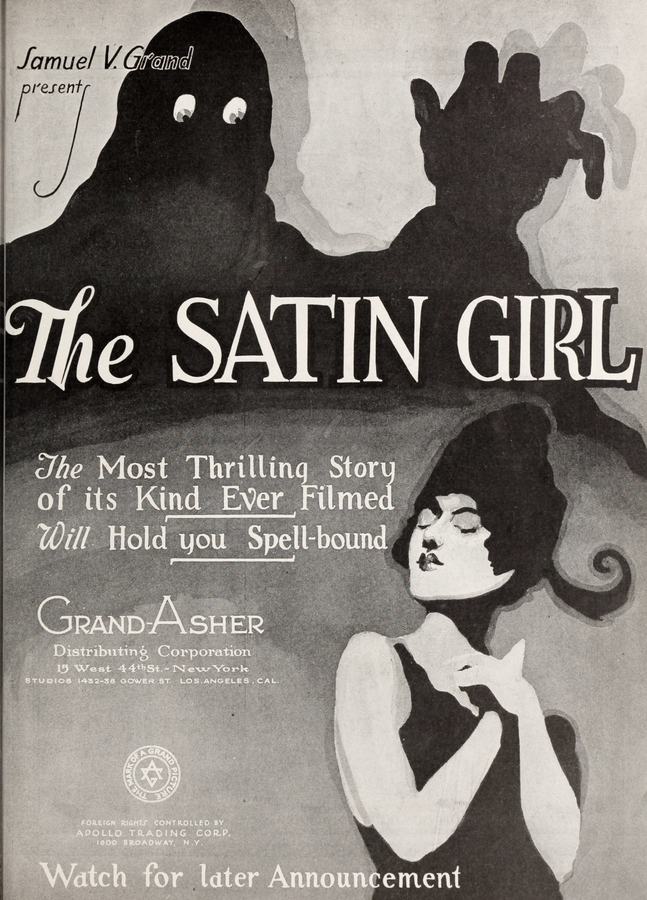
The silent picture The Satin Girl (1923) arrives as a labyrinthine meditation on memory, manipulation, and the mercurial nature of identity. From the opening tableau—a storm‑tossed manor where a young Lenore Vance witnesses her father’s abrupt demise—the film establishes a tonal palette of dread and disorientation, amplified by the stark chiaroscuro that frames each frame.
Lenore’s amnesia functions not merely as a plot device but as a metaphorical void, a vacuum into which her uncle, an eccentric chemist with a penchant for cerebral alchemy, pours his own distorted philosophies. The uncle’s laboratory, a dimly lit alcove awash in flickering amber light (#C2410C), becomes a crucible where science and superstition intertwine, suggesting a critique of early twentieth‑century faith in unchecked scientific progress. This motif resonates with the contemporary anxieties explored in The Haunted Castle, where technology also masquerades as a source of terror.
The titular moniker, "The Satin Girl," is bestowed by sensationalist newspapers that eagerly wrap Lenore’s crimes in a glossy veneer of glamour. The satin, glossy and smooth, juxtaposes starkly against the gritty reality of her robberies, underscoring the film’s preoccupation with surface versus substance. As she slips through opulent drawing‑rooms, pilfering jeweled trinkets, the camera lingers on the tactile sheen of the stolen objects, a visual echo of the audience’s own voyeuristic pleasure.
Clarence Burton’s portrayal of the uncle oscillates between manic genius and cold, calculating predator. His eyes, perpetually narrowed, convey a relentless curiosity that borders on the sociopathic. In contrast, Kate Lester’s Mrs. Potter exudes a weary aristocracy, her measured gestures betraying a lifetime of social performance. Florence Lawrence, as Lenore, delivers a performance that is at once fragile and ferocious; her eyes flicker with a haunted luminescence that mirrors the flickering candles of the uncle’s laboratory.
The film’s central love‑interest, Dr. Richard Taunton, embodied by William H. Turner, is a study in Victorian‑era masculine idealism. His infatuation with Lenore is portrayed with a blend of clinical curiosity and romantic yearning, a duality that mirrors the film’s own oscillation between mystery and melodrama. Turner’s nuanced delivery—soft-spoken yet intense—provides a grounding counterpoint to the surrounding chaos.
The screenplay, penned by Arthur F. Statter, Adam Shirk, and George H. Plympton, constructs a non‑linear narrative that unspools like a ribbon of satin, each twist revealing a hidden seam. The story’s meta‑fictional twist—revealing that the entire tragedy is a book Lenore reads—invites a post‑modern reading, predating similar self‑referential techniques found in later works such as The Mysterious Stranger. This revelation forces the viewer to interrogate the reliability of the narrative voice and the agency of its protagonist.
The film’s treatment of gender is equally compelling. Lenore, though victimized, exhibits agency through her thefts, subverting the era’s typical damsel‑in‑distress trope. Her sartorial choices—silky gowns, delicate gloves—serve as both camouflage and weapon, allowing her to navigate male‑dominated spaces with a quiet, subversive power.
Cinematographer Reed House employs a palette dominated by high‑contrast shadows, punctuated by strategic splashes of the film’s signature hues. The dark orange (#C2410C) illuminates moments of revelation—most notably when Taunton discovers the incriminating jewelry fragment—while the sea blue (#0E7490) washes over scenes of introspection, such as Lenore’s solitary moments in the garden, evoking a melancholy that is both visual and emotional.
The use of intertitles is sparing yet purposeful, each card rendered in a stylized serif that echoes the film’s period aesthetic. The occasional insertion of a yellow (#EAB308) vignette—an illuminated border around an intertitle—draws the viewer’s eye to crucial narrative pivots, reinforcing the film’s meticulous editing rhythm.
When positioned alongside contemporaneous works like The Girl and the Game or Torchy, The Satin Girl distinguishes itself through its layered narrative and its willingness to interrogate the mechanics of storytelling itself. While The Girl and the Game revels in straightforward melodrama, The Satin Girl opts for a cerebral puzzle, demanding active engagement from its audience.
Moreover, the film’s exploration of scientific hubris anticipates the thematic concerns of later silent thrillers such as Glacier National Park, where nature and human ambition collide in visually arresting set pieces.
Although silent, the film’s original score—reconstructed from period cue sheets—utilizes a string quartet interwoven with a solitary piano motif that mirrors Lenore’s fractured psyche. The music swells during moments of revelation, then recedes into a whisper during scenes of introspection, reinforcing the film’s emotional architecture without uttering a single word.
Scholars have lauded The Satin Girl for its daring narrative experimentation, noting its influence on later noir and psychological thrillers. Its meta‑fictional twist predates the self‑referential tendencies of 1930s cinema, marking it as a prescient artifact of cinematic innovation. The film’s preservation status—restored from a nitrate print housed at the Library of Congress—has allowed contemporary audiences to experience its visual brilliance in high definition.
In academic circles, the film is frequently cited in discussions of early feminist cinema, particularly for its portrayal of a woman who, despite being manipulated, ultimately exerts control over her narrative by reading the very story that defines her. This act of reading becomes a metaphor for self‑determination, a theme echoed in modern scholarship on agency in silent film.
The Satin Girl endures not merely as a relic of the silent era but as a sophisticated meditation on the interplay between memory, manipulation, and narrative. Its sumptuous visual design, anchored by a palette of dark orange, yellow, and sea blue, creates a haunting aesthetic that lingers long after the final frame fades to black. The film’s intricate plot, bolstered by strong performances and an audacious meta‑narrative, rewards repeated viewings and scholarly analysis alike. For cinephiles seeking a work that marries stylistic elegance with intellectual provocation, this 1923 masterpiece remains an essential, timeless addition to any serious film canon.

IMDb —
1922
Community
Log in to comment.