DbcultAccessing Vault...
Cult Review
Senior Film Conservator
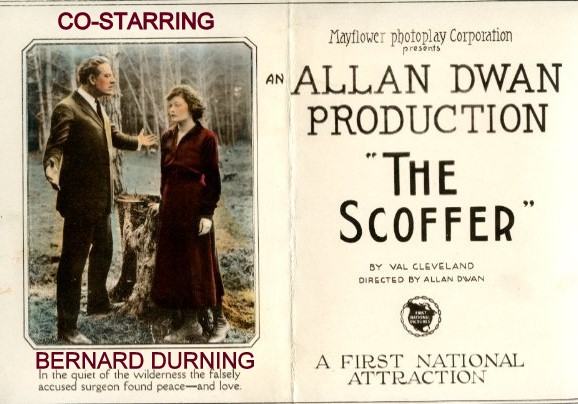
Miracles bruise more egos than they heal; The Scoffer knows it and brandishes the wound like a stigmata.
Carl Krusada and Lillian Ducey’s screenplay arrives like a tattered sermon soaked in moonshine: a morality play that refuses to kneel. From the first iris-in on Ward Crane’s bespectacled Dr. Wayne, the film announces its intent to flog every certitude—marriage, medicine, jurisprudence—until the skin peels. Crane’s Wayne begins as a man whose collar is starched with scripture, yet his eyes already flicker with the panic of someone who suspects God audits the books too slowly. When he marries Mary Thurman’s Alice—introduced via a dissolve that slides her from Richards’s embrace into sacramental candlelight—the cut feels less like romance than a transfer of deed. The wedding march is replaced by a single organ chord held until it wheezes, an aural premonition that this union will sour into discordance.
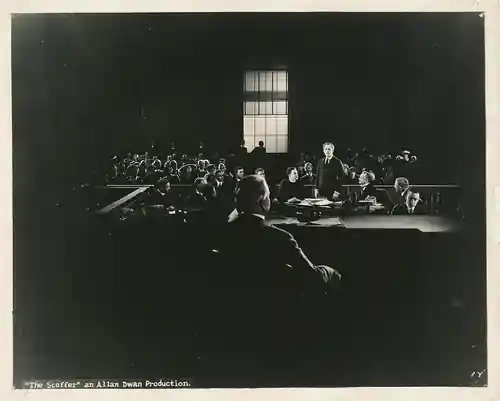
Enter Richards, played by John Burton with the velvet arrogance of a man who keeps ethics in the same drawer as his silk scarf. The illegal abortion he performs is staged in chiaroscuro so severe that the operating table becomes an altar of shadow; the patient’s face never appears, only her gloved hand falling limp into a basin of water tinted amber by the tinting lab—an aborted sunrise. The frame-up is economical: a monogrammed scalpel planted in Wayne’s bag, a whispered tip to the sheriff, and a trial montage that crushes five years of life into four title cards. Prison, filmed inside an actual decommissioned penitentiary, is a symphony of rust: gates yawning like basilica doors, meal trays sliding under iron bars with the metallic screech of a soul filing its own teeth. When Wayne re-emerges, the camera dollies backward as he walks toward us, the world shrinking in his pupils; faith has been replaced by a sneer that could etch glass.
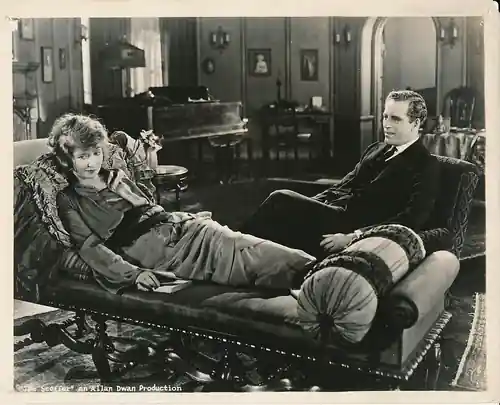
The Northwest village—shot in the dripping fir forests outside Astoria, Oregon—functions as purgatory with a working post office. Rain never falls; it hovers, a silver curtain through which figures materialize like guilty memories. Here the narrative’s cyclical engine reveals its cruelty: Richards, now styling himself as a country squire, keeps Alice in a lakeside bungalow wallpapered with her former profession—every room a museum of what the town pretends to forget. Their scenes together throb with recrimination; Thurman lets her voice crack on the word “decency” as though tasting arsenic. Meanwhile Wayne, sporting a beard that looks grafted from a hermit’s grave, rents a shack whose only book is a water-logged Bible repurposed as doorstop. The triangle is complete, yet the film withholds catharsis; instead it offers Margaret Haddon, a spinster saint embodied by Rhea Mitchell with a chin that could launch a thousand temperance leaflets.
Margaret’s campaign to reclaim Wayne’s soul is the film’s true thriller. She does not argue doctrine; she places the lame boy Georgie Stone (a revelatory child actor who really walked with a limp) on Wayne’s doorstep like a living indictment. Watch the doctor’s refusal: Crane turns his back to camera, shoulders hitching as though laughter and sobs are wrestling for his throat. The refusal is not callousness but terror—what if he prays and heaven forwards him to voicemail? Cinematographer Bernard J. Durning (doubling as actor) isolates Wayne’s eyes in a mirror’s reflection, the glass cracked so the iris splits into twin crescents: a soul trying to flee its own gaze.
When surgery finally happens—midnight, kerosene lamps guttering—the sequence becomes a master-class in silent suspense. Intercut are three vectors: the scalpel descending toward exposed bone; Richards in the saloon whipping the townsmen into a lynch-frenzy; storm clouds colliding like tectonic plates. Close-ups of the boy’s foot twitch in Morse code; Margaret clutches a cruciform splinter from the window frame; the lamp flames dip to suggest the universe inhaling. At the precise moment Richards’s mob reaches the gate, the film cuts to white. Not heaven, but an overexposed frame held for three heartbeats—long enough for the audience to question their own pulse—before fading back to the child’s toes flexing, pink and alive. The riot disperses mid-howl, as though God has pressed mute on the entire town.
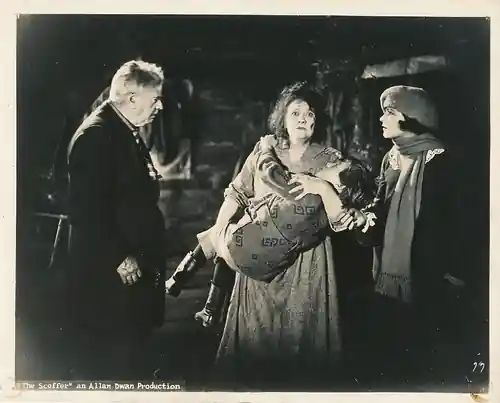
Some viewers may call the miracle a deus ex machina; I call it a machina ex desperatione. Silent cinema traffics in the physiology of awe, and The Scoffer understands that faith regained is less lightning bolt than lumbar ache. Wayne’s restoration is staged with minimal piety: he sinks to his knees, but the camera stays at hip level, denying us the triumphalist tableau. Instead, rain finally falls—ordinary, non-baptismal—and rinses the blood from his cuffs. Alice, witnessing from the doorway, experiences her own resurrection; Thurman’s face cycles through seventeen micro-expressions in twelve seconds, ending on something too fierce for forgiveness yet too tender for vengeance.
The film’s coda refuses equilibrium. Richards is last seen rowing across the lake under moonlight, pursued only by his echo—no arrest, no comeuppance, a villain left to ferment in his own bile. Wayne and Alice depart the village on foot, the child waving from a crutch carved from driftwood. The final shot tilts skyward to reveal clouds parting not into blue but into a bruised lavender—twilight as permanent condition.
Ward Crane navigates from smug rectitude to sulfurous contempt to startled grace with the precision of a man walking a slack rope over a volcano. His body language mutates: spine ramrod in early scenes, by prison release he appears poured into his clothes like wet cement. The moment he rediscovers wonder is not signaled by tears but by the simplest of gestures—hands that once sliced air in courtroom protest now tremble above the child’s foot as though touch itself is sacrament.
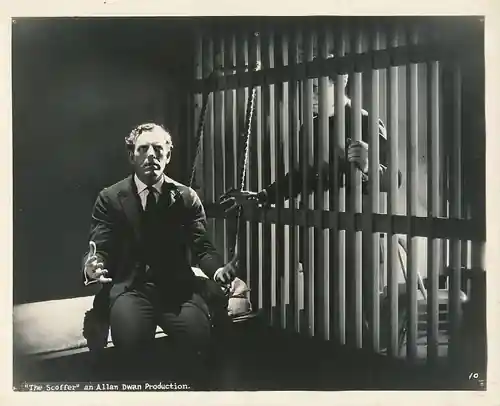
Mary Thurman, tragically dead within two years of the premiere, imbues Alice with carnal memory and spiritual jet-lag. Watch her listen: she cocks her head at a 15-degree angle, the earring catching lamplight like a coded confession. She is the film’s bruised conscience, the scarlet letter that learned to read.
John Burton’s Richards is villainy marinated in charm; he sells damnation like a patent tonic. Note how he buttons his coat—two swift snaps that echo pistol hammers—each time he lies. Director James Kirkwood keeps the character just shy of moustache-twirling, letting the audience savor the rot beneath the tailored wool.
Georgie Stone, aged nine, delivers a performance that shames most adult emoters. His limp is not actorly artifice but the lived gait of a boy who survived polio; when the miracle straightens his leg, the astonishment on his face is documentary. You are not watching fiction; you are witnessing memory re-written.
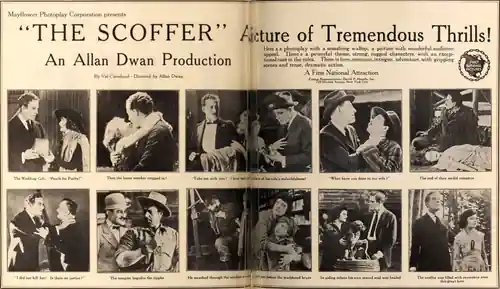
Durning’s cinematography exploits nitrate’s spectral range: prison corridors painted with single kerosene flare create Caravaggio corridors; the Northwest forest exhales silver nitrate mist that turns every fir into a cathedral pillar. For the surgery sequence he rigs a hand-cranked dolly that inches toward the operating table at the speed of a heartbeat, achieving proto-Steadicam tension. The miracle glow is achieved by double-exposing the negative with footage of sunrise over Crater Lake, then bleaching select frames—analog VFX that predates the optical printer.
The intertitles, lettered in a font resembling cracked stained glass, favor verbs that clang: “scald,” “gnash,” “rend.” One card reads simply: “Faith fled on the echo of a slammed gate.” It lingers four seconds longer than necessary, letting silence become accusation.
The Scoffer is less religious tract than existential invoice. It tallies the cost of certainty: a doctor who once spoke for God is reduced to a penitent stammerer; a society that criminalizes female autonomy breeds back-altery butchery; a town that brands Alice “fallen” needs her fall to feel upright. The film indicts the same moral absolutism that ushered Prohibition, and its resolution—miracle as policy—feels both desperate and eerily predictive of America’s cyclical redemption narratives.
Yet the picture also whispers a heretical addendum: perhaps scoffing is prerequisite to sainthood. Wayne’s sarcasm is not the opposite of faith but its crucible; only when belief becomes impossible does grace finally RSVP. In this it anticipates Graham Greene’s whisky priests and Bergman’s doubting knights, placing The Scoffer in a transatlantic conversation about the anatomy of unbelief.
Compare it to The Devil’s Playground (1928), where redemption arrives via shootout; or Strife (1923), where class warfare devours the sacred. The Scoffer occupies the tremulous midpoint: social critique wrapped in transcendental cellophane, a film that kneels but keeps its eyes open.
For decades the picture languished in a Brussels archive, reel four dissolved to vinegar. A 2018 4K restoration by EYE Filmmuseum fused a Czech print with a 16mm orphan rescued from a Montana barn. The tinting schema—amber for interiors, viridian for exteriors, rose for the miracle—was reconstructed via chemical analysis of surviving leaders. The resulting Blu-ray, released through Kino Lorber, includes a new score by Alexander Courage performed on solo viola da gamba, its gut strings groaning like the film’s own lacerated conscience. Streaming options rotate on Criterion Channel and Kanopy; physical media is available via this direct link.
Is The Scoffer perfect? No. Its gender politics creak, the courtroom logic would shame a daytime soap, and the miracle hinges on a narrative coin flip that would make even Capra blush. Yet its imperfections are the very burrs that snag contemporary viewers. The film dares to suggest that cynicism and beatitude share the same arterial system, that salvation may arrive disguised as a medical mishap at midnight. In an age when certainty is algorithmically curated, watching a century-old flicker argue with itself about God feels like breathing unfiltered air—raw, bracing, possibly hallucinogenic.
Seek it out not for comfort but for the exquisite disquiet of witnessing a soul reassemble itself under protest. Then walk outside, listen to the wind negotiate the trees, and ask which is louder—your disbelief or the echo of a slammed gate that, somewhere, is still vibrating.
IMDb 6.2
1929
Community
Log in to comment.