DbcultAccessing Vault...
Cult Review
Senior Film Conservator
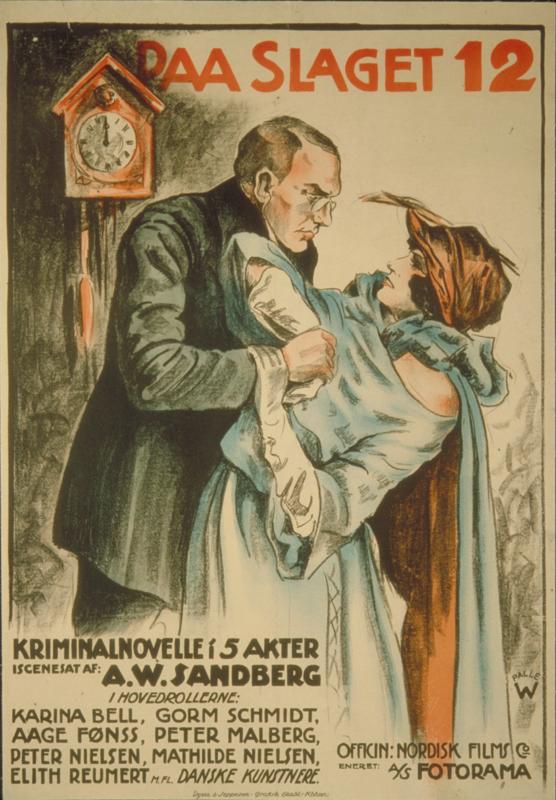
The flickering shadows of early cinema often birthed narratives of profound simplicity, yet their capacity for psychological depth and gripping suspense remains undiminished. Such is the case with Paa slaget 12 (At the Stroke of 12), a Danish silent film that, despite its vintage, delivers a meticulously crafted murder mystery imbued with an atmospheric tension rarely achieved even in contemporary thrillers. This cinematic gem plunges its audience into a world where an ordinary man's quiet life is irrevocably shattered by an unforeseen intrusion, demonstrating that true terror often stems from the mundane suddenly turned monstrous. It's a testament to the power of visual storytelling, where every gesture, every lingering gaze, every sudden movement carries the weight of unspoken dialogue.
The narrative of Paa slaget 12 commences with an understated elegance, introducing us to a parish clerk, a figure of quiet routine and civic responsibility. His nocturnal peace is shattered by a telephone call — a seemingly innocuous act transformed into a harbinger of dread. The voice on the other end is that of a woman, her pleas for help escalating into a bloodcurdling scream, punctuated by the chilling finality of gunshots. This sequence, devoid of spoken words, relies entirely on the visceral power of sound (as imagined by the viewer) and the potent reactions of the protagonist, drawing the audience into an immediate, palpable sense of alarm. What begins as a disembodied voice becomes a haunting imperative, compelling our unassuming hero to abandon his comfort and confront the unknown. The film masterfully builds this initial tension, ensuring that the audience feels every tremor of the clerk's growing apprehension and nascent determination.
The brilliance of this setup lies in its simplicity. There are no elaborate preambles, no convoluted subplots to navigate before the central conflict takes hold. Instead, we are thrust directly into the heart of the mystery, experiencing the unfolding horror alongside the protagonist. This immediate immersion is a hallmark of effective silent cinema, where narrative economy and visual impact are paramount. The film posits a compelling question: what would you do when confronted with an undeniable cry for help, even if it meant venturing into the darkest corners of human depravity? Our parish clerk, portrayed with a nuanced blend of trepidation and burgeoning resolve, embodies the everyday hero thrust into extraordinary circumstances. His journey from startled listener to active investigator is the engine of the plot, propelling us through a series of revelations and red herrings.
The strength of Paa slaget 12 lies not only in its taut narrative, ingeniously conceived by writer Aage Falck-Rasmussen, but also in the compelling performances that breathe life into its characters. In an era where dialogue was absent, actors had to convey entire emotional landscapes through gesture, facial expression, and physical presence. Elith Reumert, in particular, delivers a captivating performance as the unwitting investigator, his every movement conveying the weight of his predicament. His initial bewilderment, the slow dawning of horror, and the eventual, determined pursuit of truth are beautifully articulated without a single spoken word. One can almost feel his heart pounding as he steps out into the unknown, a solitary figure against the backdrop of a sleeping city now awakened to violence.
The ensemble cast further enriches the film's tapestry. Mathilde Nielsen, a formidable presence in early Danish cinema, commands attention with her nuanced portrayal, adding layers of gravitas and perhaps a touch of tragic weariness to her role. Her ability to communicate complex emotions with subtle shifts in expression is a masterclass in silent acting. Similarly, Peter Malberg, often known for his comedic roles, here demonstrates a versatility that underscores the film's dramatic intensity, proving his mettle in a more serious vein. The supporting players, including Peter Nielsen, Lauritz Olsen, Hjalmar Schønfeld, Karina Bell, Aage Fønss, Gorm Schmidt, and Clara Schønfeld, each contribute to the film's authenticity, creating a believable world fraught with peril and human frailty. Their collective efforts ensure that even the briefest appearances leave a lasting impression, adding to the intricate web of suspicion and intrigue.
Cinematically, Paa slaget 12 is a marvel of its time. The use of light and shadow is particularly effective, creating an atmosphere that is both ominous and deeply immersive. The dimly lit streets, the stark interiors, and the dramatic close-ups all contribute to a sense of claustrophobia and impending danger. The camera work, though perhaps less overtly dynamic than later periods, is nonetheless purposeful, guiding the viewer's eye with precision, highlighting crucial details, and emphasizing the emotional states of the characters. The pacing, too, is expertly managed; moments of frantic action are interspersed with periods of eerie stillness, allowing the tension to simmer and build, mirroring the protagonist's own internal struggle. The visual lexicon of the film speaks volumes, proving that a picture truly is worth a thousand words, especially when those pictures are imbued with such deliberate artistic intent. One cannot help but be drawn into the visual narrative, deciphering the silent cues and piecing together the grim puzzle.
The film's aesthetic choices are not merely stylistic flourishes; they are integral to the storytelling. The stark contrast between the domestic quietude of the clerk's home and the brutal reality he encounters outside creates a powerful visual metaphor for the disruption of order. The unfolding investigation takes him through various strata of society, each depicted with a keen eye for detail, adding to the film's verisimilitude. The director's ability to maintain a consistent tone of suspense throughout, without resorting to cheap scares, is commendable. Instead, the dread is a slow burn, a creeping realization of the depravity lurking beneath the surface of everyday life. This thoughtful approach distinguishes Paa slaget 12 as more than just a genre piece; it's a profound exploration of human vulnerability and the unexpected courage that can arise from it.
Comparing this film to others of its era, one might draw parallels to the atmospheric tension of early German Expressionism or the nascent detective thrillers emerging from other European studios. While not as overtly stylized as something like Rhythmus 23, which pushed boundaries in abstract form, Paa slaget 12 shares a thematic undercurrent with films that explored the darker psychological landscapes of the human condition. Its meticulous unraveling of a crime might remind one of the intricate plots found in Madame Spy, though the Danish film grounds its mystery in a more localized, personal tragedy rather than international intrigue. The film also subtly echoes the existential dread found in works like Remorse, a Story of the Red Plague, not in its apocalyptic scope, but in the sudden, inexplicable intrusion of violence into an otherwise orderly world, forcing characters to confront their mortality and morality. The sense of a world turned upside down, of an individual battling forces beyond their control, is a powerful through-line in these disparate yet thematically linked early cinematic efforts. The raw emotion conveyed by the actors, particularly Elith Reumert and Mathilde Nielsen, in confronting these profound challenges, resonates with the universal struggle against chaos and despair.
Furthermore, the film's depiction of an unexpected hero, an ordinary citizen thrust into extraordinary circumstances, is a narrative trope that has resonated throughout cinematic history, from the silent era to modern blockbusters. It speaks to a fundamental human desire to believe in the capacity for good, even in the face of overwhelming evil. The parish clerk's transformation from a passive recipient of distress to an active agent of justice is both inspiring and deeply human. He is not a hardened detective or a seasoned adventurer; he is simply a man who cannot ignore a cry for help, a man whose conscience propels him forward into danger. This relatable aspect of his character makes his journey all the more compelling and his eventual triumph, or indeed his struggle, all the more poignant. The narrative avoids excessive melodrama, opting instead for a grounded, almost journalistic approach to its unfolding mystery, allowing the audience to feel as if they are discovering the truth alongside the protagonist.
Paa slaget 12 stands as a commendable example of early Danish cinema's ability to craft intricate and engaging stories. It's a film that, despite its lack of spoken dialogue, communicates volumes through its visual language, its atmospheric setting, and the powerful performances of its cast. It serves as a vital historical document, showcasing the evolving techniques of filmmaking in the silent era, particularly in the realm of suspense and psychological drama. For enthusiasts of classic cinema and aficionados of the murder mystery genre, this film offers a fascinating glimpse into the foundations upon which countless thrillers would later be built. It proves that the essence of a compelling narrative transcends technological limitations, relying instead on the universal language of human emotion and the timeless allure of a well-told story.
The film's enduring quality lies in its capacity to still generate genuine suspense and intrigue. Even with the passage of decades, the core elements of the story – the unexpected phone call, the desperate plea, the chilling gunshots, and the subsequent investigation – retain their power. It’s a reminder that truly effective storytelling often comes from simple, yet profoundly impactful, narrative hooks. The sense of an ordinary world disrupted by extraordinary evil is a theme that continues to resonate, making Paa slaget 12 a film worthy of rediscovery and appreciation. Its place in the pantheon of early mystery films is well-deserved, offering a masterclass in how to build tension and deliver a satisfying resolution without uttering a single word. It is a cinematic experience that proves the silent era was far from silent in its emotional and dramatic impact, echoing with the screams and whispers of a forgotten crime.
IMDb 6.1
1918
Community
Log in to comment.