A definitive 3.6/10 rating for a film that redefined the boundaries of cult cinema. The Scrappin' Kid remains a cornerstone of transgressive art.
Is 'The Scrappin' Kid' a film worth unearthing from the silent era's vast archives today? The short answer is yes, but with significant caveats that demand a specific viewing palate. This film is unequivocally for dedicated aficionados of early Westerns, silent cinema historians, and those with a keen interest in the foundational elements of the genre. It is decidedly not for casual viewers seeking modern narrative sophistication, high-octane action, or a challenge to contemporary cinematic sensibilities.
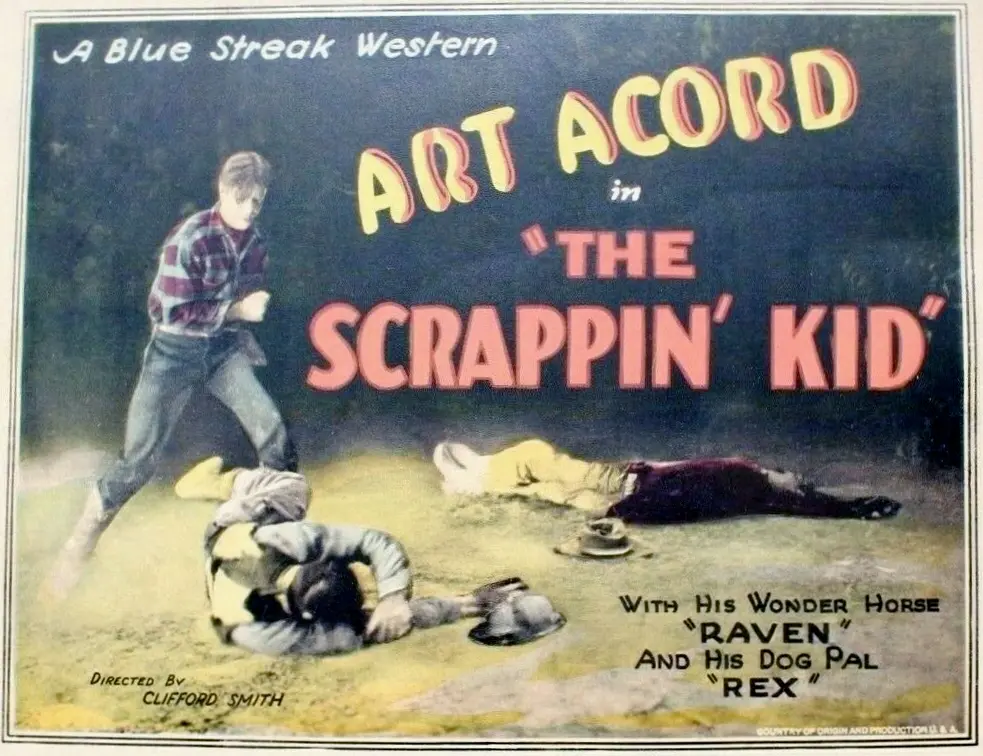
This 1926 production, starring Edmund Cobb and the incredibly capable Rex the Dog, offers a fascinating, if rudimentary, glimpse into the nascent stages of a genre that would come to define American cinema. It’s a historical artifact as much as it is a piece of entertainment, reflecting the storytelling conventions and technical limitations of its time with earnest simplicity.
This film works because… it offers a remarkably clear snapshot of early Western tropes, showcasing the genre's nascent morality plays and the reliance on animal actors to drive critical plot points. Its straightforward narrative, while simple, is effective.
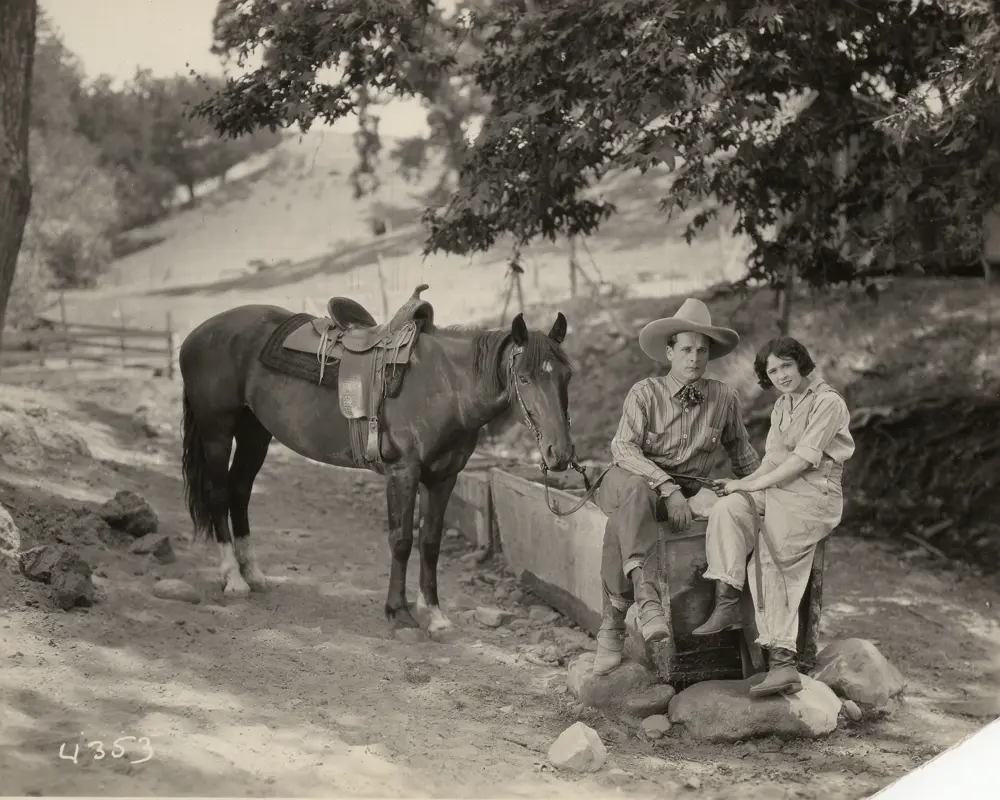
Scene from The Scrappin' Kid
Cinematic perspective: Exploring the visual vocabulary of The Scrappin' Kid (1926) through its definitive frames.
This film fails because… its narrative simplicity often borders on predictability, and the technical limitations of its era, while understandable, can test the patience of modern audiences accustomed to more dynamic filmmaking. Character development is minimal, relying heavily on archetypes.
You should watch it if… you want to understand the roots of the Western, appreciate the raw charm of silent filmmaking, or simply enjoy a straightforward tale of frontier justice and loyalty where the hero's canine companion is as crucial as any human performance.
A Glimpse into the Genesis of the Western
'The Scrappin' Kid' is a distillation of early Western mythology, presenting a world of clear-cut good and evil, where justice is swift and personal. Richard Schayer's screenplay, while not groundbreaking, is a textbook example of how these foundational stories were constructed. We have the benevolent rancher, Bill Bradley, whose initial act of charity sets the entire plot in motion. This immediate establishment of his moral compass is crucial in a silent film, where character traits must be conveyed through action and expression rather than dialogue.
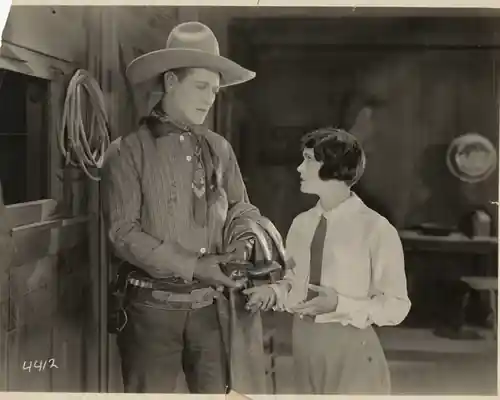
Scene from The Scrappin' Kid
Cinematic perspective: Exploring the visual vocabulary of The Scrappin' Kid (1926) through its definitive frames.
The plot centers on familiar motifs: the orphaned innocents, the meddling town gossips, the ruthless outlaws, and the hero's unwavering pursuit of vengeance and rescue. There's a certain purity to this narrative, unburdened by the moral ambiguities or psychological complexities that would later define the genre's golden age. It's a fable of the frontier, where virtue is rewarded and villainy is punished without exception.
Comparing it to later, more nuanced Westerns, say, a John Ford epic, feels almost unfair. 'The Scrappin' Kid' operates on a much simpler, more primal level. It’s less about exploring the soul of the West and more about enacting its foundational principles. The struggle is external, visceral. The landscape itself, often shot in wide, static frames, reinforces this sense of raw, untamed nature, a stark backdrop for human drama.
One could argue that the film’s very predictability is its strength in a historical context. It shows us what audiences expected from a Western in the 1920s: a clear hero, a damsel in distress, a chase, and a triumphant resolution. There’s no subversion of tropes here; rather, it’s an affirmation of them. It's a foundational text, not a cinematic revolution. Its simplicity is both its greatest asset and its most significant limitation for contemporary viewers.
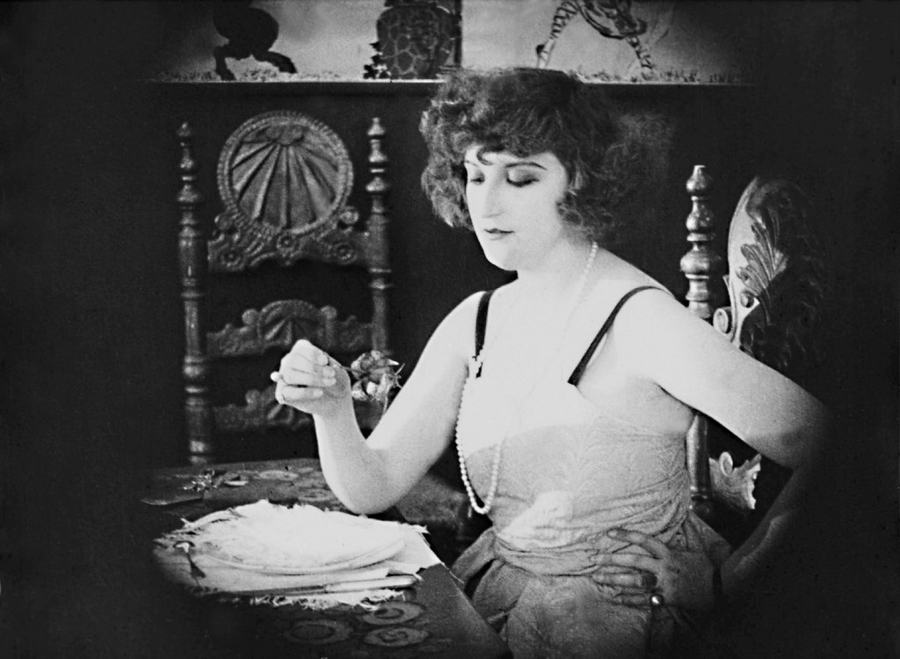
Scene from The Scrappin' Kid
Cinematic perspective: Exploring the visual vocabulary of The Scrappin' Kid (1926) through its definitive frames.
Performances: Man, Beast, and Archetype
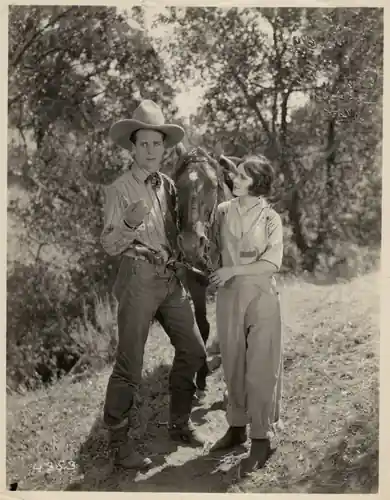
In silent cinema, acting is a physical art, and 'The Scrappin' Kid' provides ample evidence of this. Edmund Cobb as Bill Bradley delivers a performance rooted in stoicism and physical resolve. He isn't given to grand gestures or overt emotional displays. Instead, his character's strength is conveyed through his posture, his determined stride, and the unwavering gaze he directs at his adversaries. His portrayal is less about internal conflict and more about embodying the steadfast, honorable cowboy archetype. When he discovers Betty's abduction, the sudden stiffening of his frame, the clenching of his jaw, speaks volumes without a single intertitle needed to explain his fury.
However, the true standout performance, and perhaps the most memorable aspect of the film, comes from Rex the Dog. Rex is not merely a prop; he is an active participant in the narrative, a genuine co-star. His trained actions, particularly the scene where he carries a message to the sheriff, are remarkably sophisticated and utterly convincing. Rex’s intelligence and loyalty are not just told; they are shown with impressive clarity, making him the emotional anchor for much of the film’s middle act. It's a testament to animal training in early Hollywood that Rex's contribution feels so integral and so genuinely impactful. He conveys urgency and purpose with a clarity that many human actors of the era struggled to achieve.
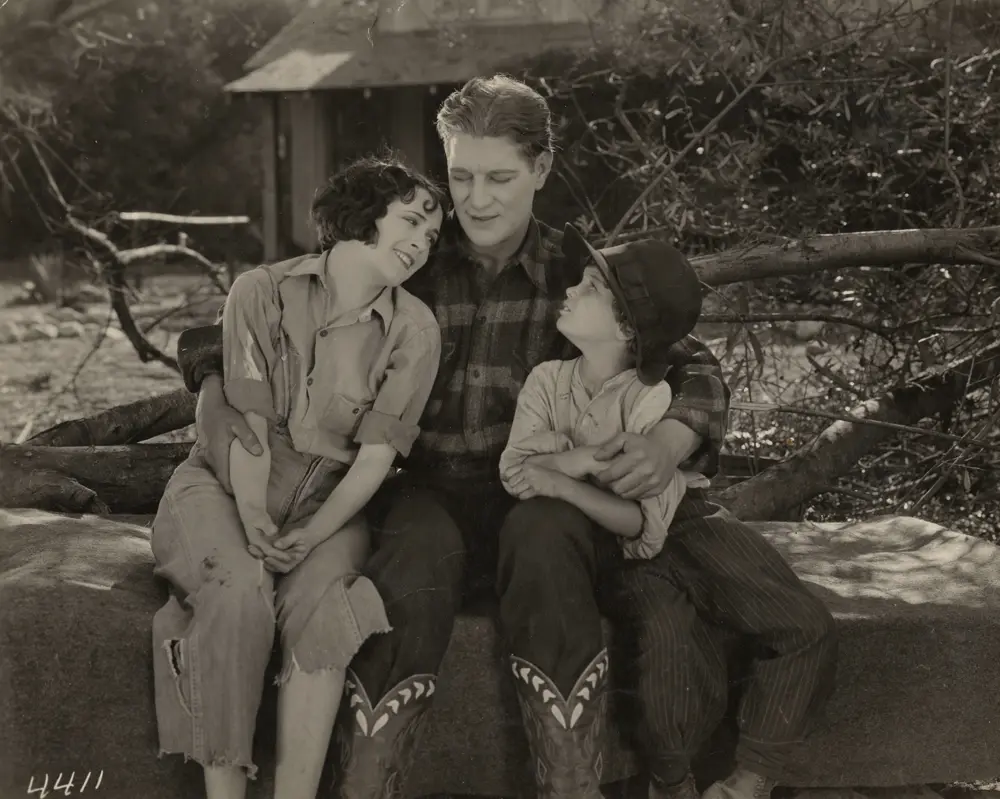
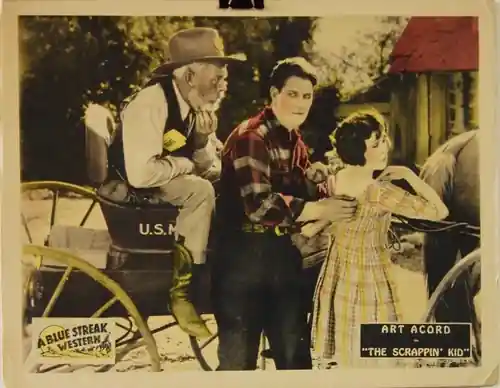
Velma Connor as Betty Brent fills the role of the damsel in distress adequately, her wide-eyed vulnerability serving the plot's need for a captive. Her character, typical of the era, has limited agency, primarily existing as the object of both Bill's protective instincts and the outlaws' nefarious intentions. The villains, played by Art Acord and Jess Deffenbach, are broadly drawn, their wickedness conveyed through sneers, rough handling, and general malevolence. They are functional antagonists, serving to propel Bill's heroic journey rather than offering any complex threat. The supporting cast, including C.E. Anderson as the kindly sheriff, rounds out the archetypal ensemble, each playing their part in the moral universe of the film.
Scene from The Scrappin' Kid
Cinematic perspective: Exploring the visual vocabulary of The Scrappin' Kid (1926) through its definitive frames.
Direction and Cinematography: Rough Edges, Clear Intent
The direction in 'The Scrappin' Kid' is functional, prioritizing clarity of action over stylistic flair. The camera work, typical of the period, is largely static, relying on wide shots to establish settings and medium shots to capture key interactions. There’s a directness to the visual storytelling, an unpretentious approach that ensures the audience can follow the narrative even without spoken dialogue. Close-ups are used sparingly but effectively, often to emphasize a character's reaction or to highlight a crucial object, like the message tied to Rex's collar.
The cinematography, while not groundbreaking, makes effective use of the natural Western landscape. The dusty plains, the rugged hills, and the stark light of the sun-drenched environment are not merely a backdrop; they are an active character, influencing the very rhythm of the narrative. The outdoor sequences, particularly the chase scenes, feel authentic, benefiting from real locations and the absence of elaborate studio sets. The practicalities of early filmmaking, with its reliance on available light and less sophisticated equipment, lend a raw, almost documentary-like quality to these scenes.
One particularly effective moment is the initial fight at Bill’s ranch. The choreography, while basic, communicates the struggle effectively through physical blocking and rapid cuts between combatants. The visual language is simple: good guys fight fair, bad guys hit from behind. This clear distinction is a hallmark of the era and is executed without ambiguity. The film doesn't aim for visual poetry; it aims for clear, concise storytelling, and in that regard, it largely succeeds.
Scene from The Scrappin' Kid
Cinematic perspective: Exploring the visual vocabulary of The Scrappin' Kid (1926) through its definitive frames.
Pacing and Tone: A Stroll Through the Old West
The pacing of 'The Scrappin' Kid' will undoubtedly feel deliberate, even slow, to modern audiences. Silent films, by their very nature, operate on a different temporal rhythm. The frequent intertitles, while essential for exposition and dialogue, naturally punctuate and slow the visual flow. This isn't a flaw of the film itself, but rather a characteristic of its medium. The narrative takes its time to establish characters and situations before escalating into conflict.
The tone is earnest and adventurous, with a strong undercurrent of moral rectitude. There's no cynicism here, no postmodern deconstruction of the hero myth. It’s a straightforward tale of good versus evil, where the stakes are clear: rescue the innocent, punish the wicked. The melodrama, inherent in silent cinema, is present but never feels overly saccharine. The danger, though simply portrayed, feels genuine enough to drive the plot forward.
The film builds tension through anticipation rather than rapid-fire action. The sequence where Rex carries the message, for instance, relies on the audience's understanding of the urgency and the dog's perilous journey. The simple, almost primal nature of the conflict—kidnapping and revenge—allows the film to maintain a consistent, focused tone. It’s a journey through a familiar landscape of heroism and villainy, a comfortable stroll rather than a frantic sprint. This predictable, yet comforting, rhythm is part of its charm.
Is This Film Worth Watching?
For those who approach silent cinema with an open mind and a genuine interest in cinematic history, 'The Scrappin' Kid' offers genuine value. It's a foundational text for the Western genre. It's not a forgotten masterpiece, nor is it a film that will revolutionize your understanding of cinema. It works. But it’s flawed.
Expect a rudimentary plot, clear moral lines, and a surprisingly compelling star turn from a canine. It’s a testament to the enduring power of simple storytelling and the raw appeal of the Western archetype. If you're looking for a complex narrative or dazzling special effects, you'll be disappointed. But if you're seeking a window into early Hollywood and the birth of a genre, it's an enjoyable, albeit dated, experience.
It’s a film that demands historical context to be fully appreciated. Without that lens, it might feel slow or simplistic. With it, it becomes a valuable piece of the cinematic puzzle, showcasing the building blocks of a cultural phenomenon. It’s best viewed as a historical document that still retains a quaint charm, a testament to the storytelling craft of its era.
Key Takeaways
Best for: Enthusiasts of early Westerns, silent film historians, and those interested in the foundational elements of genre cinema.
Not for: Viewers seeking modern narrative complexity, fast-paced action, or character-driven drama.
Standout element: The remarkable performance and integral role of Rex the Dog, whose actions are crucial to the plot.
Biggest flaw: Its narrative simplicity and predictable adherence to genre tropes can feel dated and unengaging for contemporary audiences.
Pros and Cons
Pros:
Historical Significance: Offers a clear, unadulterated example of early Western filmmaking conventions and tropes.
Animal Actor Excellence: Rex the Dog delivers a genuinely impressive and critical performance, a highlight of the film.
Clear Morality: A straightforward good vs. evil narrative that is easy to follow and emotionally direct.
Authentic Setting: Utilizes real Western landscapes, lending a sense of authenticity to the frontier environment.
Compact Storytelling: Despite its pacing, the plot is efficient in conveying its core narrative without unnecessary detours, much like The Pretenders.
Cons:
Predictable Plot: The narrative adheres strictly to genre clichés, offering few surprises for informed viewers.
Slow Pacing: The rhythm of silent film, punctuated by intertitles, can test the patience of modern audiences.
Limited Character Depth: Characters are largely archetypes, lacking the psychological complexity common in later cinema.
Technical Limitations: The rudimentary camera work and editing, while historically accurate, can feel unpolished and static.
Lack of Innovation: The film doesn't push any cinematic boundaries, content to exist within established norms, unlike some more experimental silent films such as Kurfürstendamm.
Verdict
'The Scrappin' Kid' is a film that exists squarely as a product of its time. It’s not a lost masterpiece, nor is it particularly innovative. What it is, however, is a remarkably clear and earnest example of early Western cinema, showcasing the genre's foundational elements with an almost textbook precision. Its narrative is simple, its characters are archetypal, and its technical execution is straightforward. Yet, within these confines, it delivers an engaging, if predictable, tale of frontier justice and loyalty.
The film's most enduring legacy might well be the performance of Rex the Dog, a testament to the unique star power that animal actors could wield in the silent era. For anyone interested in tracing the lineage of the American Western, or simply curious about the unadorned charm of 1920s filmmaking, 'The Scrappin' Kid' is a worthwhile, if not essential, viewing experience. It's a journey back to the roots of a genre, offering a glimpse into a cinematic past where heroism was uncomplicated and a good dog was often the best co-star a cowboy could ask for. Approach it with the right expectations, and you'll find a quaint, historically significant piece of cinematic Americana that, against all odds, still manages to entertain.