DbcultAccessing Vault...
Cult Review
Senior Film Conservator
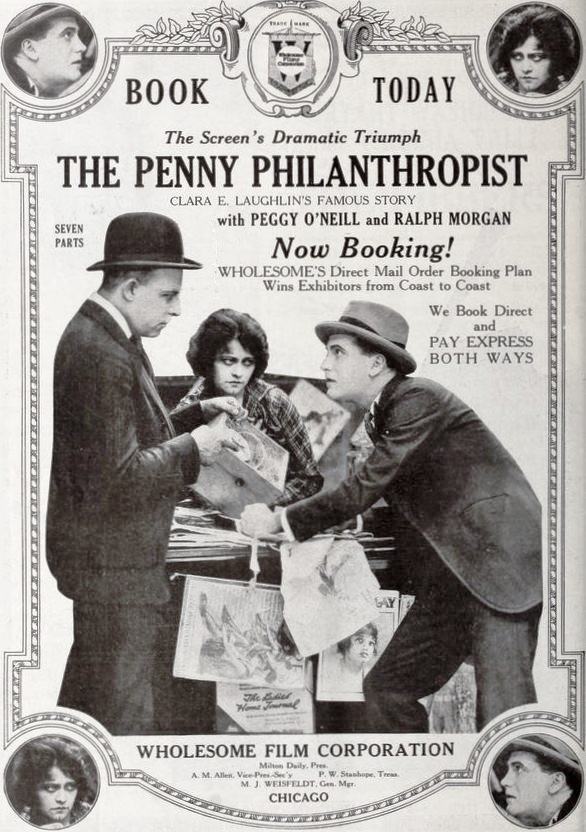
If you have ever paused to watch a sparrow share breadcrumb fragments with its fledgling, you already possess the emotional lexicon required for The Penny Philanthropist. Clara E. Laughlin’s screenplay is not a tale of grand endowments but of fiscal haiku: one copper disc per diem, flicked into the void of human need with the precision of a haiku’s syllabic cut.
Director Rex Adams and cinematographer D.E. Ehrich eschew the Germanic gloom then fashionable in Gothic imports, bathing even alleyways in a buttery chiaroscuro that makes every frame resemble stained glass seen from the inside. Note the sequence where Peggy counts her meager earnings: the camera tilts downward to catch the reflection of gaslight on the coins so that the circle of light mirrors the halo of a medieval annunciation. It’s micro-budget transcendence, executed years before European expressionists would fetishize similar tricks.
Laflin’s performance is a masterclass in calibrated restraint. Her smile is never toothpaste-ad radiant; it flickers, recedes, questions, consents. Watch her eyes when Andrew Kimbalton—played with patent-leather hauteur by William P. Burt—offers her a crisp dollar bill. The pupils dilate not with greed but with the mild panic of a saint offered a throne. She delivers her refusal in a single intertitle that deserves to be stitched on pillows: “The pleasure of giving lies in giving yourself.” The line is quietly revolutionary, refuting the Gilded Age gospel that charity is a product one can purchase wholesale.
Unlike In the Hands of the Law, where jurisprudence is a sledgehammer, this film treats social strata as porous membranes. When Ann Kimbalton (Grace Arnold) descends from her terra-cotta mansion to the newsstand, her mink coat brushes against newsprint ink, and the contamination is mutual: the coat loses its invincibility, the ink gains a whiff of aristocracy. Peggy never demonizes wealth; she merely insists that money must pass through the eye of a needle before it can enter heaven.
Mid-film, the narrative pivots from ethical treatise to courthouse thriller when Tom Oliphant (Frank Wood) is accused of plotting to bomb the Kimbalton estate. Suddenly the penny’s gentle clink is replaced by the sizzle of a fuse. Yet even here, Laughlin refuses to relinquish her thesis: the most explosive force in society is not black powder but calumny, the careless rumor that can raze reputations faster than dynamite can crumble stone. Peggy’s detective work—trudging through taverns, sweatshops, and a printshop that smells of turpentine and injustice—rehabilitates not only Tom but the very notion that empathy can be forensic.
Original exhibitors were encouraged to accompany the final reel with “Sweet and Low,” the 1865 hymn, thereby slyly aligning Peggy’s secular charity with sacred anthems. Variety’s 1921 capsule dismissed the film as “sugarplum socialism,” yet Midwestern newspapers reported parish priests passing collection baskets immediately after screenings—proof that audiences intuited the film’s ecclesiastical undertow.
Place The Penny Philanthropist beside A Soldier’s Oath and you see two conflicting Americas—one swearing fealty to flag, the other to fraternity. Pair it with Philip Holden — Waster and the contrast is even starker: both films interrogate prodigal heirs, but while Holden luxuriates in moral decay, Kimbalton’s daughter is redeemable, a walking possibility that generosity can be learned like French or violin.
Modern viewers will note the absence of Black speaking roles—an omission that stings, especially in Chicago, epicenter of the post-Great Migration renaissance. Yet within the film’s suffragette subtext, Peggy’s autonomy glimmers. She owns her kiosk, dictates her labor hours, and rejects a marriage proposal until it comes packaged with equality rather than rescue. In 1921, such self-governance was still a daredevil stunt for a female protagonist.
One can read the picture as a Protestant rejoinder to Ramona’s Catholic melodrama: no rosaries, no confessional booths, just the laity of the street performing works of mercy without ecclesial scaffolding. The penny becomes a secular Eucharist, transubstantiating copper into compassion while bypassing priestly mediation.
Frank Capra screened a 16-mm print at Columbia in 1938 and later joked that Mr. Deeds’s tuba-playing philanthropist was his “penny guy with a trust fund.” More recently, the 2014 indie Station Agent lifts the motif of benevolence as contagion, proving that Laughlin’s fable still secretes underground rivers into contemporary storytelling.
As of this writing, only a 2K scan survives, held by the University of Illinois at Chicago. The nitrate is marred by vinegar syndrome in reel four, creating ghost halos around streetlights—an accidental aesthetic that, while haunting, hampers legibility. A crowdfunding campaign for full 4K restoration is rumored for late 2025; cinephiles should keep nostrils attuned to the scent of nitrate and nostalgia.
This film will not detonate your worldview; it will perforate it, one pin-prick of light at a time. Long after the last penny drops, what lingers is the hush—the hush of a conscience learning to breathe through the clatter of coins. In an age where philanthropy is often a hashtag or tax write-off, The Penny Philanthropist reminds us that the smallest denomination can purchase the largest acreage in the human heart. Bring a penny; leave with a cathedral.
IMDb —
1933
Community
Log in to comment.