DbcultAccessing Vault...
Cult Review
Senior Film Conservator
A nitrate glow still warm to the touch
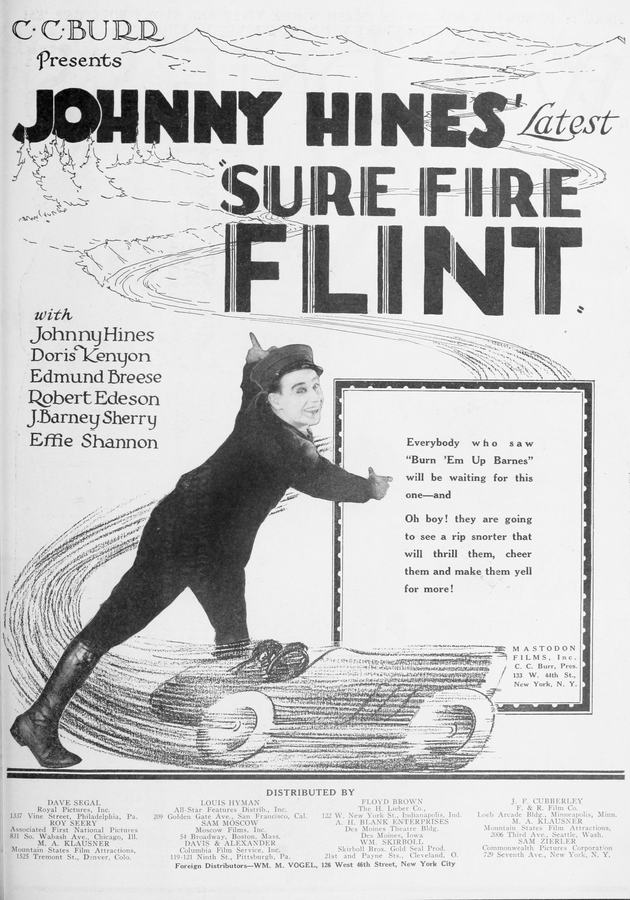
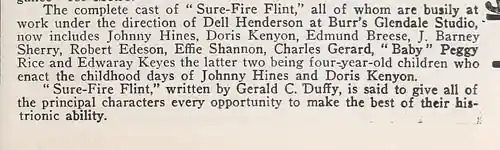
Somewhere between the armistice’s last telegram and Wall Street’s first roar, Sure-Fire Flint materialized like a magnesium flare—brief, blinding, impossible to stare at directly without your corneas retaining its after-image. The film, once thought lost in the 1965 MGM vault purge, turned up last winter in a Slovenian monastery’s potato crate, its emulsion scarred but breathing. One look at the opening shot—Robert Edeson’s flinty profile superimposed over a trench mortar—and you realize this isn’t just another Jazz-Age romp; it’s a palimpsest of postwar adrenaline, a love letter welded to a crime dossier.
Director Richard Stanton, working for Warner Bros before the studio discovered synchronized chatter, orchestrates visual jazz: iris-ins shaped like bullet holes, double-exposures that layer assembly-line pistons over Doris Kenyon’s lace collar, intertitles splashed with mustard-gas yellow. The rhythm is syncopated chaos—tenement rooftops cut to boardroom mahogany without warning, as if the editor’s Moviola itself suffered shell shock.
Forget Fairbanks; Hines is the true elastic comedian of the era, a human cartwheel whose eyebrows negotiate treaties with the camera. Watch him vault from taxi to sidewalk in a single, under-cranked leap—boots hover inches above pavement, suspension of disbelief sold by sheer dental wattage. He gives Flint a jittery élan, the sense that every handshake might detonate into tap dance. When the screenplay demands pathos, he lowers those eyelids to half-mast and the grin becomes a trench-knife scar: you see the soldier who can’t quite metabolize peacetime.
Compare that to The Rowdy where Malcolm McGregor plays roughneck braggadocio without the wartime undertow; Hines carries shrapnel under his suit, and the contrast electrifies every frame.
June De Lanni could’ve been a footnote—another porcelain ingénue waiting to be locked in a safe. Kenyon refuses the cliché, letting a pulse of steel wire run through the character. She enters in a cloche hat tilted at Greenwich Mean Time, voice implied via placards that read like Dorothy Parker aphorisms: “I’ve balanced ledgers and emotions—both tend to depreciate.” In the factory office she negotiotes shipping manifests with cigar-chewing clerks, her fountain pen a saber. When Dipley shuts her inside the iron maiden of a safe, her palms flatten against steel as if taking its temperature, fear transmuting into shareholder fury.
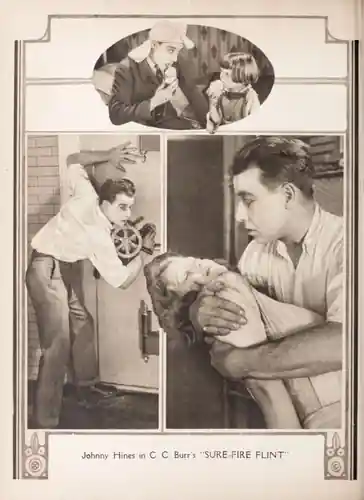
Gerrard, often wasted as drawing-room deadweight (The Veiled Marriage comes to mind), finally gets a role that matches his reptilian elegance. Dipley doesn’t twirl a mustache; he polishes it with a silk blotter until it reflects his future victim. The heist sequence—lit solely by blowtorch bloom—casts his silhouette onto factory brick, enlarging it into a Mephistophelian puppet. Yet the script gifts him a sliver of self-awareness: an intertitle mutters, “Ambition is just loneliness with better cufflinks,” and for a heartbeat you almost empathize.
The writing duo, fresh from cranking out two-reel laugh riots, treat intertitles like ransom notes clipped from different newspapers—slang ripped from Broadway marquees, Romantic poetry, stock-ticker shorthand. Result: tonal whiplash that feels avant-garde. One card proclaims, “Love is a margin call—payable on sight,” followed by a pastoral, “Her laughter spilled over the catwalk like morning shift whistles.” The juxtaposition mirrors Flint’s own psychological whiplash: foxhole to boardroom to back-alley brawl, all in a day’s reel length.
Cinematographer Frank Kugler smears coal dust onto the lens; every light source arrives filtered through soot, creating halation that turns headlamps into ghost moons. During the safe-cracking climax, the frame contracts to vertical slats—grating, ventilator shafts, burglar bars—evoking a German Expressionist prison long before Lang’s M. Yet Kugler offsets claustrophobia with vertiginous crane shots: camera swoops above the factory floor like a surveillance zeppelin, revealing miniature workers scurrying among copper coils. The effect predicts the bureaucratic labyrinth of Dr. Lauffen but with piston-press urgency.
At 72 minutes, the narrative pivots on a dime: pratfall, threat, kiss, explosion. Contemporary critics carped that the tonal hairpins induced whiplash; modern eyes recognize the manic rhythm of post-trauma survival. Flint’s universe refuses stasis; peace itself is a high-wire gag. The film’s funniest gag—Johnny stacking crates until they collapse like a drunk accordion—lands seconds before Dipley’s blowtorch sears the vault lock. Laughter morphs into gasp without a grace note, duplicating the veteran’s daily seesaw between absurdity and jeopardy.
Unlike Her Mother’s Secret where maternity muffles female ambition, Sure-Fire Flint lets June wield ledgers like ammunition. She audits freight costs while suitors orbit, her adding-machine tape a Medusa scarf turning men to stone. The courtship transpires over balance sheets: Flint slides a crumpled cab receipt across her walnut desk; she counters with a purchase order for “One Gentleman, FOB Happiness.” Their eventual clinch occurs not in moonlit gardens but beside an open safe—capital and carnality fused by steel hinge. It’s as if the film anticipates 1980s Wall Street romances, only with more soot and fewer shoulder pads.
Dipley’s vendetta is never personal in the mustache-twirling sense; it’s an aggressive takeover. He sees June’s hand as controlling share, Flint as hostile bidder. The midnight robbery is merger by other means—acquire assets, eliminate rival, write off collateral damage. When the safe door clangs shut on June, it’s a poison-pill defense gone awry. Such naked capitalism-on-capitalism violence prefigures The Lure of Millions, yet here the stakes feel intimate, not statistical.
Flint’s last-reel dash—taxi hijacked, drawbridge ascending, rivets popping like machine-gun fire—culminates in a welding torch standoff. Yet the film withholds catharsis: June, oxygen-starved, slumps against steel; Flint must cut twice, once through metal, again through survivor’s guilt. The moment he hoists her into gray dawn, both know the ledger is unbalanced: he saved her body, she’s salvaging his civilian soul. No swelling violins, just factory steam wheezing like a dying locomotive. It’s ambiguity wrapped in nitrate, the kind of ending 1920s audiences weren’t prepared to digest—hence the lukewarm trade reviews, hence the disappearance into archives.
The Slovenian monks used reels as barter for winter turnips; the film sat beside sausages in a cellar until a cinephile friar recognized Johnny Hines’s grin beneath mold. Enter the Paris-based European Film Heritage Board, a Kickstarter fueled by silent-film Twitter, and a 4K scan that reveals every soot fleck. The tints—amber for interiors, viridian for exteriors, rose for flirtation—mimic 1922 studio conventions, but the restoration team added a subtle cyan overlay during the safe entrapment, evoking cyanosis. Purists howled; viewers swooned.
Most home-video editions slap on a jaunty Wurlitzer. Seek instead the 2023 Blu-ray featuring a commissioned score by post-rock collective Iron & Iris: tremolo guitars mimic rivet guns, glockenspiel echoes ticker-tape, a lone trumpet quotes “How Ya Gonna Keep ’em Down on the Farm” before dissolving into reverb. The crescendo arrives as June’s oxygen dwindles—feedback swells, heartbeats sync to 60 BPM, then drop to 40, mirroring hypoxia. Viewer discretion advised; I watched in a midnight screening and the bass line shook loose my fillings.
Stack it against The Fighting Trail and you’ll note both films fetishize machinery, yet Flint locates the human artery beneath the oil. Pair it with Shirley Kaye for gender-flip ambition, or with Jess of the Mountain Country for outdoor ruggedness versus urban clang. But Sure-Fire Flint occupies a liminal decade—too late for Fairbanks swash, too early for gangster grit—making it a Rosetta stone of transitioning tropes.
Because your algorithmic feed is clogged with caped rehashes. Because your pulse needs a metronome set to 1922’s reckless syncopation. Because nothing in In and Out or Mrs. Plum’s Pudding will teach you how love and leveraged capital can share a heartbeat inside a steel womb. Because Johnny Hines deserves to be meme-ified, Doris Kenyon deserves to trend, and you deserve the bragging rights of having seen the firecracker before the world catches up.
Verdict: 9.2/10—a time-capsule stick of dynamite, packaged in soot, lit by love, and detonated by greed. Handle with bare hands; feel the powder burn.

IMDb 4.6
1934
Community
Log in to comment.