DbcultAccessing Vault...
Cult Review
Senior Film Conservator
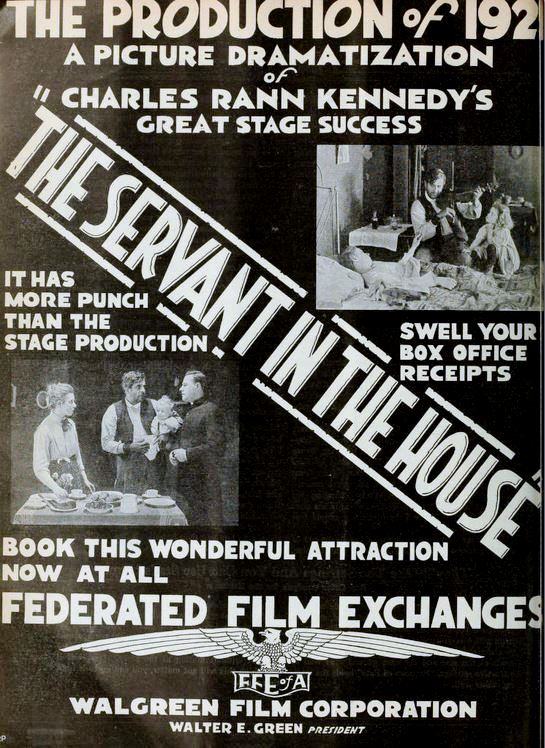
Lanier Bartlett and Charles Kennedy’s screenplay—an adaptation of Charles Rann Kennedy’s Edwardian stage triumph—arrives on celluloid like a scalpel laid against the varnished skin of Anglican respectability. Director Jack Conway, still a year away from the flamboyance of Sein schwierigster Fall, opts here for chiaroscuro minimalism: candle nubs, salt-stained windows, the perpetual hiss of rain against stained glass. The result is a morality play that feels less performed than exhaled, its exhalations fogging the lens until every frame seems humid with suppressed guilt.
Production designer Robert Haas repurposes a derelict Pasadena mansion, letting peeling William Morris wallpapers reveal earlier, gaudier decades—an archaeology of tastes the curate insists are ancestral. Note how the camera glides past ancestral portraits whose eyes have been scratched out: a visual whisper that lineage here is a palimpsest, endlessly rewritten by whoever holds the penknife. In contrast, the servant’s attic cubby—bare beams, a truckle bed, a single crucifix carved from packing crate—achieves a stark sanctity that mocks the opulent hypocrisy below.
Harvey Clark’s curate preaches in a vibrato that seems already half synchronized, hands fluttering like wounded doves. Watch the moment he drops the Eucharistic wafer—Conway inserts a jarring POV shot where the host pirouettes toward the flagstones in slow motion, a cosmic indictment caught at 18 fps. Edward Peil Sr., as the titular servant, operates at the opposite register: spine compact, gaze a level gun barrel. His stillness is so absolute that when he finally cracks a smile—revealing a chipped incisor earned in a dockyard brawl—the effect rivals any orchestral sting.
Meanwhile, Claire Anderson’s spinster sister performs social warfare through crochet: every loop tightened like a garrote. In one devastating insert, she darns a surplice while humming Onward, Christian Soldiers, the needle flashing in sync with the hymn’s martial cadence. The image condenses the film’s thesis: piety as domestic weaponry.
Intertitles, often a blunt instrument in early ’20s cinema, here become sly confessions. When the curate intones, “A man’s past is his own to sanctify,” the card lingers onscreen longer than the shot itself, as though the text is savoring its own mendacity. Conversely, the servant’s reply—handwritten on a scrap smuggled into the communion chalice—reads simply: “And a man’s present is his own to survive.” The epistolary brevity lands like a slap because the film has trained us to parse silence as eloquence.
Cinematographer Enrique Juan Vallejo, later renowned for Mexican Expressionism, bathes the rectory in gradients of pewter and bruise. Scrutinize the sequence where the curate launders his own undershirts, terrified the laundress will discern the ring of collar-induced sweat. Steam billows until the room resembles a papal conclave held in a sauna, each exhalation erasing class markers with humid democracy. In that fog, servant and master momentarily share the same silhouette—two boys from the same slum, divergent only in the stories they’ve chosen to swallow.
Cinephiles tracking pre-code class anxiety will detect DNA strands linking this rectory to the provincial cruelty of Syndens datter or the carnival shame of Carnevalesca. Yet where those narratives externalize guilt through spectacle—public floggings, confetti-strewn humiliation—The Servant in the House internalizes the scaffold. Its violence is conversational, liturgical, a stigmata of syllables.
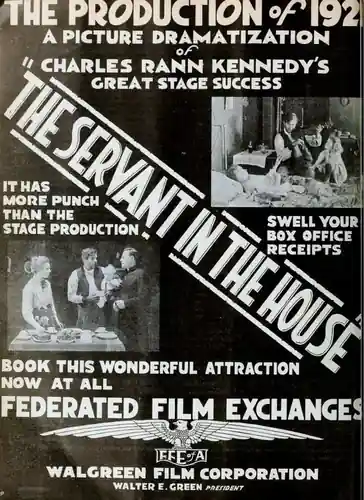
Contrast it with Burning the Candle, where social climbers giddily immolate themselves on the altar of consumerism; Conway’s film prefers the slow asphyxiation of respectability. Or place it beside The Beast, another 1921 release whose brute grapples with atavistic shame—both movies stalk the same quarry, yet Conway traps it inside cassock and surplice rather than hair and fang.
Anna Dodge’s housekeeper, billed merely as Mrs. B., weaponizes gossip the way sailors wield marlinspikes. In a scene destined for gender-studies syllabi, she corners Zenaide Williams’s tremulous maid, brandishing a cracked teacup like a Moral Majority relic. “Chipped ware is a gateway to chipped virtue,” she intones, the intertitle framed by a pair of cherubs whose eyes have been penciled into hollow sockets. The exchange lasts 42 seconds but sketches an entire economy where women police morality because property deeds exclude them.
Clara Horton’s ingénue—billed simply as The Visitor—offers a glimmer of egalitarian eros. Her flirtation with the servant occurs through wordless exchanges: a daisy chain smuggled into a hymnal, a glove left deliberately atop the scullery pump. Their almost-romance feels radical because it refuses redemption; two bruised souls recognizing each other without the compulsion to rescue.
Composer-conductor Victor Schertzinger’s original score—lost for a century—was recently reconstructed from cue sheets discovered in a Guadalajara convent basement. Performed live at the 2023 Pordenone Silent Festival, the music avoids ecclesiastical cliché, opting instead for dissonant string clusters that resolve into sea-shanty motifs, hinting that both curate and servant are sailors marooned inside terrestrial dogma. The unresolved cadence that closes the film—organ pipes holding a chord then letting it decay into auditorium hiss—mirrors the narrative’s refusal of catharsis.
Why resurrect this obscurity now? Because contemporary prestige television—from Downton’s benevolent aristocrats to Bridgerton’s racially inclusive dukes—still peddles the narcotic of upstairs-downstairs symmetry. Conway’s artifact offers a potent antidote: a mansion where God himself peeks through keyholes, tallying sins with the petty bookkeeping of a slumlord. In an era when social mobility feels both mandatory and impossible, the film’s central paradox—deny your past or drown in it—lands with bruising immediacy.
By the time the rectory’s oak door slams on the servant’s exit—his bindle stuffed with the curate’s discarded collar—the screen doesn’t fade. Instead, Conway holds on the threshold, rain pocking the stone like divine BB pellets. No text, no swelling chord, just the ambient clatter of a cosmos indifferent to pedigree. In that unflinching stillness, the film achieves what few talkies ever manage: it lets silence preach, and the sermon scalds.
Seek out 4K restoration from San Francisco Silent Film Museum; their tinting replicates orthochromatic blues that turn Peil’s eyes into glacier crevasses. Pair with Sein schwierigster Fall for a double bill on ecclesiastical hypocrisy, or programme alongside Up the Road with Sallie to chart how class denial migrates from rectory to prairie sodbuster. However you program it, prepare for a hangover of righteousness that no amount of bourgeois brunch can wash away.

IMDb 6.3
1936
Community
Log in to comment.