DbcultAccessing Vault...
7.8/10
Senior Film Conservator
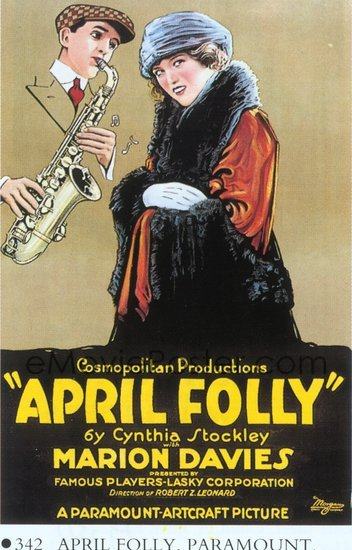
A definitive 7.8/10 rating for a film that redefined the boundaries of cult cinema. April Folly remains a cornerstone of transgressive art.
In the pantheon of early American cinema, few collaborations carry the historical weight—or the polarizing baggage—of the partnership between William Randolph Hearst and Marion Davies. April Folly (1920), a production of Hearst’s Cosmopolitan Productions, stands as a fascinating artifact of this era. Unlike the more somber efforts found in The Waiting Soul, this film leans heavily into the whimsical, leveraging Davies’ undeniable comedic timing and luminous screen presence. The film is not merely a narrative; it is a showcase, a meticulously crafted vessel designed to broadcast Davies’ versatility to a global audience. The historiography of this film often gets mired in the shadow of Citizen Kane, yet when viewed through a lens unclouded by Orson Welles’ caricature, one discovers a performer of remarkable nuance and a film of surprising structural complexity.
The film’s primary conceit—a novelist reading her own work to her inner circle—establishes an ontological playground that allows for a delightful suspension of disbelief. April Poole, played with a sparkling intelligence by Davies, is not content to be a passive observer of her life. By casting her real-life associates into the roles of hero and villain within her story, she exerts a form of authorial control that was quite progressive for the 1920s. This nesting-doll structure elevates the film above the standard melodrama of its day. We see echoes of this creative self-insertion in other contemporary works like The Venus Model, but April Folly executes the transition between reality and fiction with a seamlessness that speaks to the high production values Hearst demanded.
The sequence at the masked ball is a visual feast, utilizing the chiaroscuro lighting typical of the period to heighten the sense of mystery and chicanery. Here, the film introduces Ronald Kenna (J. Herbert Frank), the editor who, in April’s imagination, becomes the antagonist. The use of masks serves as a blunt but effective metaphor for the fluid identities that permeate the film. As April retrieves the discarded note, the cinematic language shifts from social comedy to high-stakes espionage. The tension is palpable, not because we fear for the diamond, but because we are invested in April’s success as a storyteller. Her ability to navigate this treacherous social landscape mirrors the challenges faced by women in the industry, making the film a subtle commentary on female agency.
Conway Tearle, as Kerry Sarle, provides a sturdy, if somewhat conventional, romantic foil. His performance lacks the kinetic energy of Davies, but his gravitas grounds the more fantastical elements of the plot. Their chemistry is most evident during the train sequences, where the cramped quarters of the stateroom force a physical intimacy that the intertitles can only hint at. Tearle’s character represents the ideal audience: skeptical yet ultimately seduced by the power of the narrative. In contrast to the gritty realism of The Toilers, Tearle and Davies operate in a world of polished surfaces and heightened emotions, a hallmark of the Cosmopolitan aesthetic.
Marion Davies, however, is the sun around which all other elements orbit. Her transition from the demure novelist to the swashbuckling heroine who hides in a trunk is executed with a physicality that belies her socialite reputation. She possesses a rare ability to communicate complex internal monologues through subtle shifts in her gaze and the tilt of her head. This is particularly evident when she assumes the identity of Diana Mannister. The duality of her performance—playing April, who is playing Diana—requires a level of technical precision that many of her peers struggled to achieve. It is a performance that anticipates the screwball comedies of the 1930s, proving that Davies was a pioneer of the genre.
The journey to South Africa allows the production designers to indulge in exoticism, a common trope in silent cinema designed to transport audiences to far-flung locales they would likely never visit. While the depiction of South Africa is clearly a studio-bound approximation, it possesses a dreamlike quality that aligns perfectly with the film’s fictional frame. The sets are opulent, reflecting the Earl of Mannister’s status and the high stakes of the diamond heist. The contrast between the confined spaces of the train and the sprawling vistas of the African coast creates a rhythmic visual flow that keeps the viewer engaged. This attention to environmental detail is reminiscent of the atmospheric work seen in Victory, though April Folly maintains a lighter, more adventurous tone.
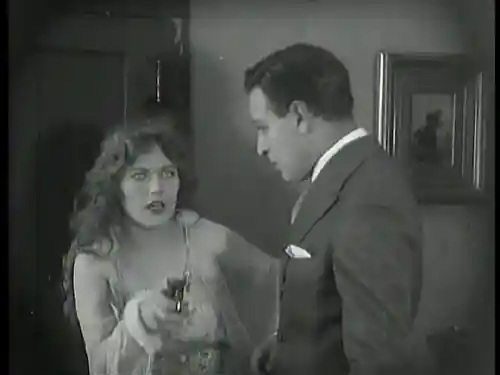
Director Robert Z. Leonard demonstrates a firm grasp of cinematic syntax, utilizing close-ups and medium shots to emphasize the emotional beats of the story. The editing, particularly during the climax where April captures the thieves, is surprisingly modern. The cross-cutting between the trunk and the unsuspecting criminals builds a sense of anticipation that is rare for a film of this vintage. Furthermore, the use of intertitles in April Folly is judicious; they supplement the action rather than replacing it, allowing the visual storytelling to take center stage. This is a marked improvement over more dialogue-heavy silents like The Final Close-Up, where the narrative momentum often stalls under the weight of excessive text.
The cinematography by L. William O'Connell captures the luminosity of Davies’ skin and the intricate textures of the period costumes. The lighting in the final scene, as April concludes her tale and returns to the reality of her study, is soft and romantic, providing a visual resolution that mirrors the narrative closure. The way the light catches the dust motes in the air as she embraces Kerry adds a layer of verisimilitude to an otherwise highly stylized film. It is these small technical flourishes that elevate April Folly from a mere star vehicle to a genuine piece of cinematic art.
At its core, April Folly is a meditation on the power of storytelling. April Poole uses her fiction to navigate her real-world anxieties and desires. By placing herself at the center of a dangerous adventure, she proves her worth to the men who control her professional and personal life. The film suggests that for a woman in 1920, the only way to achieve true autonomy was through the exercise of the imagination. This theme of female self-actualization through creative endeavor is a recurring motif in Davies’ work, though it is perhaps most overtly addressed here. The film’s resolution—where the story is accepted and the romance is solidified—implies that fiction is not an escape from reality, but a tool for shaping it.
When compared to the starker narratives of films like L'ira or the historical rigidity of Du Barry, April Folly feels remarkably light and agile. It does not seek to moralize or educate; it seeks to enchant. This enchantment is achieved through a perfect synchronization of performance, direction, and production value. The film’s legacy is not just as a Marion Davies vehicle, but as an early example of how cinema could play with narrative structure to engage an increasingly sophisticated audience.
To view April Folly today is to witness the birth of the modern romantic adventure. It possesses a charm that is both ephemeral and enduring. While some of its plot points may seem dated, the central performance by Marion Davies remains a masterclass in silent film acting. She navigates the shifts in tone—from the suspense of the jewel heist to the warmth of the romantic conclusion—with an ease that few of her contemporaries could match. The film is a vibrant reminder of a time when cinema was still discovering its own possibilities, and in the hands of a talent like Davies, those possibilities were limitless.
In the broader context of 1920 cinema, alongside titles such as Tempered Steel and The Jungle Trail, April Folly distinguishes itself through its sheer exuberance. It is a film that celebrates the act of creation, the thrill of the chase, and the ultimate triumph of love. For the modern cinephile, it offers a window into a bygone era of glamour and innovation, anchored by a performance that still sparkles over a century later. It is a folly, perhaps, but a glorious one that rewards the viewer with every frame.
IMDb —
1921
Community
Log in to comment.