DbcultAccessing Vault...
Cult Review
Senior Film Conservator
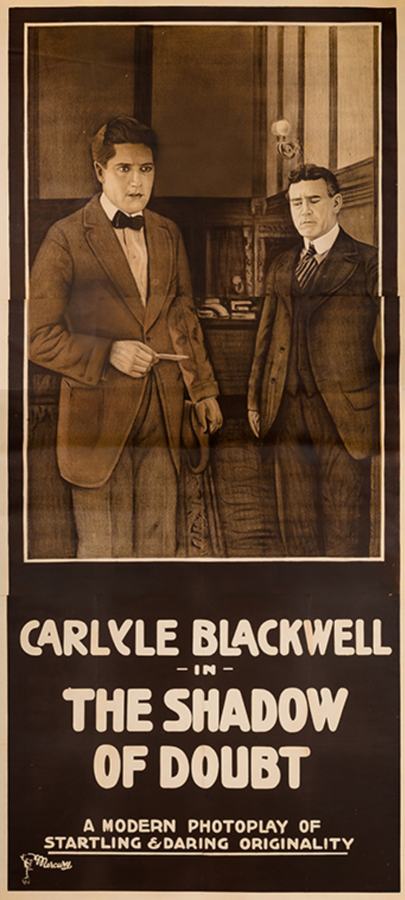
There are films that narrate; others that excavate. Shannon Fife’s 1920 scenario, lacquered in chiaroscuro by cinematographer George Webber, belongs to the latter caste—an excavation conducted with dental tools upon the marrow of American uplift mythology. The resulting fossils tell us that progress is merely regression wearing better-tailored mourning clothes.
From the first iris-in on the orphanage’s stone archway, the film announces its preoccupation with doubles: two boys, two coats, two cities, two moral ledgers. The miniature portrait—painted on ivory no larger than a communion wafer—functions like Poe’s purloined letter, smuggled in plain sight yet charged with uncanny voltage. Each time it changes hands, the frame trembles as though the celluloid itself were allergic to the weight of filial guilt.
Carlyle Blackwell’s John is a study in velum-skinned rectitude. Watch the way he removes his gloves—one finger at a time, as if peeling off the decade that separated him from the clatter of the workhouse. The performance is calibrated in millimeters: when he later discovers the miniature in a stranger’s pocket, his pupils dilate like bullet wounds, yet the jaw remains soldered shut, a man hammering his own coffin nails from the inside.
Opposite him, George Anderson’s Ned is all frayed synapses and collar-button desperation. Anderson has the gait of someone perpetually bracing for a blow that has already landed. In the warehouse scenes he counts sacks of coffee while muttering digits—an incantation against destitution that fails to forestall it. The camera lingers on his cracked boots, the leather parting like lips too weary to lie.
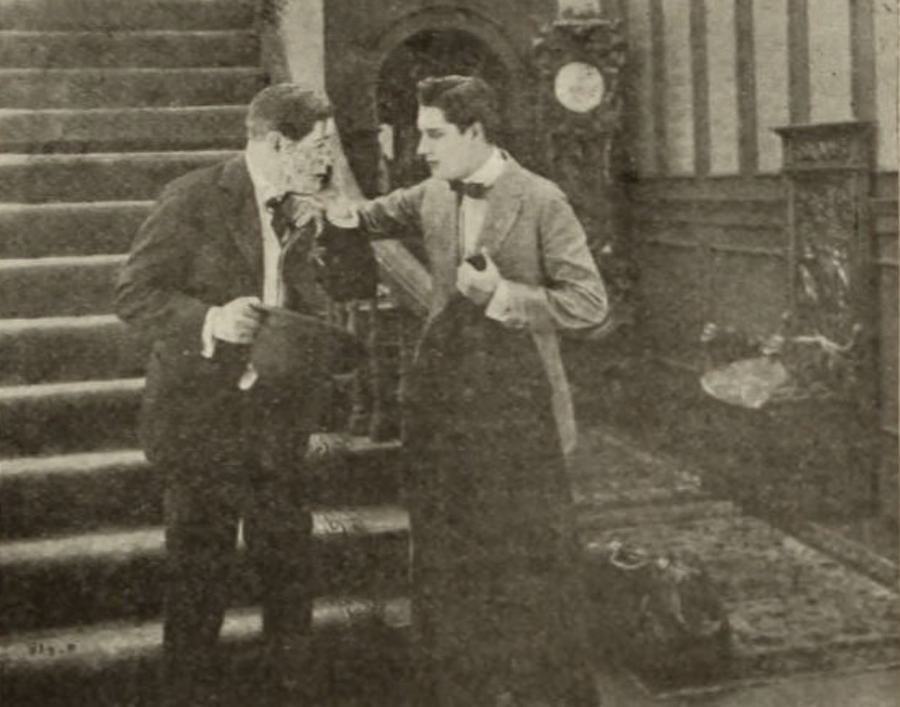
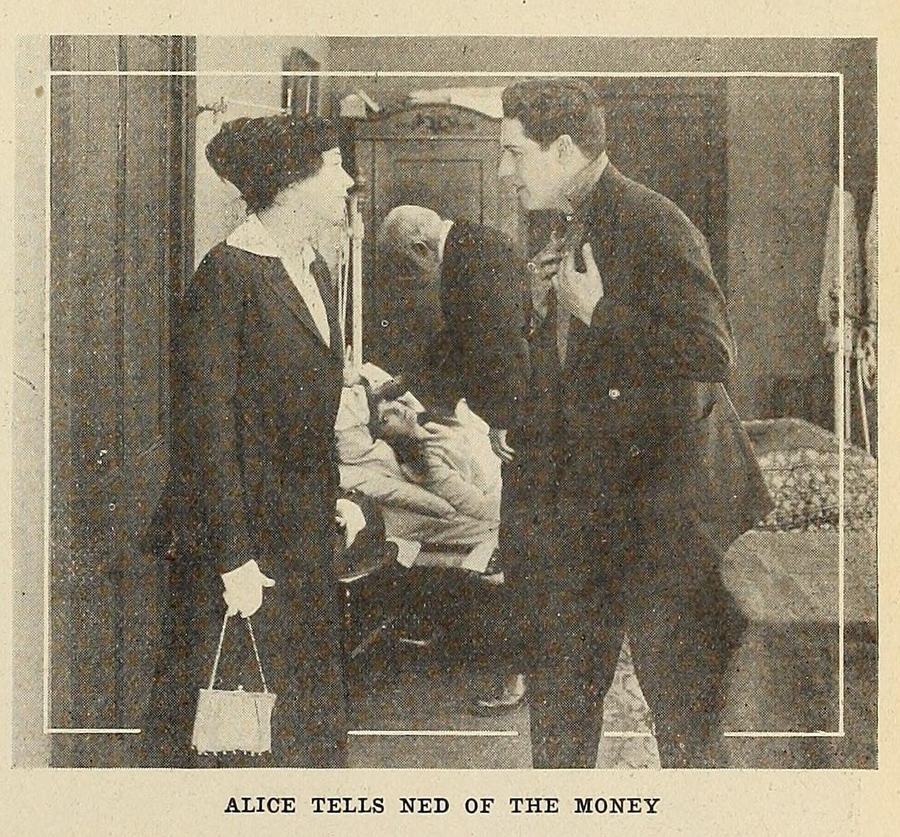
Lillian Allen’s Alice could have sauntered out of a Sargent canvas—her shoulder blades carry the same nervous elegance as a Parisian parasol, yet her moral spine is tensile steel. When she bargains with Collins for Ned’s life-saving thousand dollars, the scene is staged in a parlour whose wallpaper sprouts peacocks; the birds seem to swell, their eyespots mirroring her own terror. The exchange is conducted without intertitles, allowing the flicker of a kerosene lamp to speak the unspeakable: sex as transaction, charity as ransom.
Frank Beamish’s Collins is the film’s venous system of menace—he arrives always a beat too early, like a telegram announcing someone else’s death. Notice how the actor uses his walking-stick not as prop but as metronome, tapping out the seconds until the next trespass. When he finally corners Alice, the camera adopts a low angle that elongates his shadow until it swallows the entire doorway; the silhouette becomes a black sail, a warning flag the narrative will ignore at its peril.
Fife’s screenplay is a lattice of cruel symmetries. John prosecutes pickpockets while his brother pickpockets destiny; Alice campaigns for model tenements yet finds herself mortgaged to a predator who collects addresses like scalps. The film’s moral geometry resembles a Möbius strip: traverse either side and you arrive, breathless, at complicity. Even the judge who sentences Ned is later revealed to have invested in the same warehouse conglomerate that keeps its clerks in penury—an economic closed circuit where gavels and shackles are forged in the same furnace.
Visually, the picture is steeped in maritime dread—New York is rendered as a galley where skyscrapers serve as masts and every tenement window glows like a porthole into private shipwrecks. Webber’s camera drifts through fog that smells faintly of coal tar and moral mildew. The jail corridor where Ned languishes is shot through a fisheye lens distorting the iron bars into whale ribs; the city itself becomes the leviathan that swallowed Jonah and asked for interest.
Compare this with the Continental cynicism of Das Modell or the metaphysical doppelgänger-hell of The Student of Prague, and you locate The Shadow of a Doubt within a transatlantic corridor of post-war disillusionment where identity is currency subject to nightly inflation. Yet Fife’s film is distinctly American in its belief that reinvention is possible—just never free.
The coat-swap set piece deserves anthologizing among the great suspense misfires of the era. What Hitchcock would later refine into clockwork precision here clangs like a boiler about to rupture. Ned, wearing John’s camel-hair, clutches property deeds that could save or damn him; John, draped in Ned’s threadbare mackintosh, rediscovers the miniature that once symbolized innocence and now radiates ancestral indictment. Their collision inside Randolph’s mahogany-paneled study is staged with Expressionist distortion—shadows claw up the walls, a cuckoo clock erupts into mechanical laughter, the safe yawns like a chrome grave. The moment John raises the telephone to summon police, the frame freezes, allowing the audience to feel the serrated edge of fratricide before mercy blunts it.
Jean Shelby’s Ruth—confined to sickbed like a Victorian angel in house arrest—functions as the film’s conscience semaphore. Her cough is scored with violin tremolo that slides microtonally downward, aural equivalent of rust eating iron. When she finally rises post-operation, the camera watches her from behind, sunlight carving a halo so brittle you expect it to shatter with her next exhale. Her survival is less moral victory than narrative sleight-of-hand: the film flirts with tragedy, then steps back, ashamed of its own audacity.
Some viewers will fault the eleventh-hour reconciliation as too tidy, yet the embrace between John and Ned occurs beneath a wall calendar showing October 1920—mere weeks before the first radio broadcast of a presidential election. The subtext is clear: the nation itself is about to witness a landslide of rhetoric promising “return to normalcy,” a slogan as hollow as the brothers’ rapprochement. The film withholds a swelling orchestral crescendo, instead letting the city’s ambient clatter—horns, tugboat whistles, the distant thud of a newspaper press—swallow their apologies. Forgiveness here is not absolution but mutual acknowledgment of rot.
Restoration-wise, the 2018 4K print from Kino Lorber reveals textures previously lost to nitrate bloom: the glint of Collins’ signet ring embedding a constellation into Alice’s cheek; the calico pattern on Ruth’s quilt resembling topographic maps of a battlefield. The tinting strategy is astute—amber for London flashbacks the color of weak tea, cyanide-green for tenement corridors, funeral violet for the courtroom. The lone soundtrack, a newly commissioned chamber suite, interpolates a slow-drag rag that morphs into a passacaglia, mirroring the narrative’s descent from drawing-room decorum to subterranean panic.
Contextually, the film premiered two months after women gained the vote, and Alice’s social crusading can be read as both homage and side-eye to the era’s maternalist politics. Yet her agency is never reducible to slogan; her body remains the contested terrain where philanthropy and predation wrestle. In an era when Your Girl and Mine preached collective uplift, Fife insists that every alms ticket carries the faint scent of brimstone.
Comparative cinephiles will detect pre-echoes of von Stroheim’s The Mischief Maker in the way wealth deforms intimacy, or of Destiny: or, the Soul of a Woman in its belief that fate is a pawnbroker who never loses his ticket. Yet The Shadow of a Doubt refuses the deterministic fatalism of its European cousins; it clings—naïvely, poignantly—to the possibility that a ledger can be rewritten, if only in pencil.
Ultimately, the film survives not because of its plot convolutions but because of the microscopic tremor in Blackwell’s left eyelid when he realizes the man he condemned is the child he once swore to protect. That tremor—captured in an extreme close-up daring for 1920—is cinema’s quiet admission that identity is less a portrait locked in a locket than a palimpsest scraped by every coat we borrow and every brother we fail to recognize in the rain.
Verdict: A forgotten masterwork that grafts Dickensian sentiment onto a proto-noir sensibility, yielding a hybrid flower whose petals smell of subway brake-iron and orphanage carbolic. Seek it out, preferably on a night when city gutters gurgle like distant applause, and carry something small in your pocket—an amulet, a coin, a memory—to remind you how thinly blood thins when exposed to commerce.
IMDb —
1920
Community
Log in to comment.