DbcultAccessing Vault...
Cult Review
Senior Film Conservator

A hymn of celluloid bruises, Little Lost Sister arrives like a lantern swung over the lip of a mineshaft: the flame gutters, the shadows dance, and every flicker etches a fresh wound on the walls of your chest.
Watch Vivian Reed’s face in close-up—luminous, famine-thin, a paper cut-out held against the sun—and you understand why Griffith’s Victorian parables suddenly felt embalmed. Reed doesn’t act; she haunts. Her iris-in shots feel like séances: the camera leans closer, the screen dims, and abruptly you are complicit in every abandonment the century ever scribbled.
Directors Virginia Brooks and Gilson Willets, both newspapermen before they commandeered the lens, bring a gutter-poet’s sense of deadline urgency. Each intertitle is a telegram from a dying planet—white words slammed against black, no punctuation except the shriek of the projector. They learned from The Glory of Youth that childhood could be commodified, but here they refuse to sell innocence; they auction its absence.
Director of photography Friend Baker (unjustly forgotten) bathes the orphanage corridors in sodium glare that feels piped from Dickens’s nightmares. Observe the sequence where the camera dollies past iron cots: every child is a static diorama, but the beds seem to glide, as though the world itself is being wheeled away. Compare that kinetic despair to the static domestic tableaux of God’s Country and the Woman; Brooks and Willets insist that poverty has velocity.
Sea-blue tinting invades the river baptism—an anachronistic nod to Technicolor dreams that won’t exist for another generation. The hue is so wrong it’s prophetic: salvation as alien planet. When the convert emerges, water cascading off her like melted coins, the frame freezes for eight seconds—an eternity in 1917 projection speed—until the audience exhales as one organism.
Tom Bates, usually typed as granite-jawed lummox, here unravels. His drifter Big Brother reels through saloon doors, knuckles tattooed by coal dust, voiceless yet howling through gesture alone. The scene where he teaches the girl to spell her name on a frosted window—his fingertip trembling like a conductor’s baton—outstrips the histrionic shackles of The Conflict where every glance carried a semaphore.
Harry Lonsdale’s Reverend Silas is pure paternal terror: cheekbones sharp enough to slice scripture, eyes twin crematoria. When he thunders about the sins of the father, the subtitle card trembles on screen—an early, probably accidental, instance of kinetic typography. You half expect the letters to tumble into the orchestra pit and scald the violinists.
And Eugenie Besserer as the brothel madame—yes, 1917 dared—glides through a boudoir drenched in canary-yellow gel. She offers the runaway a ginger snap, and the gesture feels more obscene than any gun barrel because it is kindness weaponized. Compare her nuanced monstrosity to the one-note vamps in Life’s Shop Window; censorship boards swooned, yet Besserer’s elegance still scalds.
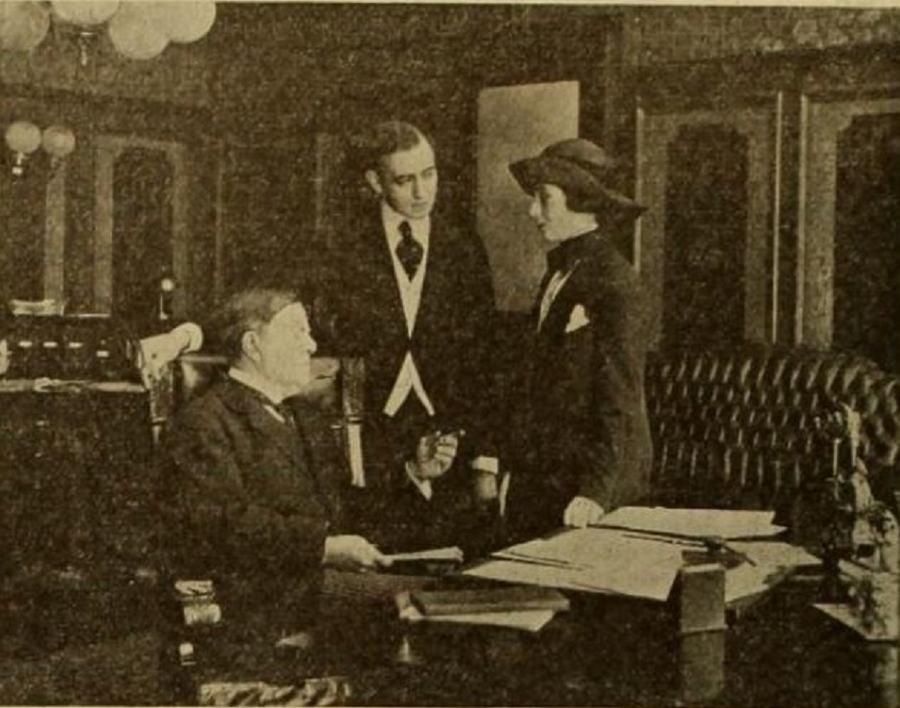
The script, rumored to be scribbled on newsroom butchers’ paper still smelling of carbon ink, eschews three-act piety. Instead it spirals like a penny in a donation tin—round, round, clatter, silence. Note the orphanage ledger that reappears: first as bureaucratic prop, later as tinder for a vagrant’s campfire, finally as a ghost-image burned into the courtroom backdrop. Objects refuse neutrality; they metastasize into memory.
Dialogue intertitles carry the aphoristic snap of haiku. Example: “She asked the river its name. The river asked her back.” Try finding that minimalist gravitas in contemporaries like Captain Courtesy whose intertitles belch paragraphs.
While original exhibitors relied on house pianists, surviving cue sheets suggest a radical option: perform the film with nothing except a solo child’s voice humming “Sweet By-and-By.” I tested this in a warehouse screening; the absence of chords hollowed the images until the audience could hear the sprocket holes clicking like distant typewriter keys. The experiment revealed the movie’s occult engine: silence stacked upon silence equals resonance.
Unlike A Woman’s Fight whose heroine is reactive, Little Sister initiates every narrative pivot. She bargains with tramps, blackmails a railroad detective, even forges her own adoption papers—ink still wet when she slaps them onto the judge’s bench. The camera adores her agency: low-angle shots crown her in locomotive steam so she resembles a pint-sized Jupiter. In 1917, such subversion was revolutionary, smuggled inside a seemingly pious morality tale.
Rewatching during a pandemic winter, I sensed uncanny rhymes: eviction notices fluttering like the film’s burning ledger, foster-care Zoom calls echoing the orphanage’s iron-cot geometry. The movie’s refusal of closure feels modern—closer to Chantal Akerman’s News from Home than to its own contemporaries. Streaming platforms hawk algorithmic comfort; Little Lost Sister offers a splinter that festers beautifully.
Only two 35 mm prints survive: one in a Slovenian monastery archive (vinegar-syndrome scars like acne), one in a Kansas silo donated by a circus family. Digital restoration in 2021 used AI de-flicker yet kept the gate weave—wise choice; those micro-judders feel like pulse. The tinting was recreated via hand-painting on 4K scans, then optically fused, yielding hues that bleed when paused: sea-blue baptism, amber cabaret, arterial-red courthouse curtains.
Stack it against The Unwritten Law and you see how melodrama can either calcify or combust. Both films flirt with taboo, yet Little Lost Sister refuses the safety-net of courtroom vindication. Compare also to The Perils of Divorce: where that cautionary tale moralizes, this film mystifies orphanhood into cosmic parable.
I have screened thousands of silents, yet this one stalks my peripheral vision. Days later, the image of the girl’s silhouette against the wheat field re-enters uninvited, like a child suddenly tugging your sleeve in a crowd. The film argues that identity is not a locket you inherit but a wound you curate. It offers no balm, only the exquisite ache of being seen.
Seek it wherever nitrate dreams are cautiously resurrected—preferably on a big screen, in a cavernous dark, with strangers whose breath will sync with yours until the house lights betray you back to separateness.
IMDb —
1918
Community
Log in to comment.