DbcultAccessing Vault...
Cult Review
Senior Film Conservator

Spoilers course through this text like bilge water—plug your conscience if you wish to stay dry.
There is a moment—brief, almost subliminal—when the Aurora’s rusted hull bisects the moon’s reflection and the world seems to balance on a rivet. That fleeting gleam encapsulates The Shark: a film that stitches grime to grandeur, proletariat sweat to debutante champagne, and then sets the whole tapestry ablaze.
Thomas F. Fallon’s screenplay, lean yet literate, treats the freighter as floating panopticon: every porthole an eye, every cargo hold a confession booth. Sanchez—played with lip-curling relish by William Nally—doesn’t merely command; he officiates, a black-hearted priest in a sanctuary of iron. His introductory close-up—backlit by the ship’s furnace—carves his silhouette into the viewer’s retina like a brand.
George Walsh’s Shark arrives ashore like a coiled spring in oilskins. Watch the way he downs a shot: the liquor disappears, the glass stays suspended a beat too long, as though gravity itself hesitates. Walsh, a lesser-known swashbuckler compared to Fairbanks, possesses a feral athleticism; when he leaps from pier to gangway the camera tilts, momentarily drunk on his momentum. The stunt feels spontaneous, perilous—no rear projection, no safety net, just sinew and conviction.
Marie Pagano’s Doris first appears framed between two chorus girls whose cigarette tips glow like predatory fireflies. Pagano’s doe eyes mask calculation; her flapper nonchalance is a costume she can’t wait to shed. When Sanchez manhandles her toward the ship, the camera lingers on her torn silk knee—fabric as wounded skin—then cuts to a seagull’s scream, an audacious splice that turns the bird into Greek chorus.
The Wine Room sequence is a chiaroscuro bacchanal: barrels loom like Neolithic sentinels, a jazz trio pounds out-of-sync, and the air is viscous with contraband perfume. Cinematographer Henry W. Pemberton bathes faces in amber lamplight until pores become topographies. Compare this murk to the sun-bleached yachting frivolity of Just Out of College and you’ll gauge how radically The Shark rejects Jazz Age gloss.
Once aboard, Doris’s abduction reframes the freighter as gothic manor: cargo cranes become turrets, the engine room a sulfurous dungeon. Sanchez’s quartermaster, McGinn (James T. Mack), sports a scar that bisects his eyebrow—every scowl a split curtain revealing raw flesh. The crew’s chanteys are half-sung, half-grunted, a dying language that underscores their indenture to the captain’s psychosis.

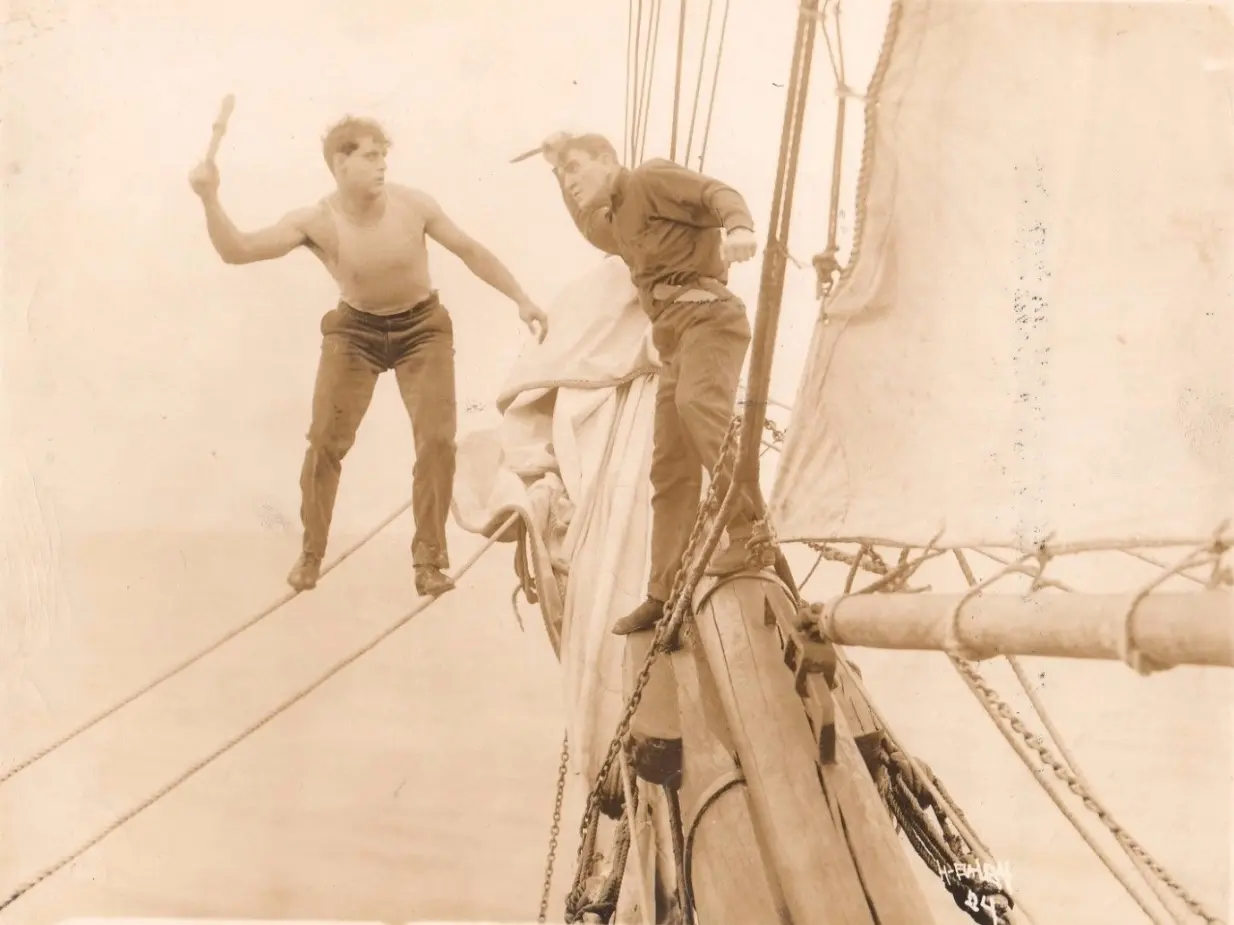
Then comes the insurrection. Shark’s barefoot sprint across the wet deck—each footfall drumming a Morse of rebellion—escalates into a tangle of chains, boathooks, and flying tackle. Intercut shots of furnace doors ajar make the frame itself seem to pant. A rivet gun becomes Excalibur; when Shark fires it into a steam pipe, the hiss is so abrupt the audience in 1920 reportedly ducked.
Fire blooms next, crimson petals eating tar. Pemberton’s camera, now hand-cranked to uneven speed, renders flames as flickering glyphs—an alphabet of annihilation. The lifeboat’s descent is shot from above: ropes squeal, pulleys spin like demented astrolabes, and the ocean waits below, a mercury abyss. Compare this orchestrated chaos to the static tableaux of Royal Progress Through London; you’ll see how far American silent cinema had veered toward visceral dynamism.
In the final drift, Shark and Doris cling to a hatch cover, their silhouettes black commas against a rose-gold horizon. Pagano’s face, smeared with soot, achieves a luminosity no studio lighting could manufacture. Walsh’s eyes, meanwhile, telegraph not victory but stunned humility—an acknowledgment that survival is merely the prologue to accountability. When the rescue steamer’s searchlight razors the darkness, the couple’s entwined hands form a hieroglyph of fragile solidarity.
Fallon repeatedly juxtaposes circles with verticals: portholes versus masts, handcuffs versus belaying pins, the moon versus the ship’s smokestack. This dialectic hints at fate’s roulette (circles) against mankind’s urge to ascend (verticals). When the burning mast ultimately topples, the two geometries collapse into one—an emblem of entropy that still feels inexorably poetic.
Notice also the motif of shoes. Sanchez’s knee-high boots thud with authoritarian certainty; Shark’s bare feet slap with libertarian defiance; Doris’s satin pumps, lost early, prefigure her societal constraints jettisoned. The absence of footwear becomes a barometer of emancipation.
Silent film acting often ages into pantomime; here, it matures into opera. Walsh’s physical vocabulary—an eyebrow semaphore, a torso pivot—conveys interior monologue sans histrionics. Pagano, meanwhile wields micro-gestures: a lip-corner tremor when she spies the ship’s furnace, a blink held half-a-second longer when Shark professes—via title card—his vow to protect her. These nuances accumulate, rendering intertitles almost redundant.
Nally’s Sanchez deserves scholarly ink. He underplays villainy: a soft chuckle, a thumb brushing his suspender buckle—each tick more unsettling than mustache-twirling moustache. Watch how he fingers the ship’s brass rail as though appraising a slave’s collar; possession, not violence, is his aphrodisiac.
Editor Robert Broderick eschews Griffith-like cross-cutting for something closer to musical syncopation. Sequences stutter, breathe, then sprint. The firefight’s cadence—six frames of blaze, two frames of darkness—mimics the human blink reflex, embedding panic in the viewer’s nervous system. Cine-literati may trace this to Soviet montage, yet Broderick’s tempo feels more akin to a live Duke Ellington jam session: improvisational, propulsive, dangerously alive.
Original exhibitors reportedly accompanied The Shark with a melange of Wagner, sea-shanties, and improvised sound effects (crackling cellophane for fire, a coconut shell chorus for waves). Modern screenings—should you be fortunate to catch the 2017 Library of Congress restoration—often feature commissioned scores. The standout, by the indie ensemble Horns of Tin, employs bowed saw and waterphone to transmute the auditorium into a creaking hull. The cacophony crescendos until viewers taste brine on their lips—a synesthetic coup.
Place it beside Gift o’ Gab and you’ll see how swiftly urbanity can curdle into maritime gothic. Contrast it with the maternal melodrama of Fräulein Mutter; both films obsess over custody—one of children, the other of self-possession. Even the cosmic fatalism of The Eternal Law pales before The Shark’s visceral nihilism: divine justice is replaced by thermodynamic collapse—fire, water, and the entropy of desire.
Trade papers of 1920 praised the “salty realism” yet balked at the heroine’s “compromised virtue.” Box-office was respectable on coastal cities’ Main Streets but middling in landlocked states where the closest ocean was a wheat sea. Within five years the picture vanished—shelved, sold for scrap, rumored lost until a sole 35mm nitrate print surfaced in a Hoboken crawlspace in 1983, fused into a single smoky coil. Decades of photochemical witchcraft followed, restoring 86 % of the original runtime; the missing fragments survive only in the form of a continuity script peppered with Thomas F. Fallon’s crabbed marginalia: “Insert—Doris’s eyes reflecting inferno.”
Contemporary discourse on toxic masculinity finds fertile case study in Sanchez’s tyranny; gender studies scholars dissect Doris’s transition from object to agent; film-philosophy circles cite the blaze as a metaphor for cinema’s own combustible temporality—celluloid forever poised between illumination and obliteration. Meanwhile, cinephiles hungry for uncharted silents now laud The Shark as a missing link between von Sterneberg’s Morocco and Milestone’s All Quiet. Streaming algorithms, however, still relegate it to sidebar oblivion, a casualty of metadata poverty.
The 2017 4K restoration clocks 78 minutes at 20 fps, tinted sepia for shore scenes and cerulean for open sea. The Library of Congress hosts quarterly screenings; a European Blu-ray via Silent Seas label offers English, French, and Portuguese intertitles plus a 40-page booklet. For region-locked cineastes, digital purchase exists on the nonprofit portal Vintagenova—proceeds fund further preservation. Beware YouTube bootlegs with chipmunk-speed frame rates; they transform tragedy into slapstick.
Long after the lights rise you may taste iron on your tongue, hear ropes creak in distant rooms, feel floorboards sway. The Shark does not merely depict maritime revolt; it colonizes your sensorium, barnacle by barnacle, until you realize every vessel—be it marriage, career, nation—is a tramp steamer steered by some Sanchez, awaiting its mutinous Shark. And when that recognition lands, the film’s flaming mast topples not across the screen but across the fragile deck of your certainties. What remains is driftwood and salt-stung hope—an artifact both ruinous and radiant, bobbing in the dark waters of cinema’s forgotten abyss.
IMDb 7
1932
Community
Log in to comment.