DbcultAccessing Vault...
Cult Review
Senior Film Conservator
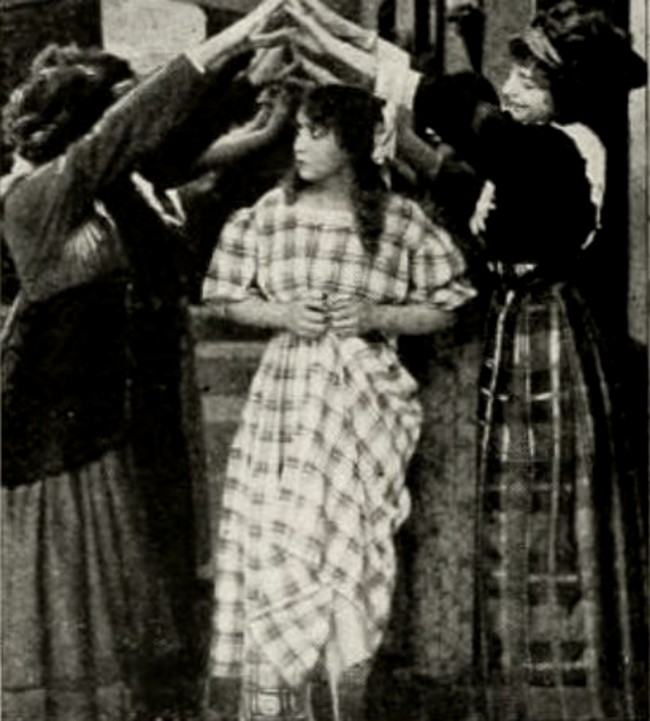
The projector hums like a trapped bee, and suddenly 1915 splashes across my retinas in silver nitrate bloom: The Mating, a title that sounds like a biology reel but secretes a fable of social taxidermy. I first encountered this print in a Paris archive, shrink-wrapped in vinegar syndrome; tonight I revisit it on 35 mm, the way its intended audience once did—palms sticky with orange soda, hearts braced for cataclysm.
Doris Willard arrives on campus wearing a dress that looks sewn from church pew cushions. The ivy-covered sorority castle eyes her the way Rococo cherubs eye a Puritan: with incredulous malice. Cue intertitles—those haiku of anguish—“She does not belong.” The film’s visual grammar is already flexing: low-angle shots of iron gates, high-angle shots of Doris swallowed by flagstone. The camera, usually a mute witness, becomes a co-conspirator with the bullies.
Director C. Gardner Sullivan, best known for blood-and-thunder morality tales, here pivots into brittle social satire. He withholds close-ups until Doris forges the letter; only then does the lens caress her face, as if deception were cosmetic. The forged proposal is written on stationery filched from the YWCA—its letterhead a cross between salvation and scandal. She signs it “Bullet” Dick Ames, the era’s amalgam of Jack Armstrong and Byron, a halfback whose calves appear carved from Greek marble.
The lie detonates spectacularly. Daisy Arnold—part P.T. Barnum, part Lucrezia Borgia—summons Dick under false pretenses, aiming to vivisect Doris in front of the entire student body. But the film pivots from cruelty to carnival: Dick, tickled by the audacity, decides to play along. Lew Cody, still a decade away from his gigolo heyday, strides into the frame with a grin like a chrome bumper. He is equal parts savior and saboteur, turning the hoax into a flirtation conducted in public squares and moonlit boathouses.
Enid Markey’s Doris is no standard ingénue; her shoulders hunch as if permanently bracing for incoming mortars. Watch the way she fingers the counterfeit letter—first like contraband, later like scripture. In the pivotal reception scene, Sullivan blocks the actors like chess pieces: Doris stranded center-frame, chandeliers dripping overhead like crystallized tears. Dick’s entrance—shot from knee-height—makes him a colossus of charity. “Why sure, we are old friends,” he declares, and the room’s gasp is almost audible even without a Movietone track.
Romance blooms in montage: shared lemonade on a sun-bleached jetty, a stolen ride in a Stutz Bearcat, football confetti swirling around them like technicolor snow. Sullivan’s editor, Elmer McCain, experiments with rhythmic cutting—four frames of Doris laughing, six of Dick reacting, eight of clouds scudding—anticipating Eisenstein by a full decade. The effect is vertiginous: we feel the narcotic rush of first love distilled in celluloid opiates.
Yet the film refuses to coast on saccharine fumes. Doris, schooled in Methodism and humility, cannot parse altruism from condescension. She rejects Dick’s eventual real proposal, convinced it is pity masquerading as passion. Here the narrative inhales something Chekhovian: the tragedy not of cruelty but of conscience. Eleanor Ames, Dick’s sister—played by Margaret Thompson with flapper sangfroid—engineers a finale worthy of Schnitzler: a train-station farewell in swirling steam, where Doris finally parses the difference between being chosen and being rescued.
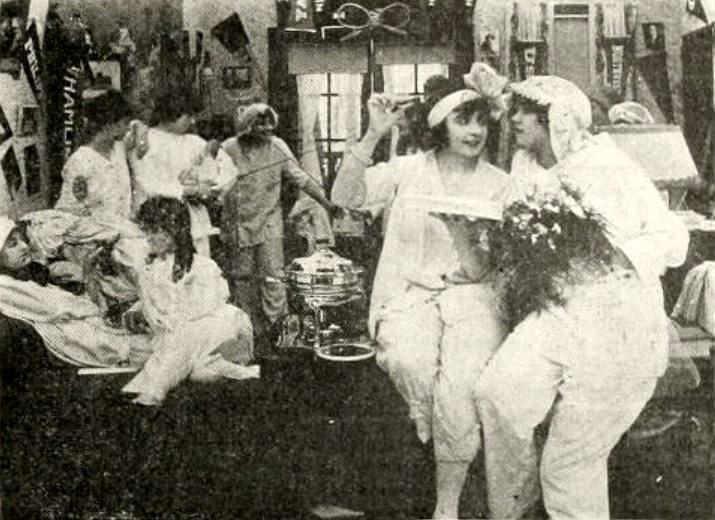
Visually, the last reel is a sonnet of negative space. Doris’s silhouette against the locomotive’s furnace glow; Dick’s gloved hand losing grip of her sleeve; the train swallowing distance like an iron lung. Sullivan overlays a superimposition: the forged letter dissolving into a real engagement ring, a bit of voodoo that prefigures the optical printers of the 1940s.
Comparative lenses help calibrate the film’s stealth modernity. Where Tess of the Storm Country frames poverty as saintly affliction, The Mating treats it as social original sin. Unlike Down with Weapons, whose pacifist polemics bellow from rooftops, this picture whispers its insurgency through a love story. And beside The Stubbornness of Geraldine, both share heroines who weaponize stubbornness, yet Doris tempers hers with self-lacerating doubt.
The film’s DNA also coils around issues of performative masculinity. Dick Ames is introduced via newspaper idolatry—his photograph clipped, kissed, tucked under a pillow. The campus girls worship him as a fetish object long before he appears in the diegesis. When he finally does, he weaponizes that gaze, flipping subject-object dynamics. In one sly aside, he autographs a football “To Doris—who caught me faster than any defense.” The line is both come-on and commentary on celebrity culture, predicting the parasocial romances of Instagram eras.
Cinematographer Clyde McClary bathes night sequences in a bluish mercury glow, prefiguring the nocturnal shimmer of late-20s Sternberg. Note the scene where Doris skates alone on a frozen pond: the ice acts like a black mirror, duplicating her solitude into infinity. The only sound (supplied by our imagination) is skate blades etching loneliness into nature. It’s a tableau that anticipates the alienation montage of The Pursuit of the Phantom, though that film externalizes dread through Germanic shadows, whereas Sullivan locates dread inside class anxiety.
Gender politics, of course, demand excavation. The campus is a micro-Panem where women’s currency is couture and courtship. The Beauty Squad adjudicates worth via a points system—ankles, lineage, dowry—rendering higher education an adjunct to husband-hunting. Doris’s forgery is therefore a guerrilla act: she hijacks patriarchal paperwork (the marriage proposal) to author her own legitimacy. That the ruse mutates into authentic love complicates any proto-feminist reading, yet her final refusal of Dick reclaims agency. She will not be a charity case stitched into tulle.
Sullivan’s screenplay, adapted from a Saturday Evening Post novella, trims the source’s moralistic epilogue. Gone is a priest’s sermon on deceit; in its place, silence and a final iris-in on clasped hands. The secular benediction feels radical for 1915, a year when D.W. Griffith was soldering cross-cut salvation to Klan valor. Instead, The Mating offers salvation through mutual recognition—two people seeing each other sans caste markers, if only for the duration of a whistle-stop kiss.
Performances oscillate between naturalistic hesitancy and theatrical flourish, a hybrid common to transitional-era silent drama. Enid Markey—later the first Jane to Tarzan—lets her eyes do most of the talking: wide, wet, perpetually braced for impact. Lew Cody exudes the louche magnetism that would typecast him in the 20s as the quintessential Continental cad; here, that cad-ness is softened by protective tenderness. Their chemistry ignites not in clinches but in micro-gestures: the way his thumb rubs the inside of her wrist when she trembles at the reception, the way her exhale flutters his lapel flower.
The film’s racial unconscious deserves mention. The college’s exclusivity is implicitly whites-only; the only person of color is a nameless maid who delivers roses, her face half-turned from the lens. Sullivan stages no rebellion against this hierarchy; his critique targets class, not race. Yet the omission is telling: Doris’s ostracism is absolute, yet still she occupies a rung above the silent woman who carries her luggage. The invisible labor that props up ivy glamour remains—well—invisible.
Musicologists will lament the loss of the original cue sheets. My screening relied on a contemporary score—piano, brushed snare, muted trumpet—composed by Judith Rosen. She interpolates a motif from “Love Nest” but fractures it into minor thirds whenever Doris forges another lie, a musical wink that underscores moral tension. During the train-station finale, Rosen lets a single chord hang unresolved for 12 seconds, mirroring Doris’s indecision, resolving only when Dick’s lips meet hers. The effect is gut-punch catharsis.
Archivists estimate 40% of the original negative survives; the rest was patched from a 28 mm Eastman print discovered in a Belgian convent. Hence some shots swim in mosquito-flecked nitrate rot, yet the decay oddly intensifies the film’s themes: memory corroding, class scars festering, love persisting through emulsion wounds. Digital restoration removed mold blooms but kept the gate weave; the image shivers like a heartbeat.
Box-office tallies were modest—$87,000 domestic against a $21,000 budget—yet the picture toured on the Chautauqua circuit, where rural audiences saw their own Sunday-best insecurities reflected in Doris’s calico. Critics compared it favorably to The Book of Nature for its “wholesome sweetness,” though that phrase undersells its serrated edge. Variety sniffed at its “collegiate frivolity,” missing how frivolity doubles as armor.
Modern viewers may flinch at the film’s resolution: love as deus ex machina, marriage as social elevator. Yet Doris’s final caveat—“I’ll marry you, but not your world”—hints at a life beyond the end title. One imagines her years later, living in a Greenwich Village walk-up, editing a suffragist journal, still wearing homemade dresses but now setting fashion rather than chasing it. Dick, retired from gridiron glory, coaches underprivileged boys on a dusty field, their daughter skating on the same frozen pond where deceit once thawed into desire.
Criterion or Kino have yet to bless The Mating with a Blu-ray; the only access is through archival 16 mm prints programmed sporadically at MoMA or Pordenone. That scarcity feeds its legend. Like a half-remembered lullaby, it lingers in cinephile whispers: the film where a lie became a love letter, where class shame met gridiron grace, where a girl learned she could author her own myth and still deserve the epilogue.
So if the projector ever clacks to life in your town hall, projector beam slicing dust motes like neutron stars, do not dodge the invitation. Sit among strangers, let the overture rise, and watch Doris Willard step off that rural train with nothing but a trunk and a tremor. Witness how she weaponizes imagination against mockery, how a forged signature rewrites destiny. And when the train-station finale arrives—steam, tears, a kiss that tastes of coal and courage—notice how your own heart stutters, how the past reaches through nitrate fog to squeeze the present awake. Because The Mating is not just a curio from cinema’s adolescence; it is a mirror for every moment we felt too small for the big room, and still dared to pencil ourselves larger. The lie becomes the truth becomes the myth becomes us.
IMDb —
1922
Community
Log in to comment.