DbcultAccessing Vault...
6/10
Senior Film Conservator
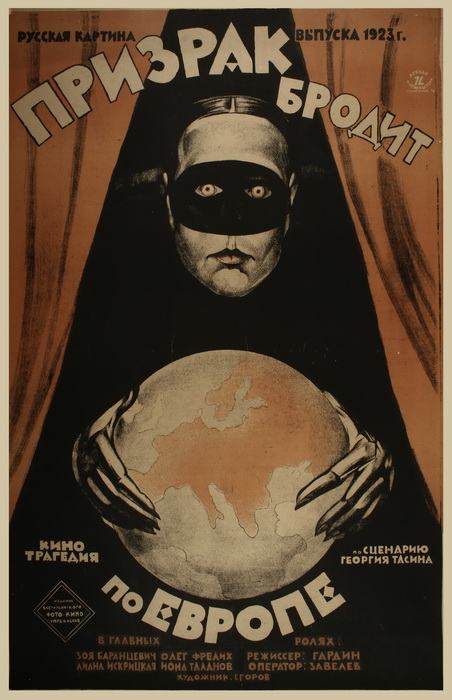
A definitive 6/10 rating for a film that redefined the boundaries of cult cinema. Prizrak brodit po Evrope remains a cornerstone of transgressive art.
In the nascent years of Soviet cinema, specifically 1923, the medium was a laboratory of ideological and aesthetic alchemy. Prizrak brodit po Evrope (A Spectre is Haunting Europe) stands as a monumental, if often overlooked, artifact of this era. Directed by Vladimir Gardin and scripted by Georgi Tasin with a heavy nod to the macabre sensibilities of Edgar Allan Poe, the film is a visceral exploration of the 'specter' mentioned in the Communist Manifesto. It does not merely depict a political transition; it visualizes the psychological disintegration of an era. The narrative transports us to a fictionalized realm where an Emperor, played with a brittle, haunting fragility by Oleg Frelikh, flees the encroaching flames of revolution. His flight to the outskirts of his kingdom is less a strategic retreat and more a descent into a Gothic purgatory.
The film’s atmosphere is thick with the influence of Poe’s The Masque of the Red Death. Where many contemporary films of the period, such as Allies' Official War Review, No. 23, were concerned with the stark realities of conflict, Prizrak brodit po Evrope opts for a dreamlike, almost hallucinatory aesthetic. The Emperor’s palace in the wilderness is a monument to isolation, a stark contrast to the burgeoning collective consciousness of the masses. The cinematography, handled with an innovative eye for shadow and scale, emphasizes the crushing weight of the architecture upon the human spirit. It is a visual language that echoes the desolation found in An Alpine Tragedy, though Gardin’s work is infused with a specifically revolutionary urgency.
Central to the film’s emotional resonance is the relationship between the Emperor and Elka, portrayed by the luminous Zoya Barantsevich. Elka is the daughter of a revolutionary exile, a man whose life has been consumed by the very fires the Emperor seeks to escape. Their meeting is an intersection of two dying worlds: the decaying aristocracy and the suffering individual caught in the crossfire of history. Barantsevich, who was a significant star of the pre-revolutionary era and appeared in films like Koroleva ekrana, brings a nuanced melancholy to the role. Her performance bridges the gap between the theatricality of the past and the burgeoning realism of the future.
Their romance is framed not as a fairytale, but as a doomed synthesis. It is a precarious bridge over a yawning chasm of class hatred. Unlike the more conventional melodramas of the time, such as The Gilded Dream, Gardin avoids sentimentalism. Instead, the love between the Emperor and Elka is presented as a tragic anomaly, a brief moment of human connection that cannot survive the relentless march of the dialectic. The Emperor’s infatuation with the daughter of his enemy is a form of political masochism; he is falling in love with the very force that will eventually consume him.
The visual identity of Prizrak brodit po Evrope is largely defined by the production design of Vladimir Yegorov. Yegorov, a master of spatial storytelling, creates a palace that feels like a tomb. The high ceilings, the cavernous halls, and the stark use of chiaroscuro lighting suggest a world where the light of the 'old sun' is rapidly fading. The film utilizes its imaginary setting to bypass the literalism of Soviet agitprop, allowing for a more universal, almost mythic exploration of power. The use of vast, empty landscapes evokes a sense of existential dread similar to the atmospheric tension in The Page Mystery, yet here the stakes are not merely a single crime, but the death of a social order.
The supporting cast, including Evgeniy Gryaznov and Vasili Kovrigin, provides a grounded, almost subterranean counterpoint to the Emperor’s ethereal presence. Kovrigin, as Elka’s father, embodies the righteous, unyielding fury of the revolution. He is the 'specter' made flesh. His performance is stripped of the nuances of individual psychology, serving instead as an elemental force of nature. This contrast between the individualized suffering of the Emperor and the collective, impersonal wrath of the revolutionaries is the film’s most potent thematic engine.
Georgi Tasin’s screenplay cleverly adapts Poe’s The Masque of the Red Death, transmuting the plague into the revolution. In Poe’s tale, the Red Death is an inescapable biological reality; in Gardin’s film, the revolution is an inescapable historical reality. The Emperor’s attempts to wall himself off from the world are as futile as Prince Prospero’s. This thematic layer adds a level of sophistication that was often missing from more straightforward political cinema like Honor First. Here, the horror is not found in the supernatural, but in the inevitable passage of time and the shifting of social tectonic plates.
The climax of the film—the destruction of the palace—is a masterclass in early special effects and editing. The fire is not just a plot device; it is a purgative element. As the palace burns, the film achieves a pyrotechnic beauty that is both terrifying and liberating. The violent end of the lovers is the final, necessary sacrifice for the birth of the new world. It is a sequence that rivals the dramatic tension of Mata Hari, but with a significantly more profound ideological weight.
To understand Prizrak brodit po Evrope, one must view it within the context of the VUFKU (All-Ukrainian Photo-Cinema Administration). This period of Ukrainian cinema was characterized by a daring willingness to experiment with form and genre. While films like Sleeping Beauty might offer a more traditional narrative experience, Gardin’s work pushes the boundaries of what a 'revolutionary' film could be. It suggests that the revolution is not just a change in government, but a fundamental shift in the human psyche, a clearing away of the Gothic cobwebs of the past.
The film also stands as a fascinating comparison to American productions of the same era. While Hollywood was exploring themes of individual morality in films like Money Madness or the domestic dramas of Help Wanted, Soviet cinema was grappling with the very definition of humanity in a post-monarchical world. Prizrak brodit po Evrope does not provide easy answers. The Emperor is not a caricature of evil, but a man out of time, a relic who is both pitiable and dangerous in his obsolescence.
Watching Prizrak brodit po Evrope today is like peering through a cracked mirror into a world of shadows. The lexical diversity of its visual storytelling is staggering. From the expressionistic use of light to the rhythmic editing of the final revolt, the film remains a potent reminder of the power of silent cinema. It avoids the repetitive structures of later socialist realism, opting instead for a complex, multifaceted approach to its subject matter. The film’s legacy can be seen in the works of later masters who understood that political truth is often best expressed through the language of the fantastic and the macabre.
Whether compared to the mystery of The Microscope Mystery or the social critiques found in The Penny Philanthropist, Prizrak brodit po Evrope occupies a unique space. It is a film that is simultaneously of its time and hauntingly timeless. It captures the moment when the specter of the future finally caught up with the ghosts of the past, leaving nothing but ashes and the memory of a love that could never have been. For anyone interested in the intersection of horror, history, and high art, this film is an essential, if chilling, experience. It is a testament to the fact that even in the most turbulent times, cinema can find a way to speak the truth, however dark and spectral that truth may be.
IMDb —
1933
Community
Log in to comment.