DbcultAccessing Vault...
Cult Review
Senior Film Conservator
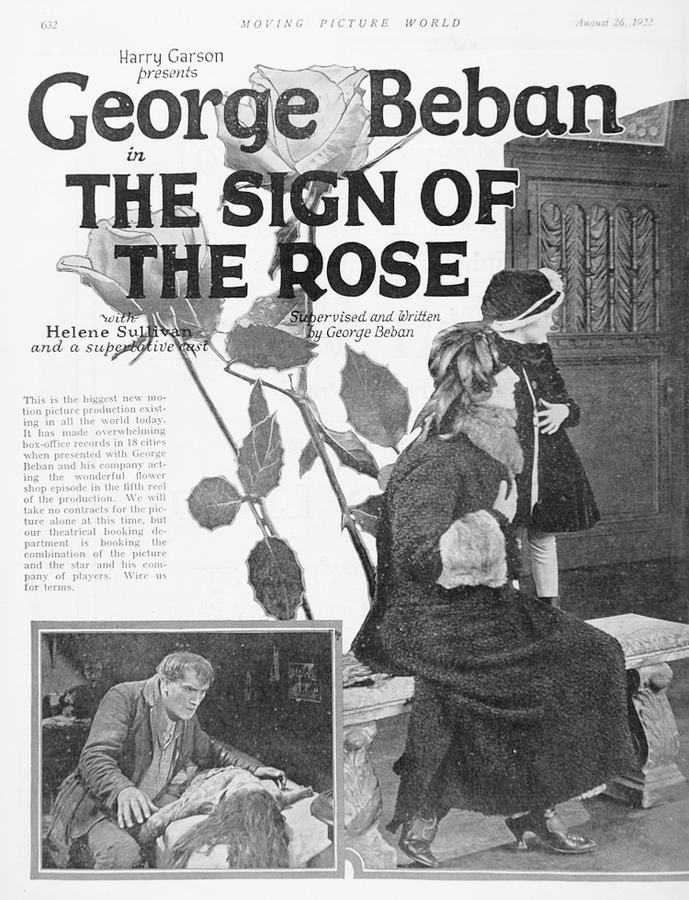
A city that never sleeps, yet always dreams of its own rot.
The Sign of the Rose belongs to that intoxicating micro-era when silent cinema still flirted with Grand-Guignol excess before the Hays office clipped its talons. Shot on orthochromatic stock that turns every blush into bruise-purple and every snowflake into meteor-shower silver, the picture opens on a Christmas Eve so morally corroded it makes Dickens look like a greeting-card illustration. Director Carroll Owen—moonlighting from his usual gig as a society caricaturist—treats the frame like a daguerreotype soaked in kerosene: every surface gleams, every shadow threatens to ignite.
Rather than the linear abduction procedural the lobby cards promise, the plot folds in on itself like a Möbius strip. Phillip’s ransom scheme is only the maggot-riddled bait; the actual hook is William’s incremental self-execution. Each time he tightens the vice on the wrong man, another barb of culpability skewers his own ribs. Owen and his three co-scenarists (including star George Beban) splice intertitles that read like entries from a penitent’s diary: spare, haiku-adjacent, refusing psychological exposition yet dripping with culpability. The result feels closer to a fever confession than to the tidy morality plays then glutting the marquees.
Arthur Thalasso’s Phillip exudes the clammy magnetism of a tenement preacher: cheekbones sharp enough to slice communion bread, smile retracted before it ever reaches the gums. Watch him bargain with a bellboy—he hands over a coin yet never relinquishes eye contact, as if the currency were the lad’s immortal soul. Opposite him, Charles Edler’s William is all frayed velvet; a man who has mistaken stoicism for virtue so long that grief arrives as a merciful unmasking. When the fatal bullet leaves his revolver, Edler’s whole torso deflates like a pierced bellows; guilt vented, humanity guttering.
George Beban, usually typed as comic relief, here sculpts Pietro into a basilisk of paternal dread. His silent howl at discovering his daughter’s body—shot in chiaroscuro silhouette against a canal’s oily shimmer—belongs in the same emotional pantheon as Maria Falconetti’s Joan. The moment lasts maybe four seconds yet etches itself into the viewer’s spinal fluid.
Cinematographer M. Solomon (who would disappear from the industry two years later in a dockside brawl) lenses the city as a petri dish: snowflakes descend like ash from a crematorium chimney, while Christmas garlands sag with Dickensian flop-sweat. Note the repeated motif of roses—pressed in a locket, tattooed on a forearm, wilting in a gutter—each iteration desaturated until the bloom becomes gangrenous. The titular “sign” is never literal; instead it’s a chromatic bruise that creeps across the mise-en-scène, from rosy street-lamp haloes to the arterial spray that finally brands William’s conscience.
Owen’s blocking favors vertical entrapment: characters pinned between fire escapes, imprisoned within bell towers, crushed under the ribcage of a half-built cathedral nave. This is urban Gothic before Labyrinth of Horror codified the subgenre, but already obsessed with the idea that modernity’s greatest monster is vertical real estate.
Editor Coral Burnette alternates between languid cross-fades—designed to let the moral rot seep—and staccato inserts that hit like garrote wire. A child’s marble rolling into a storm-drain cuts to a gold coin spinning on a nightstand; both objects share the same rotational velocity, yoking innocence and avarice into one centrifugal nightmare. The climactic chase cross-cuts William’s pursuit of Phillip with flash-frames of Pietro’s dead daughter, her eyelids finally succumbing to gravity. The cadence is almost musical, a silent requiem whose rests are as blood-curdling as the notes.
Surviving prints contain no original cue sheets, yet modern restorations often commission new scores. If you attend a 4K archival screening, beware the temptation of swooning strings; the film’s true soundtrack is the wheeze of the projector, the creak of your seat, the thud of your own anticipatory heartbeat. Any other accompaniment risks gilding the abattoir.
Place this alongside War Is Hell and you’ll see two opposing polemics on masculine culpability: one externalizes brutality onto battlefields, the other burrows until it punctures the ventricles. Stack it against The Clown’s Pups and marvel how slapstick and Grand-Guignol were once Siamese twins in the nickelodeon ecosystem. Its DNA even slithers into Love’s Penalty, whose director admitted in a 1926 interview to lifting Owen’s urban-desolation palette wholesale.
Yes, the film traffics in the oldest transactional sin: daughters as bargaining chips. Yet the actresses weaponize the trope until it backfires on the patriarchy. Jeanne Carpenter’s kidnapped niece communicates entire cosmologies of terror with the twitch of a gloved finger; Helene Sullivan’s society fiancée delivers a single close-up—a tear caught in the flash-gate like an insect in amber—that demolishes William’s pretense of moral clarity. Their suffering is not ornamental; it is the grinding stone against which male huberty is pulverized.
In an era when on-screen child death was almost pornographically explicit, Owen opts for a lacuna: the fatal shot erupts off-camera, followed by a curtain of darkness. The absence is more lacerating than any viscera; it forces the viewer to populate the void with private dread. Censorship boards applauded the restraint, yet survivors of real violence have testified that the elision feels like a confession they themselves must mouth.
The finale offers no scaffold, no gallows reprieve. William kneels amid cathedral debris, attempting to arrange the scattered petals of a trampled rose—an impotent benediction. Phillip, now manacled, smirks not in triumph but in recognition: kinship is the original prison. Pietro stands behind them both, face unreadable, cradling the corpse that used to be his future. No iris-out, no title card promising justice. Only the slow fade to black, as if the film itself were ashamed to keep breathing.
Verdict: Mandatory viewing for anyone convinced silent cinema was all pie-throwers and fainting damsels. Approach with caution—its thorns outlast the runtime.
Tags: the-sign-of-the-rose, silent thriller, 1920s cinema, Christmas noir, Arthur Thalasso, Carroll Owen, forgotten films, urban Gothic, child-in-peril trope, gaslight aesthetic.
IMDb 6
1929
Community
Log in to comment.