DbcultAccessing Vault...
Cult Review
Senior Film Conservator
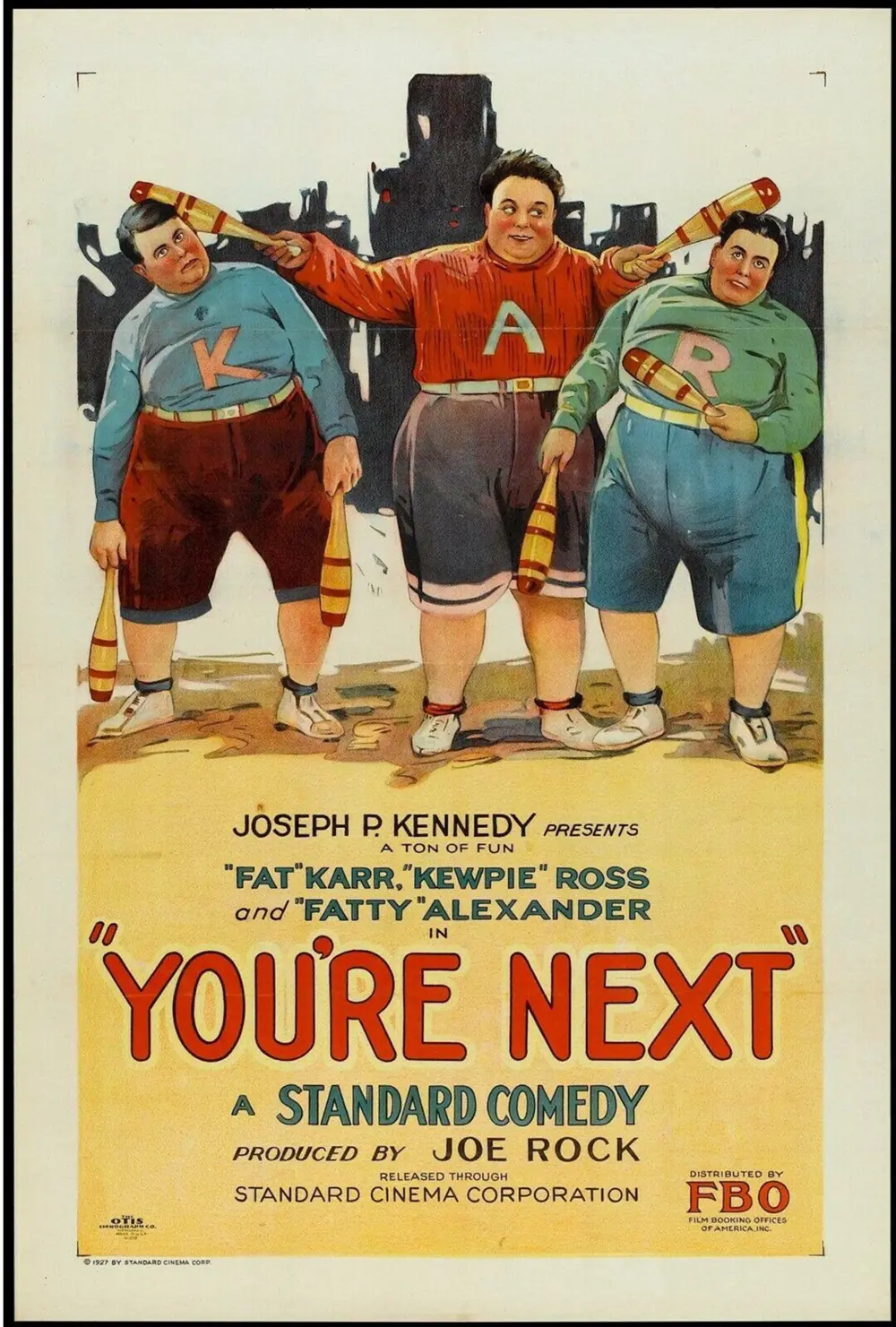
Is You're Next (1927) worth your time in the modern era? Short answer: No, unless you are a dedicated historian of silent-era slapstick or have a niche interest in the 'Ton of Fun' comedy troupe.
This film is specifically for those who appreciate the raw, unrefined energy of 1920s shorts and can overlook the repetitive nature of its central gimmick. It is absolutely NOT for viewers who require narrative logic, nuanced character development, or humor that doesn't revolve entirely around the physical dimensions of its cast.
1) This film works because it embraces the total surrealism of early slapstick, where walls are thin enough to pull a man in a bathtub through them and beards contain livestock.
2) This film fails because the humor is entirely one-note, relying on the physical size of the actors for every single punchline without any meaningful variation.
3) You should watch it if you want to see the primitive, chaotic origins of the Three Stooges' barbershop gags or if you are researching the evolution of the 'fat man' archetype in early cinema.
The film relies heavily on the 'Ton of Fun' trio: Hilliard Karr, Frank Alexander, and Kewpie Ross. In 1927, the mere sight of three large men performing synchronized movements was considered a sufficient comedic hook. While modern audiences might find the 'fat jokes' tiring, there is an undeniable technical skill in their coordination. The opening scene, where they roll out of bed to the command of a radio broadcaster, is a masterclass in low-brow timing. They move as a single, hulking unit, a precursor to the more sophisticated choreography seen in later groups like the Three Stooges.
One specific moment that stands out is the 'Ups and Downs' exercise. As they pull on their pulley-weights, the wall behind them literally gives way, revealing a man in a bathtub. This isn't just a gag; it’s a rejection of domestic reality. The neighbor’s complaint—that taking a bath is bad enough without making a 'personal appearance'—is the sharpest line in the film. It highlights the intrusive, destructive nature of the trio's existence. They don't just occupy space; they ruin it. This is a common theme in early comedy, seen in films like My Hero!, where the protagonist's incompetence is a force of nature.
The middle act of the film shifts to a barber school, a setting that has been a staple of comedy from Chaplin to the Three Stooges. However, You're Next (1927) takes a more grotesque approach. When one of the boys uses clippers to plow a literal path through a customer's hair, from forehead to nape, the film moves away from slapstick into something more akin to body horror. The customer’s reaction is muted, which only adds to the dreamlike, or perhaps nightmarish, quality of the scene.
Then there is the pigeon. As one of the boys begins to trim a customer's beard, a live bird flies out. This is a classic 'gag for the sake of a gag' that defies any attempt at logic. Why was the pigeon there? How did the customer not notice? The film doesn't care. It prioritizes the visual surprise over everything else. This lack of internal logic is similar to the frantic pacing found in The Teaser, where the narrative is merely a clothesline for increasingly bizarre visual stunts.
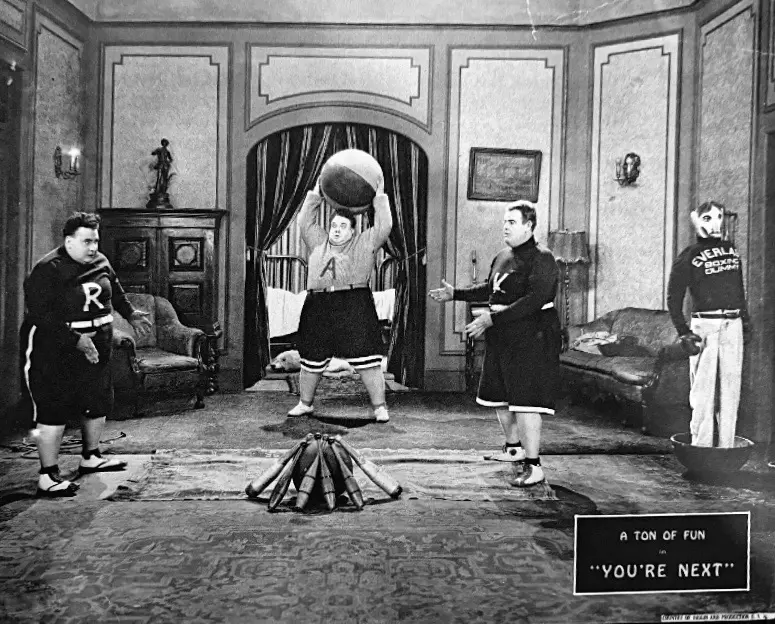
From a technical standpoint, the film is primitive even for 1927. The cinematography is static, relying on wide shots to capture the full scale of the physical comedy. There is little use of the close-up to emphasize emotion, which makes the characters feel like props rather than people. The pacing is also problematic. The transition from the apartment to the street via a rowing machine is clever, but it goes on far too long. The joke is that they are late for work, yet the film lingers on the journey until the kinetic energy of the opening is lost.
The editing is functional but lacks the rhythmic precision found in the works of Buster Keaton. In Keaton's films, every movement is calculated to lead into the next. In You're Next, the gags feel disconnected. The floor collapsing under the medicine ball is a major event, yet it is immediately forgotten once they hit the street. There is no consequence, only the next bit. This 'reset' button approach makes the film feel like a series of sketches rather than a cohesive story, a flaw also present in Brass Buttons.
If you are looking for a laugh-out-loud comedy that resonates with modern sensibilities, the answer is a resounding no. The humor is based on physical tropes that have been refined and improved upon by every generation that followed. However, if you are interested in the 'mechanics' of humor—how a gag is constructed from a simple premise like 'three large men in a small room'—then there is value here. It is a window into what 1920s audiences found hilarious, which was often the simple subversion of physical expectations.
Pros:
The film features high-energy practical effects, such as the undulating floor and the rowing machine chase. Lois Boyd provides a necessary, grounded presence as the manicurist, offering a brief respite from the trio's madness. The film is a fascinating historical document of the 'Ton of Fun' troupe's peak popularity.
Cons:
The narrative is virtually non-existent, serving only as a vehicle for gags. Much of the humor feels mean-spirited or lazy by today's standards. The 'Two-Gun Man' ending feels like a rushed attempt to find a resolution where none naturally existed, a common trope in lower-budget shorts of the era like I'll Get Him Yet.
You're Next (1927) is a loud, sweaty, and occasionally inventive relic. It works. But it’s flawed. It captures a moment in cinematic history where the camera was still a novelty and the performers were still figuring out the boundaries of the frame. While it lacks the heart of a Chaplin film or the structural genius of a Lloyd production, it possesses a certain 'punk rock' disregard for reality. It is a film that would rather break a floor than build a character. For most, it will be a curiosity; for a few, a treasure; for the rest, a chore. It is a loud echo from a silent era that doesn't quite know when to stop shouting.
IMDb —
1924
Community
Log in to comment.