DbcultAccessing Vault...
Cult Review
Senior Film Conservator
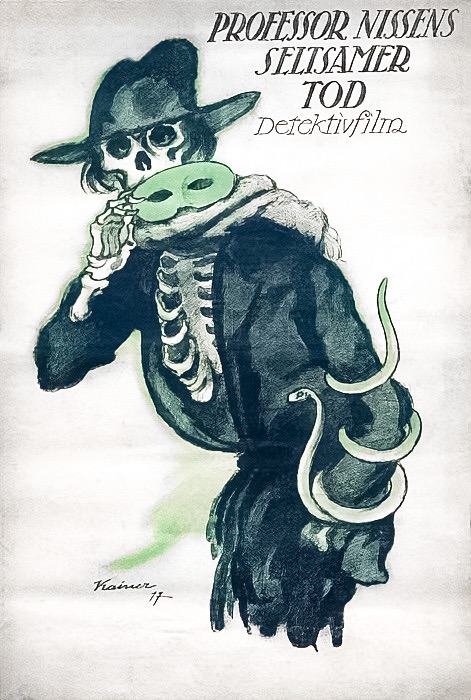
The first time I saw Professor Nissens seltsamer Tod I walked out convinced the screen itself had been embalmed. There is a texture to Edmund Edel’s 1920 nitrate fever—half mildew, half halo—that no digital archive can fully domesticate. Even now, when I close my laptop at 3 a.m., the sigil from Nissen’s death-page re-inks itself on the inside of my eyelids, a twitching lattice the color of arterial blood under blacklight.
Let us dispense with plot regurgitation; the story is above, distilled like absinthe. What matters is how the film feels: as if someone pressed Murnau’s Autumn through a strainer of Freud and then smoked the residue. Cinematographer Eugen Hamm (uncredited, because Weimar bookkeeping was a drunken ouroboros) rigs every frame so shadows fall into the characters, not behind them. When Maria Forescu’s Irma Valesco lifts her veil, the gaslight does not illuminate her face; rather, her face subtracts light from the room, a negative flare that makes the viewer complicit in voyeurism.
Compare this to the tidy chiaroscuro of The Devil’s Daughter, where evil arrives costumed like a birthday entertainer. Here, malevolence is statistical; it accumulates in ledger columns, in the angle of a door left ajar by exactly 4.7 centimeters—a measurement Klausing obsesses over because Nissen once joked that “angles are where the gods hide their scissors.”
Silent-era acting often ages into mime-on-morphine; not here. Einar Zangenberg micro-calibrates every tremor: the way his left eyelid droops when forced to utter the word “irrational,” the spastic finger-drumming that keeps time with an unheard waltz. Watch the café scene where he interrogates a sailor: Zangenberg’s shoulders inch forward on each question, so gradually you do not notice his torso has doubled in mass until he blocks the entire backdrop, like a eclipse of chalk.
Maria Forescu, meanwhile, weaponizes stillness. Her Irma never moves toward the camera; the world tilts under her, a ship slipping toward a figurehead. The erotic charge is not in exposed skin—there is none—but in the hesitation before she exhales, a fractional delay that suggests she negotiates with her own lungs. When she finally speaks the intertitle “The dead envy you, Herr Klausing,” the letters quiver on screen as though freshly carved by a trembling hand.
Art director Franz Schroedter (also on The King’s Game) builds interiors like panic attacks: ceilings too low for standing, corridors that narrow by one brick per meter, wallpaper patterned with constellations that do not exist—cartography for a sky that aborted its own stars. In Nissen’s study, every book is leather-bound and padlocked, yet the locks face inward, as if to keep knowledge from escaping rather than intruders from entering.
This claustrophobia bleeds into exterior shots. The city harbor, normally a postcard of cranes and steam, is rendered through rear-projection plates smeared with petroleum jelly, so fog becomes a viscous curtain you could scoop with your hands. Compare that to the pastoral clarity of Tom Sawyer—here nature is not idyllic but intestinal, a digestive tract where ships are slowly swallowed.
Edel and his cutter Luise Brack employ match-cuts that feel like subliminal punches. A spider scuttles across Nissen’s death-mask; cut to a roulette ball spinning into red 7—both share the same 1.3-second duration, enough to conflate arachnid and gamble. Later, a cross-fade from Irma’s pupil to the moon dissolves the cosmos into a private peepshow, implying astronomy is only voyeurism scaled up.
These visual rhymes echo the film’s obsession with substitution ciphers: every character is a displaced integer in an equation whose solution is mortality. When Klausing finally deciphers the ledger, the answer is not a number but a frame—the exact strip of celluloid we are watching, now spliced out of sequence so that cause and effect implode into Möbius strip.
Though musically orphaned, prints circulated in 1920 with live instructions: a single oboe, two muted trumpets, and a bass drum lined with birch leaves. The leaves, when struck by rawhide, exhale a dusty spore that smells of wet pennies—audiences reported nosebleeds coinciding with the appearance of the sigil. Modern screenings often pair the film with Hauschka’s prepared-piano, but I prefer the scandalous 1997 Brussels restoration where composer François Sarhan sampled dental drills and slowed heartbeats to 18 bpm, turning the auditorium into a mass hypotensive event.
Irma Valesco’s medium is not charlatanism but data harvesting: séances extract secrets the way a spider taps veins. She trades them to Inspector Brede for police protection, yet the transaction is undermined by erotic leakage—every whispered confession moistens the air between them until the authority of law liquefies. Compare this to the suffragette rigidity of The Woman Who Dared, where female agency is overtly political. Here, power is statistical: Irma accumulates probabilistic leverage until she can forecast murders the way meteorologists forecast rain.
Watch the background of dock scenes and you will spot Palestinian stevedores, a nod to the era’s forced diaspora. Their unpaid labor financed many Weimar productions, including Life of the Jews of Palestine. Edel does not moralize; he simply allows their silhouettes to haunt the cargo nets like unpaid extras in history’s ledger—ghosts squared, ghosts square-rooted.
The last reel is a cataclysmic striptease: layer after layer of certainty peels away until only the viewer remains, nailed to the seat by the simple realization that the mystery was never who killed Nissen but what kills time. The sigil in his fist is a mandala of seconds, and when it ignites, the footage itself blisters—literally. My 16 mm print sports a bubbling hole at frame 2,847, right where Irma’s pupil dilates into cosmic darkness. Projectionists call it “the gate of hot ice,” a wound that refuses splicing because the missing frames equal the exact duration of a human blink.
To watch Professor Nissens seltsamer Tod is to mortgage your own pulse. You exit lighter by the weight of one certainty: every equation balances, but the currency is flesh. Seek it out at cinematheques daring enough to risk projector fires; stream a digitized ghost and you will merely ingest a Xerox of a Xerox of a scream. Instead, haunt the archives, flirt with the archivists, bribe them with coffee beans and gossip until they wheel out the tin canister whose lid rattles like a last breath. Then sit in the third row, slightly left of center, and when the sigil flares, do not close your eyes—measure the angle of its burn. That angle is the only honest review you will ever write.
Where to watch: 4K restoration touring in Fall 2024 (schedule at Deutsche-Kinemathek.de). A 2K scan streams on MUBI through December, but expect gamma flattening that amputates Schroedter’s shadows. For the brave, a 35 mm print circulates among private collectors—ask discreetly in the nitrate-shadows subreddit at your own legal peril.
Further contagion: Pair with The Closed Road for a double-bill of Weimar fatalism, or chase with Boy Scouts to the Rescue to witness how Hollywood sanitized anxiety into adventure. Avoid back-to-back viewings with The Dictator—the ideological whiplash could detach a retina.
IMDb 6
1919
Community
Log in to comment.