DbcultAccessing Vault...
5.5/10
Senior Film Conservator
A definitive 5.5/10 rating for a film that redefined the boundaries of cult cinema. The Silent Avenger remains a cornerstone of transgressive art.
Is 'The Silent Avenger' (1927) worth your time today? The short answer is a resounding yes, though with specific caveats. This film is an absolute treat for silent film aficionados, early cinema historians, and anyone with a soft spot for animal performers. However, those seeking modern narrative pacing or complex character studies will likely find its charms limited.
It’s a fascinating historical artifact that, against all odds, still manages to entertain thanks almost entirely to its four-legged star. This isn't just a movie; it's a window into an era where narrative simplicity met genuine, unadulterated spectacle, often delivered by a remarkably talented dog.
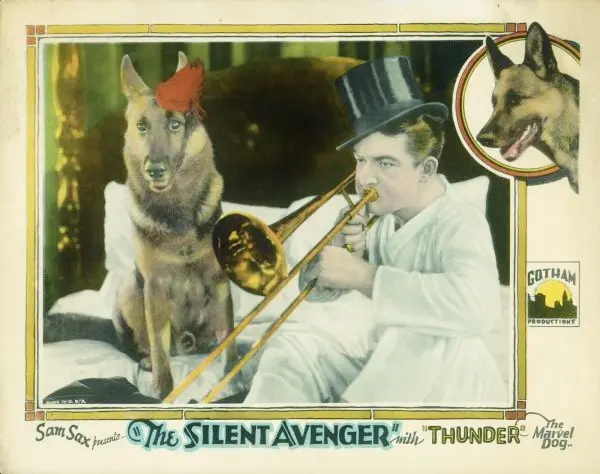
Let’s be brutally honest: without Thunder, 'The Silent Avenger' would likely be a footnote, if that. The film hinges entirely on the incredible performance of its canine lead, and it’s a masterclass in animal acting for any era. Thunder is not merely a prop; he is the undisputed protagonist, the moral compass, and the primary driver of the plot’s most thrilling moments.
From his initial introduction as Stanley Gilmore’s loyal companion, Thunder quickly establishes himself as far more than just a pet. He’s an active participant in every major conflict. Consider the scene where he thwarts Bill Garton’s attempt to steal crucial documents from Stanley. The intelligence in his eyes, the swift, decisive action — it’s genuinely impressive and completely sells the stakes.
But Thunder's heroism truly shines in the more elaborate set pieces. His battle with a wild bear in defense of Little Bud Wade is choreographed with a surprising level of intensity for a film of its time. It’s a raw, visceral sequence that could easily feel staged, yet Thunder’s commitment makes it feel genuinely perilous.
Even more remarkable is the sequence where Thunder saves Bud from drowning at the hands of the villains. The underwater photography, though rudimentary, captures the struggle effectively, and Thunder's unwavering determination to pull the boy to safety is genuinely moving. These moments aren't just cute; they are critical narrative beats that propel the story forward with a compelling emotional core.
His final act of heroism, rescuing Stanley from kidnapping and then flagging down a train, is the stuff of legend. It’s a sequence that demands a significant suspension of disbelief, yet Thunder’s conviction sells it. This dog isn't just performing tricks; he’s embodying a character, expressing loyalty, bravery, and intelligence that frankly outshines most of his human co-stars.
Thunder is not merely a prop; he is the undisputed protagonist, the moral compass, and the primary driver of the plot’s most thrilling moments.
Directed by William Wyler, though credited to others given the nature of early Hollywood production, 'The Silent Avenger' offers a fascinating look at how narratives were constructed in the silent era. The storytelling is remarkably direct, relying heavily on visual cues and intertitles to convey plot points and character motivations. There’s a charming simplicity to it all, a refreshing lack of pretension.
The pacing, by modern standards, might feel deliberate, even slow at times, but it allows the audience to absorb the visual information and connect with the characters (or at least, the dog). Action sequences, though less frenetic than today’s blockbusters, are staged with a clear understanding of spatial relationships and dramatic tension. The camera work, while not groundbreaking, is functional and effective, often employing close-ups on Thunder’s expressive face to convey emotion or intent.
The film’s tone is straightforward adventure, with clear heroes and villains. There’s no moral ambiguity here; Stanley is on a path to redemption, the Wades are good, honest folk, and the rival railroad men are unequivocally evil. This clarity is part of its charm, making it an accessible piece of cinema even for those less familiar with silent films.
It’s a testament to the filmmakers’ craft that they could weave such a compelling, action-packed story with the limited tools of the time, especially when working with an animal star. They understood what would captivate an audience, and they leaned into it with gusto.
While Thunder commands the screen with undeniable charisma, the human cast, bless their hearts, often feel like animated props by comparison. Clarence Wilson, as Stanley Gilmore, embodies the 'wild escapades' turned 'atonement' arc adequately, but his performance rarely transcends the archetypal silent film hero. His expressions are broad, his gestures emphatic, but there’s a distinct lack of nuanced internal life.
Patsy, portrayed by Duane Thompson, is the quintessential farmer’s daughter, kind and pure, serving primarily as the romantic interest and a figure of innocence for Stanley’s redemption. Her scenes with Stanley are sweet but lack the spark that might elevate them beyond narrative necessity. Their chemistry is more implied by the script than truly felt through their interactions.
The villains, including George Chesebro as Bill Garton and Charles Delaney as Joe Sneed, are painted with similarly broad strokes. They are recognizably nefarious, their sneers and furtive glances leaving no doubt as to their intentions. The corrupt sheriff, a classic silent film trope, is predictably menacing. These performances serve the plot’s clear-cut morality but don't offer much in the way of character depth.
It’s harsh to critique silent film acting through a modern lens, as the conventions were vastly different. Actors were often required to project emotions to the back row of a vast theater without dialogue. However, even within those conventions, the human performances here feel more like necessary components of the plot machine rather than truly engaging characters. They exist to react to Thunder’s heroics or to provide obstacles for him to overcome.
The film’s setting in rural Tennessee provides a backdrop of rustic charm, captured through relatively simple but effective cinematography. The outdoor shots of rolling hills and farm life ground the fantastical elements of Thunder’s heroics in a recognizable, wholesome environment. There’s an authenticity to the natural landscapes that contrasts sharply with the corporate machinations driving the plot.
The tone is consistently adventurous and optimistic, even during moments of peril. There’s an underlying belief in justice and the triumph of good over evil that permeates every frame. This moral clarity, while perhaps simplistic, is ultimately reassuring. The film never wallows in darkness; it’s a story about overcoming challenges through courage and loyalty.
The use of light and shadow, typical for the era, is straightforward but effective in creating mood and emphasizing dramatic moments, particularly during the kidnapping and rescue sequences. While not a visual masterpiece on par with some of its contemporaries, 'The Silent Avenger' utilizes its visual language competently to tell its story.
Yes, 'The Silent Avenger' is absolutely worth watching today, especially for specific audiences. It offers a unique window into early cinema. The film's primary draw is Thunder's incredible performance. It's a testament to animal training and direction. Expect a simple narrative, clear heroes and villains. The human acting is often broad, but the dog's actions are captivating. It's an important historical document for film buffs. It also provides pure, unpretentious entertainment.
The narrative structure of 'The Silent Avenger' is quite episodic, a common characteristic of silent adventure films. Each major act presents a new challenge for Stanley and, more importantly, Thunder, to overcome. This structure keeps the plot moving forward, albeit in a somewhat predictable fashion. The villains are relentless, and Thunder is always there to save the day, often just in the nick of time.
The intertitles are used extensively to bridge gaps in the action and provide exposition. While essential for conveying dialogue and internal thoughts in a silent film, their frequency can sometimes interrupt the flow for modern viewers accustomed to purely visual storytelling. However, they are generally concise and to the point, serving their purpose without excessive verbosity.
The overall pacing feels deliberate, allowing scenes to unfold without the rapid-fire editing we see today. This gives the audience time to process the visual information and to appreciate the physical stunts and animal performances. It’s a slower burn, but one that builds momentum through a series of escalating threats and heroic rescues.
The film is not subtle. The stakes are always clear, the motivations transparent. This directness is both a strength and a weakness. It ensures accessibility, but it leaves little room for thematic complexity or character introspection. It’s an adventure film, pure and simple, designed to thrill and entertain without much deeper thought.
The central theme of 'The Silent Avenger' is arguably redemption. Stanley Gilmore begins as a 'wild escapades' type, seeking to atone for past misdeeds. His journey to Tennessee and his interactions with the honest Wade family, coupled with the unwavering loyalty of Thunder, serve as his moral crucible. By the end, he has not only secured the right-of-way but also found personal happiness and, presumably, a more grounded sense of self.
Loyalty, particularly that of Thunder, is another dominant theme. The dog’s devotion to Stanley is absolute and unwavering, serving as a powerful emotional anchor for the film. Thunder’s actions consistently highlight the virtues of faithfulness and courage, often in stark contrast to the human villains' greed and treachery.
There’s also an underlying commentary on corporate greed and the clash between industrial progress (the railroad) and traditional rural life. While not deeply explored, the conflict over the right-of-way frames the human drama. The villains represent the corrupting influence of unchecked ambition, while the Wade family embodies a simpler, more virtuous existence. It's a classic good-vs-evil setup with minimal shades of gray.
These themes are presented with a straightforwardness typical of the era, without intricate subtext or psychological depth. The film prioritizes clear moral messages and exciting action over nuanced exploration of human nature. This isn't a flaw, but rather a characteristic of its time and genre, making it an honest and unpretentious piece of entertainment.
'The Silent Avenger' is a delightful, if somewhat uneven, journey back to the golden age of silent cinema. It works. But it’s flawed. Its greatest asset, without question, is Thunder the Dog, whose performance alone justifies the price of admission (or the click of a play button). He imbues the film with a heart and an excitement that the human cast, through no fault of their own, simply cannot match.
For those willing to embrace the conventions of a bygone era, this film offers genuine thrills, a clear moral compass, and a healthy dose of pure, unadulterated escapism. It’s not a masterpiece of cinematic artistry, but it is a profoundly charming and historically significant piece of entertainment. Give it a watch, if only to marvel at the incredible talent of its four-legged star. You might just find yourself rooting for Thunder with the same fervor audiences did nearly a century ago.
IMDb —
1924
Community
Log in to comment.