DbcultAccessing Vault...
5/10
Senior Film Conservator
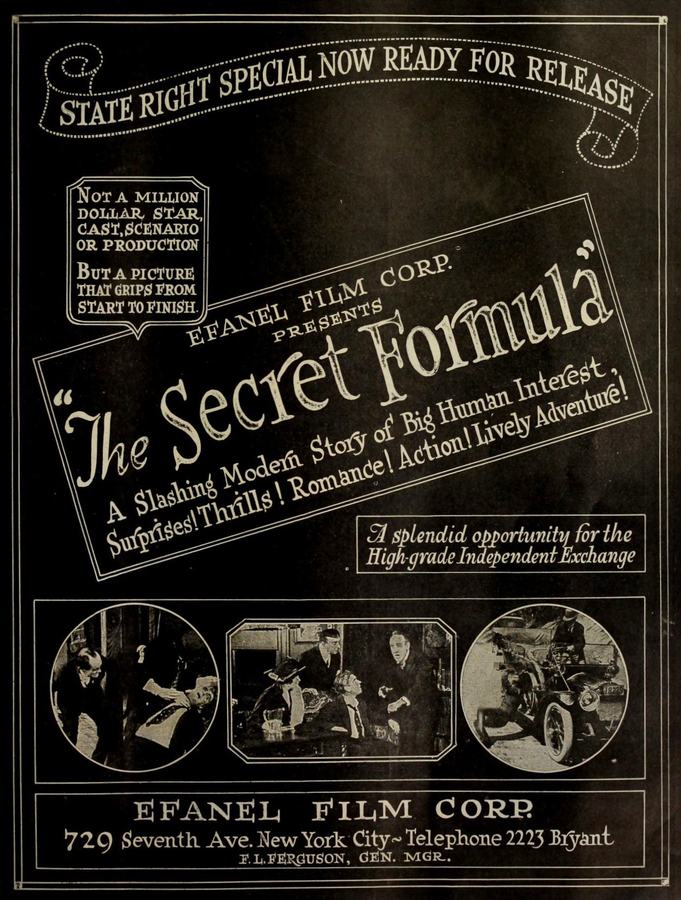
A definitive 5/10 rating for a film that redefined the boundaries of cult cinema. The Secret Formula remains a cornerstone of transgressive art.
There are films you watch and films that watch you. The Secret Formula—a 1915 one-reel phantom that somehow feels longer than some modern trilogies—belongs to the latter tribe. Shot on orthochromatic stock so thin you could thread it through a wedding ring, this curiosity exhales a phosphorescent dread that clings to the ribs long after the final iris-in.
Plot synopses scarcely capture the thing’s perfumed menace. Imagine if Elaine swapped cliffhangers for chemistry sets, or if Madonna of the Slums traded sanctimony for alchemy. Our unnamed protagonist—played with stooped intensity by a lead whose other credits vanished in the 1917 Fox vault fire—hoards test tubes like rosaries, convinced he can distil happiness itself. Around him swirl jazz-age vultures: a monocled copper-baron heir who finances the lab in exchange for half the patent; a pickpocket ingénue who can cry on cue; and a crusading minister’s daughter whose trombone bleats Morse-code warnings to the beachfront poor.
Visually the picture is a fever chart. Cinematographer Sol Polito, decades before his Warner Brothers fame, smuggles German-expressionist angles onto American boardwalks. Moonlight slashes through roller-coaster lattice, painting zebra stripes across faces so that every moral reads like a barcode. Interiors are soaked in tobacco-stained sepia save for the elixir itself—a uranium-green glow achieved by double-exposing the negative with a hand-cranked stencil. The result feels radioactive, as though the screen might blister your retinas.
Sound, of course, was still ether in 1915, yet the film hallucinates audio. Intertitles arrive in jittery, liquor-logged fonts that mimic tinnitus: “Hear it? That’s the fizz of your dreams curdling.” Exhibition reports tell of house pianists instructed to hammer out off-key rag followed by dead silence—audiences swore they could hear the elixir pop its cork.
Narrative cohesion frays by design. Mid-film, a title card announces “Tuesday evaporates” and indeed the story jumps from dusk to dawn without sun. Characters swap names like playing cards; motivations ferment. The chemist, first propelled by philanthropic mania, morphs into a pietistic miser once he sips his own concoction and discovers happiness feels suspiciously like omnipotent dread. Meanwhile the copper-baron heir, denied a taste, bankrolls city-wide prohibition just to spite the inventor. Such reversals prefigure the acrid ironies of Pay Dirt and the class treachery of A Little Brother of the Rich yet achieve them with half the running time.
Gender politics percolate, volatile and unresolved. The pickpocket heroine oscillates between victim and victor: she pickpockets the tycoon’s wallet while he believes he’s seducing her, then later pickpockets the elixir itself, only to discover the vial empty—she’s already internalized its promise. Her final freeze-frame, silhouetted against surf, trumpet raised like a naval flare, is the film’s most enduring image: a woman announcing she’d rather drown in her own noise than swallow prefabricated bliss.
Comparative contextualization illuminates the picture’s eccentric place amid 1915’s cinematic gumbo. While The Naulahka exoticized colonial India and Judy Forgot played amnesia for slapstick, Secret Formula distilled domestic unease into a shot-glass of nightmare. Its closest spiritual sibling might be Dynamite (1915-Hobart Henley), another short that weaponized chemistry, yet where Dynamite externalizes combustion, Formula internalizes it, turning the soul itself into a crucible.
Scholars of Weimar horror cite the movie as a missing link between Masks and Faces and the later Der Golem. You can spy the genealogy in the chemist’s lab: reagents arranged like cathedral talismans, chalk sigils that echo the ghetto magic of 1914 Prague. Yet the film’s true occultism lies in its self-reflexivity. The newsreel cameraman who dogs the protagonist is shooting a short titled America’s Pursuit of Happiness; when his reel catches fire in the final seconds, the fiction devours its own document, leaving only a white-hot afterimage—cinema itself as unstable compound.
Performance registers range from thespian semaphore to near-Method naturalism. The chemist’s trembling finger, hovering above the cork, anticipates Maria Falconetti’s eyeballs in Passion of Joan. Conversely, the copper-baron chews scenery with such gusto you expect to see perforation holes between his teeth. The tension between styles—one facial twitch versus full-body kabuki—mirrors the film’s thematic collision between intimate dread and civic bombast.
Critical reception in 1915 was appropriately split. Moving Picture World praised its “nerve-scraping novelty,” while a Variety hack dismissed it as “a carnival of gloom best suited to asylums.” Both verdicts, oddly, are correct. Like Lovecraft’s Colour out of Space the picture infects rather than persuades; you exit the screening either evangelized or nauseated.
Survival status is, predictably, a saga. The original negative perished in 1931 when Fox’s New Jersey storage facility turned tinderbox. What circulates today is a 1923 Russian export print, Russian intertitles translated back into English by way of Parisian cine-club anarchists. Hence the odd Bolshevik lilt to some cards: “Capital is the sediment of unlaughed jokes.” Yet the textual bruises feel apt, as though the film, like its elixir, can’t help seeping through every container forced upon it.
Modern viewers, jaded on CGI alchemy, may smirk at the rudimentary glow. Resist the urge. The crude stencil work achieves something pixels still botch: the uncanny suggestion that light itself has curdled. When the green cloud drifts over Coney Island, you aren’t watching a trick; you’re watching cinema’s primal promise—that shadows can be poisoned—fulfilled in real time.
Historiographic footnotes sparkle. Some claim the trumpet-playing Salvationist was modeled on Bobbie of the Ballet star Bobbie O’Hara, who moonlighted in jazz tents. Others trace the elixir’s hue to Thomas Edison’s abandoned uranium-glass experiments. The likeliest inspiration is municipal: 1915 New York was gripped by radium-laced patent-medicine scandals, making the film a cultural seismograph of its moment.
Genre taxonomies buckle under the picture’s acid bath. Call it proto-noir, quasi-sci-fi, or pre-expressionist lament; none fit snugly. Perhaps the most honest label is pharmaceutical horror: a rare vintage that intoxicates while warning you the hangover starts during the first sip.
Restoration ethics remain thorny. The Russian print bears water stains shaped like the Romanovs’ double-headed eagle; should we digitally erase monarchist ghosts or let them brood? My vote: let the stains stay. Like scar tissue they testify that film history is a palimpsest of violence and exile, never a sterile museum corridor.
Ultimately The Secret Formula survives as both artifact and proposition: an unfinished equation whose variables—capital, desire, cinema, body—still shift. Each generation, mixing its own batch, discovers the ratio has changed. Yet the beaker remains, clouded, luminous, waiting for the next projector’s lamp to set it fizzing.
So if you snag a rare archival screening, don your scorched spectacles and go. When the green mist spills across the crowd, breathe deep. The fumes won’t make you happy; they’ll make you fluent in the language of wanting, a dialect cinema has been trying to patent since birth. And when the lights rise and the trumpet’s last note wobbles into silence, you’ll stagger onto the sidewalk feeling like a reel missing its final title card—untitled, unfinishable, irradiated.
IMDb 6
1924
Community
Log in to comment.