DbcultAccessing Vault...
Cult Review
Senior Film Conservator
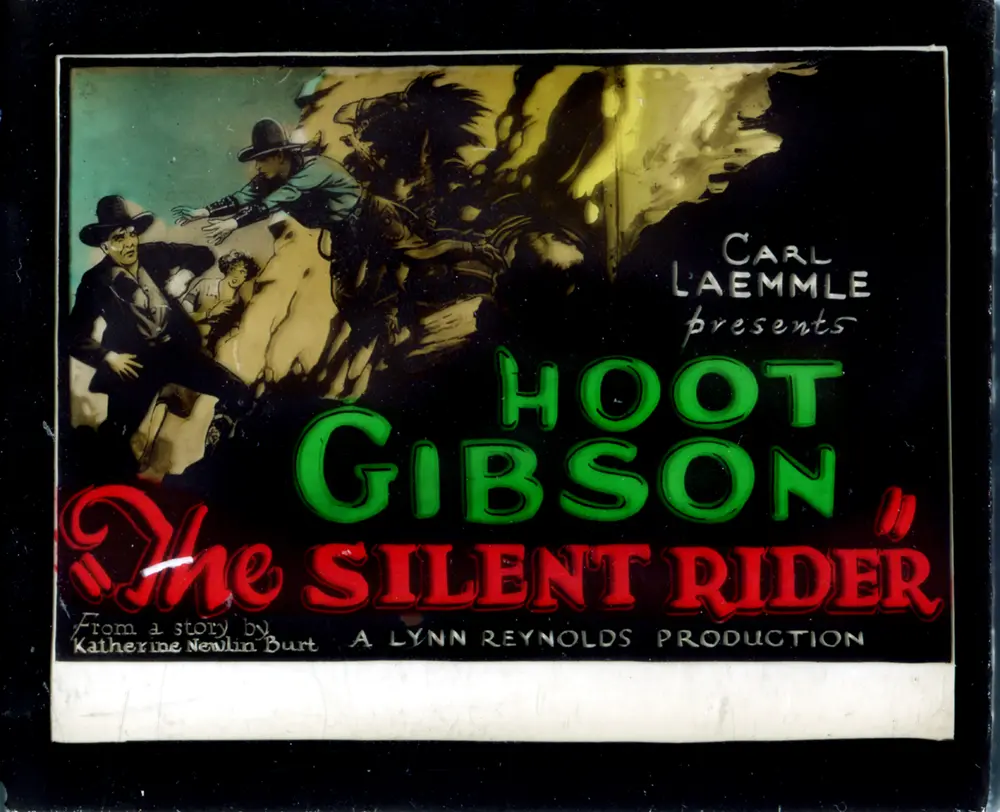
Is The Silent Rider a film you should track down in the digital archives today? Short answer: yes, but only if you appreciate the eccentric, genre-bending experiments of the late silent era rather than a straightforward cowboy shootout.
This film is specifically for those who enjoy the 'smiling cowboy' persona of Hoot Gibson and can tolerate a story that changes its identity three times in seventy minutes. It is absolutely not for viewers who demand the gritty, dusty realism of modern westerns or the moral gravity of a John Ford epic.
The Silent Rider is worth watching for its historical value and its sheer weirdness. In an era where many westerns were becoming formulaic, Hoot Gibson was pushing into a territory that felt more like a situational comedy than a frontier myth. The first half of the film is genuinely funny, bordering on the absurd. However, the sudden shift into a crime procedural in the final act creates a jarring experience. It is a fascinating relic of a time when Hollywood wasn't quite sure if westerns should be funny, tragic, or both.
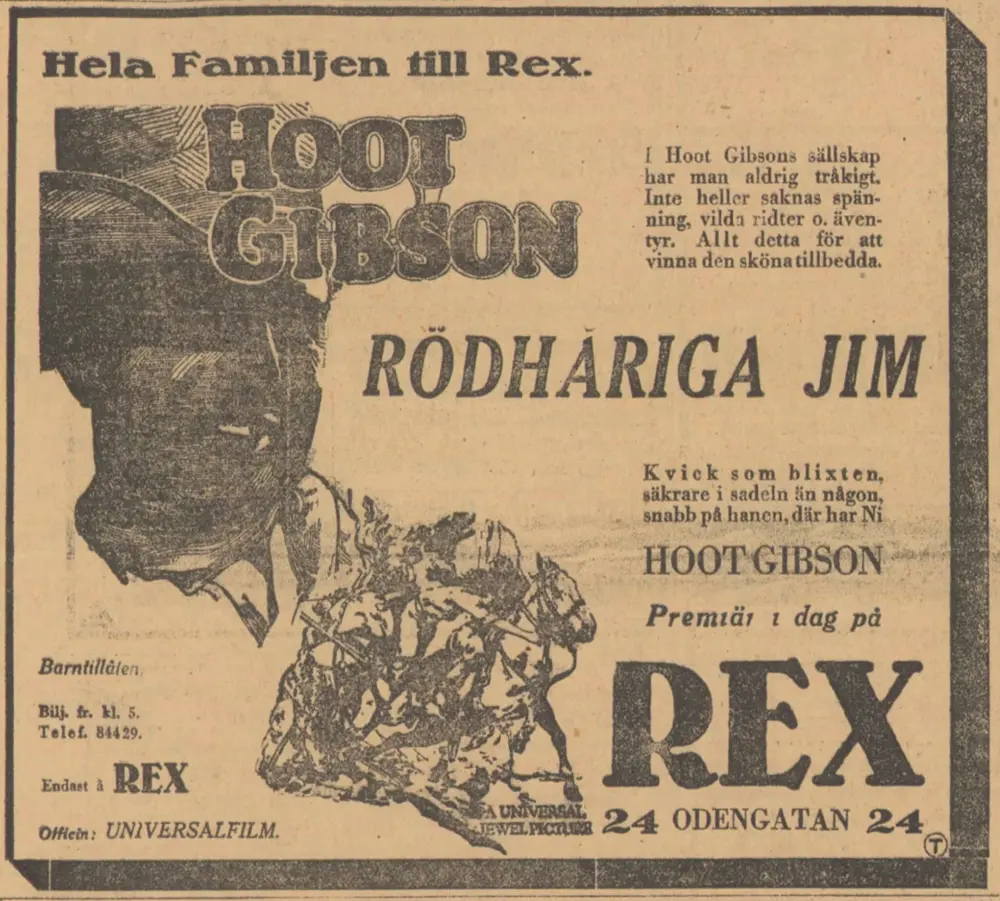
1) This film works because Hoot Gibson’s natural charisma carries the audience through an increasingly ridiculous plot.
2) This film fails because the transition from a hair-dyeing comedy to a mine-robbery drama is clunky and unearned.
3) You should watch it if you want to see how silent cinema handled the 'domestic western' subgenre before the talkies arrived.
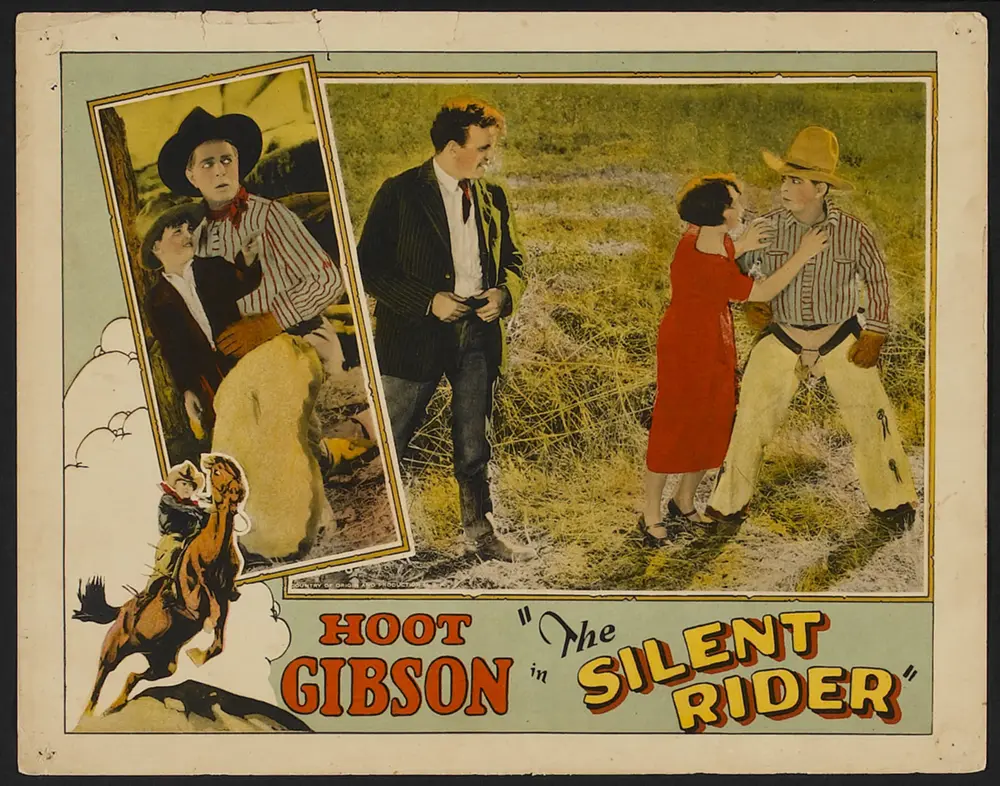
The central hook of The Silent Rider is, frankly, bizarre. Marian Faer arrives at the ranch and announces her preference for redheaded men. This sets off a sequence of events that feels more like a 1950s sitcom than a 1920s western. Watching grown men, including the legendary Hoot Gibson, obsess over hair dye is a subversion of the hyper-masculine cowboy trope. It’s a bold choice. It works. But it’s flawed.
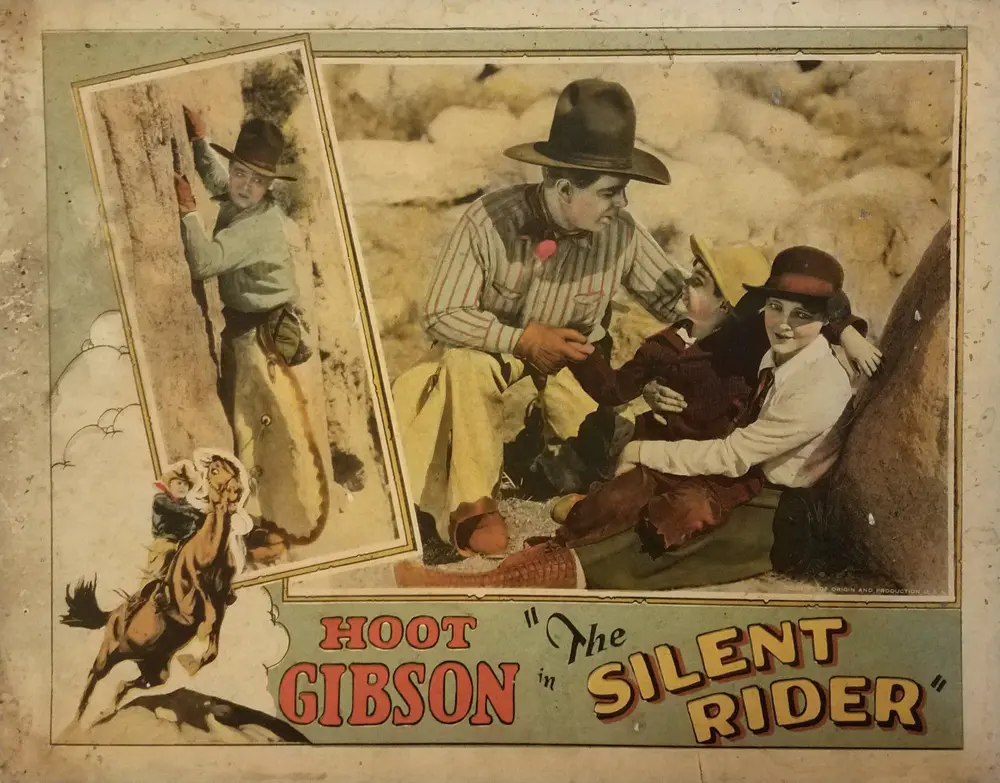
Consider the scene where Jerry (Gibson) and his companions are huddled around, trying to manipulate their appearance for a woman’s whim. This stands in stark contrast to the rugged stoicism seen in films like Border Justice. It humanizes the cowboy, making him a figure of ridicule rather than an untouchable icon. This was Gibson’s specialty—he was the relatable hero, the man who could ride a horse but also look like a fool for love.
However, the comedy is stretched thin. The joke about the hair dye is repeated until it loses its luster. By the time the 'real' redhead, Wender, shows up, the audience is ready for the plot to actually move. The film lingers too long in the bunkhouse when it should be out on the range.
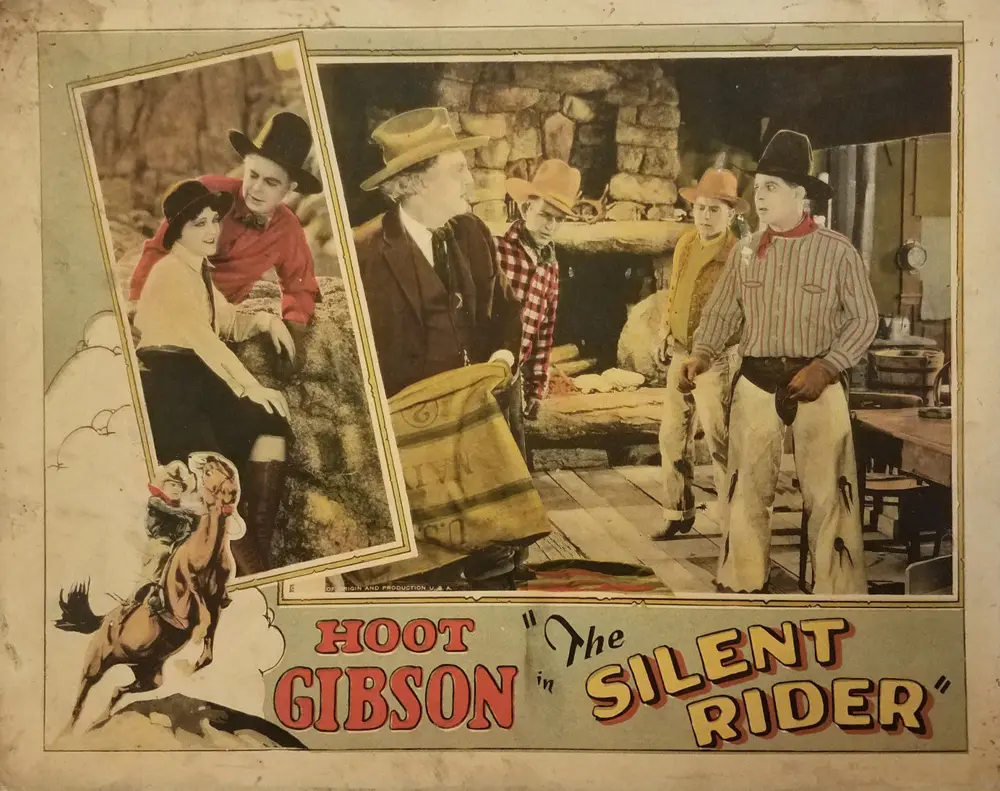
The most striking aspect of The Silent Rider is its lack of tonal consistency. One moment we are laughing at Jerry’s vanity, and the next, he and Sourdough Jackson (played with a delightful grumpiness by Otis Harlan) are adopting an abandoned child. The child, played by Wendell Phillips Franklin, introduces a layer of sentimentality that feels borrowed from a film like Angel Child.
Suddenly, the stakes are no longer about who has the best hair, but about the welfare of a toddler and a mine robbery. Wender, the redhead who stole Marian’s attention, is revealed to be a cold-blooded criminal. The scene where Wender throws suspicion on Jerry for the payroll theft is handled with a heavy-handedness typical of the era, but it lacks the nuanced build-up found in more sophisticated dramas like The Square Deal.
This shift is where the film loses its footing. It tries to be a Hoot Gibson comedy and a William S. Hart tragedy at the same time. The result is a movie that feels like two different shorts stitched together. The villainy of Wender is so sudden and so extreme that it almost feels like he walked in from a different movie set entirely.
Hoot Gibson was not the best actor of his generation, but he was one of the most watchable. In The Silent Rider, his physicality is on full display. He doesn't just ride; he inhabits the saddle. His facial expressions during the hair-dyeing sequences are masterclasses in silent comedy. He uses his eyes to convey a sense of 'why am I doing this?' that resonates with the audience.
Unlike the protagonists in A Broadway Saint, Gibson’s Jerry Alton is grounded in a specific Western reality, even when the plot goes off the rails. He possesses a casualness that was rare in 1927. He doesn't pose; he just exists. This makes the final fight with Wender more impactful. When Jerry finally gets angry, you feel it because he’s spent the last fifty minutes being the nice guy.
The supporting cast is equally competent. Otis Harlan as Sourdough provides the necessary curmudgeonly balance to Gibson’s youthful energy. Their chemistry as 'accidental fathers' to the abandoned child provides the film’s only true emotional core, even if it is draped in 1920s schmaltz.
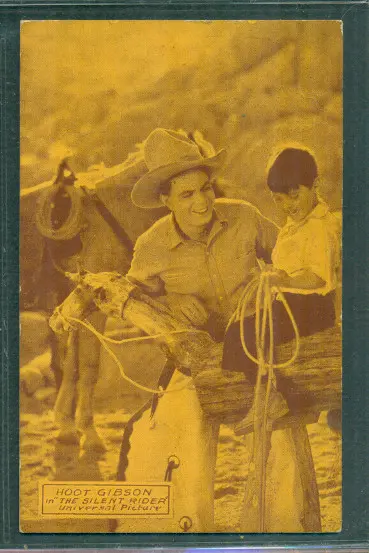
Directing a western in 1927 meant dealing with the limitations of the camera while trying to capture the vastness of the landscape. The Silent Rider manages some impressive outdoor photography. The ranch feels lived-in. The dust feels real. It lacks the stylized polish of Orchids and Ermine, but it makes up for it with a raw, documentary-like quality in its wide shots.
The pacing, however, is the film's Achilles' heel. The first two acts crawl, while the third act sprints toward a conclusion that feels rushed. The mine robbery happens and is resolved with such speed that the tension never has time to simmer. It’s a common flaw in late silent westerns, where the 'action' was often compressed into a frantic finale to satisfy the front row of the theater.
The cinematography during the final confrontation between Jerry and Wender is notable. The use of shadows and the rugged terrain of the cliffside adds a much-needed gravity to the scene. When Wender falls to his death, the camera lingers just long enough to make it feel final, a stark contrast to the lighthearted opening of the film.
Pros:
- Hoot Gibson’s charismatic and comedic performance.
- Genuine 1920s ranch locations that provide an authentic atmosphere.
- An unusual and memorable plot hook involving the hair-dyeing cowboys.
- Solid supporting work from Otis Harlan.
Cons:
- Tonal inconsistency that might leave modern audiences confused.
- A rushed and overly convenient ending.
- The 'damsel in distress' tropes are particularly dated here, even for 1927.
The Silent Rider is a strange beast. It starts as a comedy about vanity and ends as a tragedy about betrayal and death. It doesn't always work. In fact, for long stretches, it feels like a movie fighting against itself. But there is a charm to its indecision. Hoot Gibson remains one of the most likable figures of the silent screen, and his presence alone makes this worth a look for any serious cinephile.
Is it a masterpiece? No. Is it a fascinating example of the 'Smiling Cowboy' subgenre? Absolutely. It lacks the focus of The Shuttle or the thematic weight of The Bishop of the Ozarks, but it possesses a quirky energy that is hard to find in the more 'serious' westerns of the time. It’s weird. It’s dated. It’s Hoot. And for many, that will be enough.
IMDb 6.9
1934
Community
Log in to comment.