DbcultAccessing Vault...
Cult Review
Senior Film Conservator
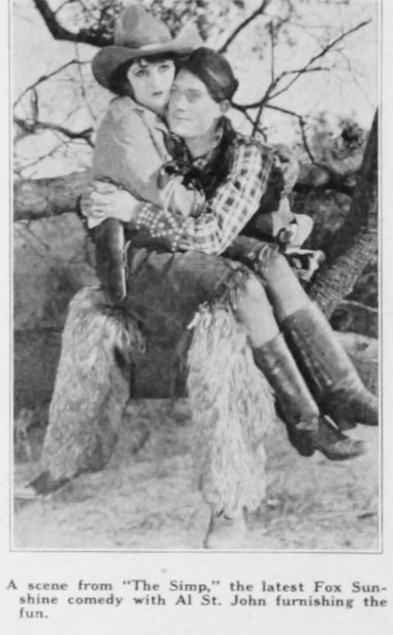
Picture a frontier where the clink of ice in a sarsaparilla glass carries more weight than a six-shooter’s roar, and you have the fizzy, fever-dream cosmos of The Simp. Shot in 1921—when Western iconography was still wet clay—this one-reel curio sculpts its own anarchic grammar: pratfalls replace pistol duels, a barrel of bootleg hooch becomes both executioner and emancipator, and the horizon line wobbles like heatstroke laughter. Director unnamed in surviving prints refuses to genuflect toward either Griffith grandeur or Sennett chaos; instead he uncorks a carbonated hybrid that predates the cocktail fusions of Chimmie Fadden Out West yet feels postmodern in its self-aware wink.
Otto Fries’s sheriff ambles through the mise-en-scène as if he’s been stitched together from cigar-store effigies and Sunday-school guilt. His legs arc in hyperbolic slo-mo, boots dragging comet tails of dust that the camera laps up like a parched coyote. Meanwhile Al St. John—Buster Keaton’s rubber-limbed contemporary—incarnates the titular simp with a vaudevillian’s elastic mug: eyebrows launch skyward like bottle-rockets, knees swivel independent of femurs, and his signature buck-toothed grin gleams brighter than the Mojave noon. The plot, gossamer as tumbleweed floss, unspools in three brisk movements: the misfire, the manhunt, and the mirage-laden danse macabre.
The soda-fountain set itself is a cubist saloon—no swinging doors, but a long zinc counter gleaming under klieg lights that bleach shadows into chalky ghosts. Patrons sip phosphates while a player-piano hammers out syncopated rag, the notes visible as jittery subtitle cards: “POP! Goes the moral compass!” When Al’s stray bullet perforates a lithograph of a temperance crusader, the image flutters to sawdust like wounded decency. Cue the chase: frames accelerate, tumbleweeds sprint uphill, and the camera—mounted on a haywagon—jounces so violently you can taste alkaline grit between your molars.
Yet the film’s bravura stroke arrives mid-gallows. As the noose cinches, the screen irises in, vignetting Al’s bobbing noggin against a hallucinated metropolis. We cut to a speakeasy bathed in amethyst light where flappers guzzle contraband gin from teacups; the camera glides past a trombonist whose slide elongates to giraffe proportions, then lands on Al—in top-hat and Cheshire grin—tap-dancing atop a mahogany bar. The intertitle, scrawled in neon-lettered animation, crows: “Who needs oxygen when you’ve got rhythm?” This Urban-Fantasia detour lasts maybe forty seconds but perforates the narrative like a subliminal postcard from Jazz-Age futurity.
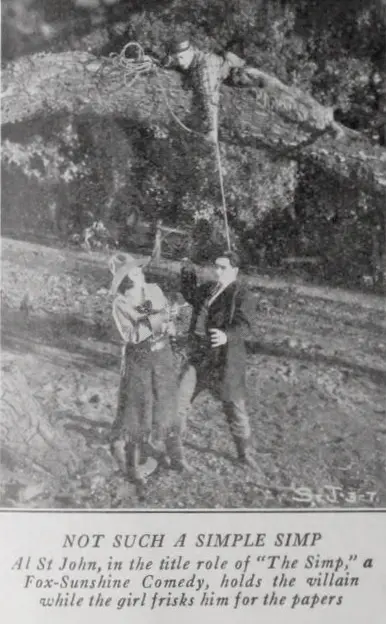
Enter the cowgirl—unnamed in the surviving continuity sheets, but christened “Dust-Devil Daisy” by contemporary fan magazines. She vaults from horizon to close-up in one match-cut, her silhouette backlit so that spurs ignite like comet spindles. A single rifle crack later, the rope splinters, Al plummets into her arms, and the pair somersault into a soft-drink vat that erupts in a Vesuvian foam of sarsaparilla. The posse, initially apoplectic, sniffs the air, detects the tell-tale aroma of fermented bliss, and converts the barrel into a communal punchbowl. Fade-out on a communal toast: the lawmen, the outlaw, the cowgirl, all swigging from tin cups as the desert night flickers with silent-film stars—those chalk-dot constellations that look like bullet-holes in black velvet.
Viewed beside the maritime melodrama Lorelei of the Sea or the continental sophistication of A Continental Girl, The Simp feels like a hiccup in the space-time continuum: too whimsical for oaters, too western for urbane romps. Its DNA resurfaces decades later in Sylvia on a Spree’s flapper slapstick and even in the bootleg surrealism of Save Me, Sadie. Yet few descendants replicate the film’s tactile effervescence—the way grainy nitrate makes soda bubbles resemble meteor showers.
Restoration-wise, the current 4K scan (courtesy of EYE Filmmuseum) retains speckles and tramline scratches, preserving the artifactual patina that digital sterility too often erases. The tinting strategy—amber for daylight, cyan for nocturnes, rose for the dream sequence—echoes early Pathé palettes but dials saturation toward pop-art punch. Mont Alto’s new score, a ragtime fever stitched with slide-whistles and temple blocks, syncs so precisely that Al’s pratfalls seem to pluck bass strings. Headphones reveal micro-rhythms: the faint wheeze of a harmonica whenever the cowgirl appears, a xylophone flutter mimicking carbonation bubbles.
Interpretive veins run rich. One can read the barrel-as-scaffold as a sly Prohibition-era jab: temperance crusaders promise salvation but threaten to drain communal joy. The dream-city speakeasy, resplendent with illegal liquor, becomes a promised land where rhythm supplants respiration. Or trace gender dynamics: Daisy’s sharpshot rewrites the damsel trope, predating the pistol-packin’ mamas of 1940s B-Westerns by two decades. She doesn’t merely rescue the male; she reconfigures the moral arithmetic of the frontier, converting vengeance into potluck revelry.
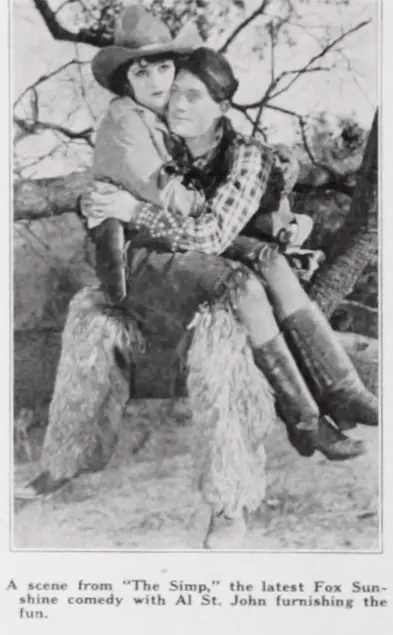
Still, the film refrains from didacticism. Its satire is froth, not acid; its feminism, a wink rather than manifesto. Even the hanging sequence—potentially macabre—gets softened by undercranking: Al’s legs pedal a bicycle that isn’t there, his sombrero levitates like a halo, and the rope behaves more like a bungee cord. Death becomes a mere improv partner, tap-dancing offstage at the first whistle of narrative convenience.
Cinephiles who revere Creation’s cosmic scope or Die Japanerin’s cultural cross-currents may dismiss The Simp as a trifle. Yet therein lies its stealth triumph: in twelve brisk minutes it distills the silent era’s core intoxicants—velocity, surreal juxtaposition, kinetic bodies—into a shot glass you can slam, savor, and belch ozone. Its slapstick is not the custard-pie anarchy of early Keystone but a balletic clockwork where every stumble seeds a future payoff. Note how Al’s initial misfire chips the bar mirror; minutes later the spider-web fracture refracts Daisy’s entrance, her face multiplied into a kaleidoscope of feminine resolve.
The film’s coda—a communal swig from the erstwhile death-barrel—lingers like the final chord of a honky-tonk hymn. Sheriff and outlaw wipe foam from each other’s moustaches, Daisy cradles Al’s head in the crook of her elbow, and the camera cranes skyward to reveal the noose repurposed as a swing, lazily orbiting in the desert breeze. It’s an image at once tender and subversive: the instrument of execution transformed into child’s play, a silent promise that tomorrow’s escapades will wipe today’s slate clean.
So, if your cine-diet tilts toward gravitas, let The Simp be your palate cleanser. It won’t sermonize, it won’t linger; it will simply carbonate your retinas, tickle your medulla, and vanish like a sarsaparilla belch on a high-plateau wind. And as the desert hush reclaims the screen, you may find yourself grinning at the cosmic punchline: sometimes salvation arrives not on a white horse, but in a foam-flecked barrel shared beneath a star-pierced sky.
IMDb 1
1920
Community
Log in to comment.