DbcultAccessing Vault...
Cult Review
Senior Film Conservator
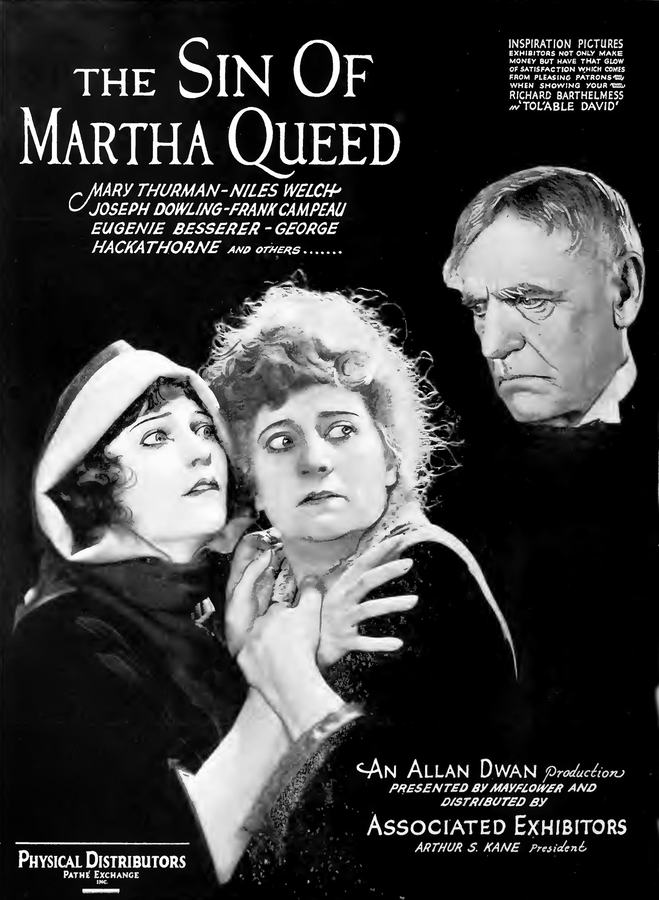
The Sin of Martha Queed, directed by Allan Dwan, is a film that lingers like a shadow in the mind—its themes of guilt, familial oppression, and the fragility of moral boundaries rendered with a starkness that feels both archaic and eerily prescient. Set against the rugged, almost inhospitable mountain backdrop, the film’s narrative unfolds with the deliberation of a ticking clock, each scene tightening the screws of tension until the final, devastating release. The script, sparse yet incisive, avoids over-explaining, trusting the audience to read between the silences and the storm of glances exchanged between Besserer and Welch.
At its core, the film interrogates the duality of sin—not as a binary of good and evil, but as a spectrum of human behavior shaped by external forces. Martha’s initial act of trespass—feigning injury to enter Arnold’s cabin—is not merely a romantic maneuver but a symbolic assertion of agency in a world that denies her autonomy. Her father Marvin, a character as immovable as the mountains he inhabits, embodies the suffocating weight of tradition. Hackathorne’s portrayal of Marvin is a masterclass in minimalism; his rigid posture and clipped gestures communicate a lifetime of suppressing empathy, a man whose love for his daughter is indistinguishable from his need to control her.
David Boyd, the drunken relative whose voyeurism sets the plot in motion, serves as both a red herring and a mirror to the audience. His death—a sudden, almost comically grotesque turn in the narrative—serves less as a plot device and more as a narrative rupture, forcing the film to pivot from social drama to existential horror. The scene where Martha disappears into the wilderness is one of the film’s most haunting, a visual metaphor for the dissolution of identity under the strain of guilt. Her eventual discovery by Atlas, the deformed boy whose confession and suicide complicate the moral calculus of the story, is less a resolution than a reconfiguration of the central conflict.
Atlas’s role is particularly enigmatic. Played by Frankie Lee with a mix of childlike vulnerability and unsettling intensity, he functions as a Christ-like figure in a film devoid of overt religiosity. His confession, delivered in a courtroom scene that is both a climax and a letdown, is a masterstroke of irony. By assuming the role of martyr, Atlas absolves Arnold but condemns Martha to a new kind of purgatory—a marriage that is less a union than a transactional escape from the weight of her actions.
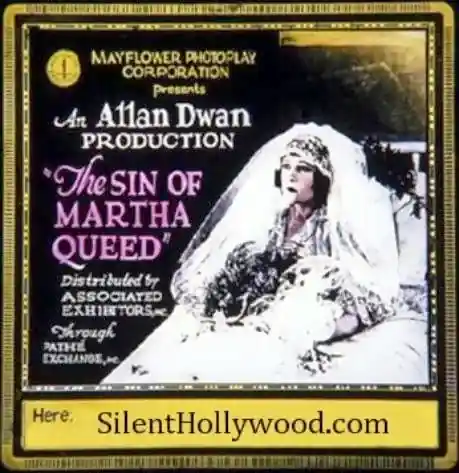
Dwan’s direction here is a study in contrasts. The mountains, rendered in grainy, high-contrast close-ups, loom over the characters like a Greek chorus, their majesty underscoring the futility of human ambition. The cabin, with its claustrophobic framing and flickering candlelight, becomes a pressure cooker for the film’s tensions. In one particularly striking sequence, Martha and Arnold’s clandestine meeting is intercut with shots of Marvin’s looming silhouette against a stormy sky, a visual motif that recurs throughout the film.
Comparisons can be drawn to Dwan’s later works, such as The Midnight Alarm, where similar themes of entrapment and moral ambiguity are explored, though The Sin of Martha Queed has a more intimate, almost operatic scale. The film’s use of silence as a narrative tool also echoes the work of contemporaries like The Chimes, though Dwan’s approach is more restrained, allowing the audience to sit with the discomfort of unanswered questions.
Eugenie Besserer’s Martha is a character of contradictions: alluring yet repelling, fragile yet capable of calculated ruthlessness. Her performance, devoid of the histrionics common to silent film acting, is a revelation. The scene where she is found delirious by Atlas is a tour de force; Besserer’s eyes, wide and unblinking, convey a psychic disintegration that rivals the most iconic performances of the era. Welch, as Arnold, is the least compelling link in the narrative, his portrayal of a man caught between love and complicity feeling slightly one-dimensional in contrast to Besserer’s depth.
Despite its age, The Sin of Martha Queed remains a bold exploration of the human condition. Its themes of familial tyranny and the corrosive effects of guilt are as relevant today as they were a century ago. In an age where streaming platforms often favor spectacle over substance, this film stands as a reminder of the power of restraint in storytelling. It is a work that demands to be seen, not just watched—a film that dares to leave its questions unanswered and its characters flawed.
The Sin of Martha Queed is a relic of a bygone era, yet its emotional resonance is undimmed by time. It is a film that challenges the viewer to find meaning in ambiguity, to see in the characters’ sins a reflection of their own human frailty. For cinephiles seeking a deeper engagement with the silent film canon, this 1919 masterpiece is an essential viewing. It is not merely a story of murder and marriage but a meditation on the sin that binds us all—the sin of being human.
IMDb —
1930
Community
Log in to comment.