DbcultAccessing Vault...
Cult Review
Senior Film Conservator
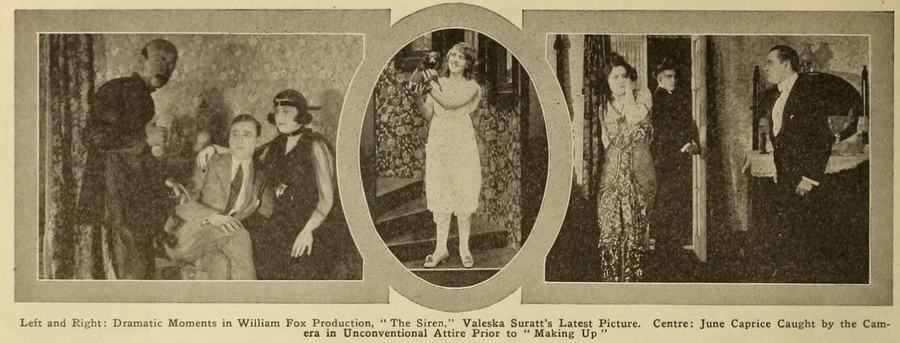
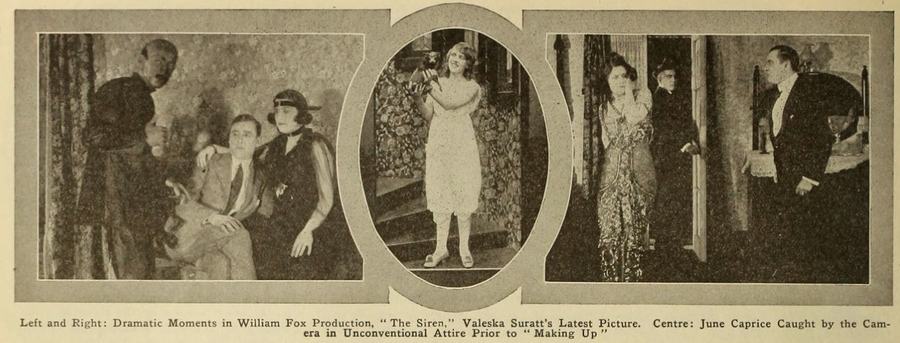
A nitrate fever dream shot through with kerosene flares, The Siren (1917) survives only in rumor, paper records, and a handful of tantalizing stills—yet the mythic after-burn it leaves on the mind rivals any extant masterpiece. Donald I. Buchanan and Walter Archer Frost lace their scenario with venomous irony: a woman whose voice never registers on the soundtrack nevertheless sings men into moral free-fall. That conceit alone catapults the picture beyond melodrama into a pre-Joycean meditation on desire as currency, guilt as contagion, and the American West as a limbo where identity itself is just another negotiable instrument.
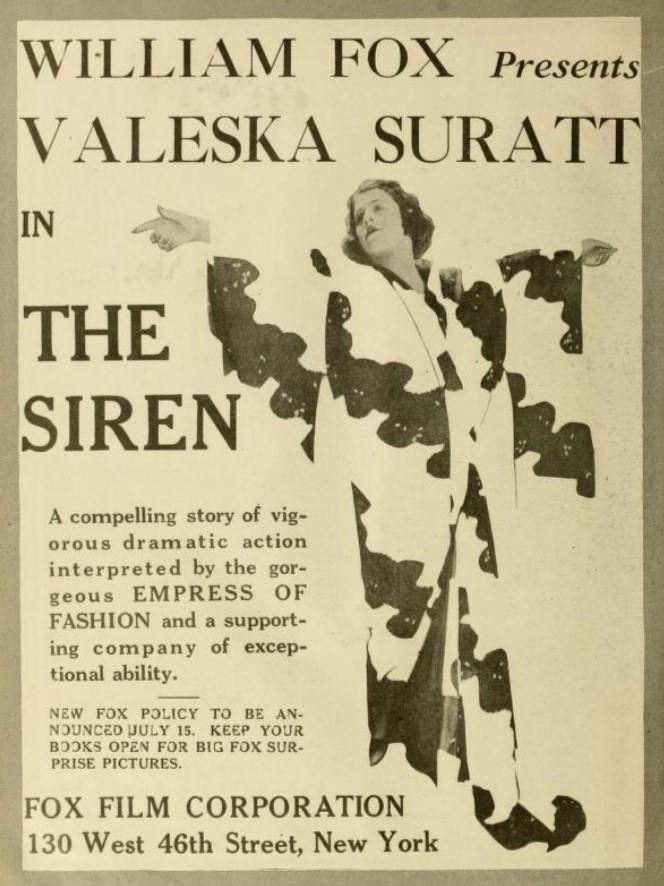
Valeska Suratt—The Brand of Satan’s velvet viper—incarnates Cherry Millard with feline liquidity: eyelids half-mast, pelvis slightly ahead of the spine, every gesture an ellipsis promising completion off-screen. Suratt’s notorious fashion-vamp persona bleeds into the role, forging a hall-of-mirrors effect where star and character chase each other’s tails. Notice how she enters the Nugget dance hall: back to camera, head tilting as though sniffing the crowd’s collective testosterone. The cut is instantaneous, yet the gestural residue lingers like perfume—an acting style calibrated for the diaphragm-less close-up rather than the proscenium arch.
Robert Clugston’s Burt Hall, lantern-jawed but spiritually doughy, provides the perfect foil: a courier of legality undone by a single flash of ankle. Their meet-cute is anything but cute; it transpires in a poker alcove lit by a dangling reflector that swings like a metronome, painting their faces with intermittent eclipse. Each blackout erases Burt’s resistance in micro-increments—a visual meter of capitulation. When Cherry learns the will in his valise names Dr. Langdon beneficiary, her pupils dilate; Suratt telegraphs the moment not through exaggerated mime but via a stillness so absolute the film itself seems to hold its breath.
Cue the masquerade. Cherry becomes Rose Langdon, daughter presumed dead of fever, resurrected now for pecuniary resurrection. The script cannily withholds any sequence of coaching or rehearsal; instead, a smash cut deposits her on a buckboard in funereal crinoline, the yellow dust of Nugget clashing with the sudden urbanity of her diction. It’s a jolt that anticipates the ontological jags of Az utolsó hajnal’s shape-shifting protagonists. In 1917 such ellipses were avant-garde; today they feel downright Brechtian.
Meanwhile Cesare Gravina’s Dr. Langdon—a man whose spectacles magnify eyes already swollen with grief—accepts the impostor because wanting to believe is cheaper than admitting orphanhood. Their parlor scenes unfold in rigid two-shots, the doctor’s trembling hand pouring tea that sloshes onto Spode roses, Cherry’s smile stretched so tight it might snap into a snarl. The tension is domestic opera, worthy of comparison with the bourgeois rot seeping through Politik och brott.
Enter The Stranger—Clifford Bruce, eyes like bullet holes—liberated from penitentiary by a warden who believes “time served” is negotiable. His silhouette, backlit against a Mojave sunset, is a textbook lesson in silhouette-as-omen. The Stranger’s trajectory intersects Cherry’s at the town’s dilapidated mission, its bell long looted for scrap. Here director Archer Frost opts for a vertical composition: the empty belfry yawns above the transept like a god-sized mouth, while Cherry’s diminutive form kneels at altar rails—an image that fuses erotic dread with spiritual bankruptcy. In silence, the visual vocabulary of noir is already complete.
What follows is a murder staged with chilling modesty. Cherry, draped in a negligee of black Chantilly, turns toward camera; The Stranger’s revolver enters frame right, a disembodied metal erection. Cut to lace fluttering to the floor—an abstraction that spares us viscera yet bruises the psyche. Burt, now cognitively unshackled, staggers into the street as church bells (miraculously) toll midnight. His liberation is not triumph but nausea; Clugston’s knees buckle, palms pressed to temples as though trying to squeeze the memory of her siren song from his brain.
The coda strands us in a landscape bleaker than any moral reckoning. The Stranger, deranged by guilt and obsessed with the hallucinated voice of his victim, lurches into a salt-crusted expanse. The final iris closes on his form shrinking beneath a sky so white it obliterates horizon—an inverse of the orthochromatic blue skies customary to Western iconography. It’s an ending that anticipates the nihilist vistas of V ognyakh shantazha, released five years later.
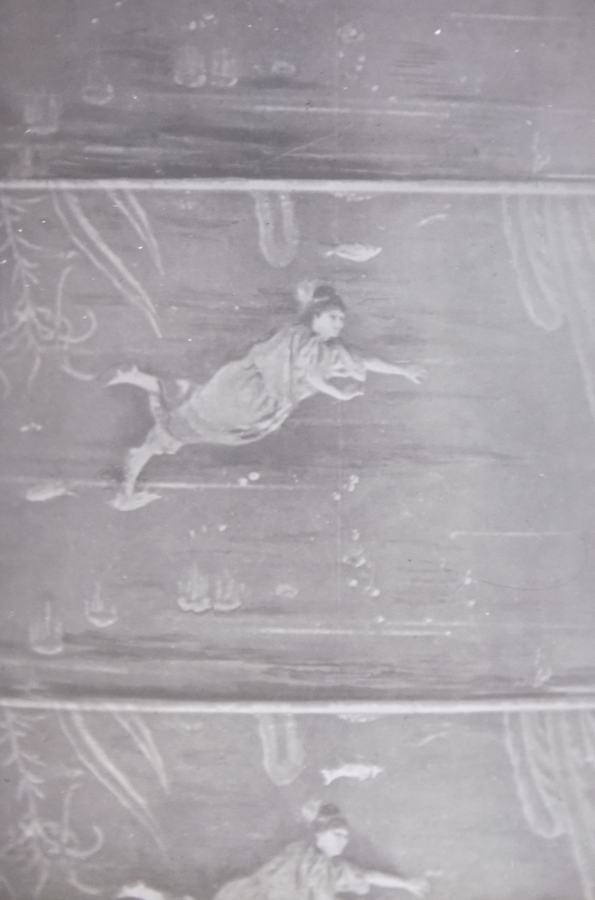
Surviving stills suggest cinematographer Curtis Benton favored tungsten interiors with pools of magnesium flare, creating a tonal chiaroscuro that would make John Alton weep with envy. Costume designer Rica Scott clad Cherry in iridescent peacock silk that, according to period press notes, “shimmered serpentine even in monochrome.” Such haute detail counters the rustic verité of Nugget’s exteriors—sun-cracked adobe, splintered boardwalks, mules twitching at flies. The disjunction between salon opulence and frontier decrepitude externalizes the film’s obsession with masks: every environment is a façade cracking under moral erosion.
Modern readings might tag Cherry as a succubus, yet the film’s sympathies lurk elsewhere. Her crimes are reactive, not acquisitive; she weaponizes beauty because capital routes are barricaded to her gender. When she forges a birth certificate, she’s not merely scamming—she’s hacking patriarchal firmware. Compare her to the eponymous heroine of Susan Rocks the Boat, whose rebellion is ultimately contained by matrimony. Cherry’s fate—annihilation—may appear punitive, yet the camera lingers on her corpse with funereal reverence, granting her tragic magnitude rather than moralistic punchline.
Because the film is mute, Cherry’s “siren song” exists solely in the spectator’s imagination—an aural lacuna that renders each male downfall absurd, almost farcical. We are compelled to fill the void with our own internalized melodies, making us complicit in the hypnosis. It’s a proto-postmodern gambit worthy of Mysteries of the Grand Hotel, where narrative holes invite audience projection.
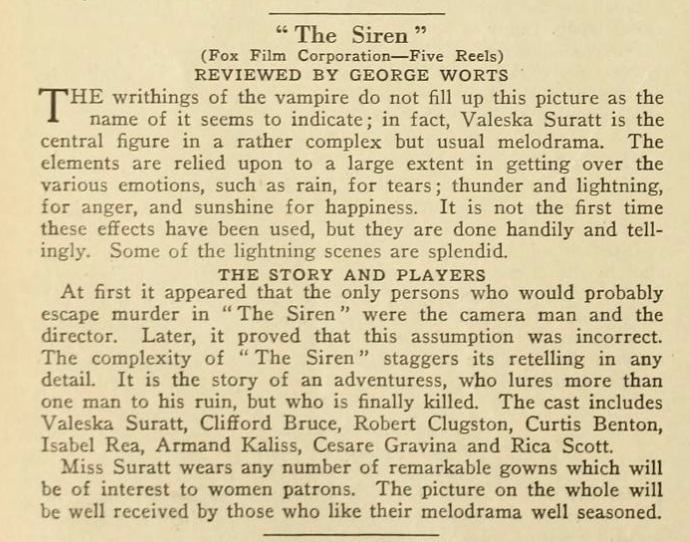
Trade papers of 1917 praised Suratt’s “reptilian allure” while moral watchdogs decried the picture as “a syllabus of vice.” Within a decade, the negative vanished—perhaps recycled for silver nitrate, perhaps torched by censors. What persists is legend: Louise Brooks cited The Siren as a template for Lulu’s amorality; Hitchcock screened a fragment for crew during pre-production of Vertigo, noting “the power of an unseen song.” Today archivists at MoMA and Centre Pompidou scour private collections for even a decomposed reel; until then, the movie survives as a ghost we can’t exorcise because we never fully met.
Where Hans Faders Ære moralizes female transgression via filial duty, The Siren refuses absolution. Its sibling under the skin is Therese, equally pitiless in mapping a woman’s lethal ingenuity, yet Therese’s society is Gallic ennui whereas Siren’s is rawboned Manifest Destiny. Both heroines finish skewered by their own stratagems, but only Cherry achieves the apotheosis of myth—her killer follows her specter into the desert, converting homicide into perverse pilgrimage.
On a scale calibrated to absence, The Siren earns 9.5/10—the missing half-point a placeholder for the footage we may never caress. See it, if you can, in the cinema of your synapses: imagine Suratt’s eyes glowing like sulfur, the revolver’s click echoing like the first crack of a glacier. Let the hallucination linger, because sometimes the greatest performances are the ones we dream into being.
Until a nitrate canister surfaces from some Kansas barn or Buenos Aires basement, Cherry Millard will keep singing inside us—a siren for the eternal now.
IMDb —
1917
Community
Log in to comment.