DbcultAccessing Vault...
Cult Review
Senior Film Conservator
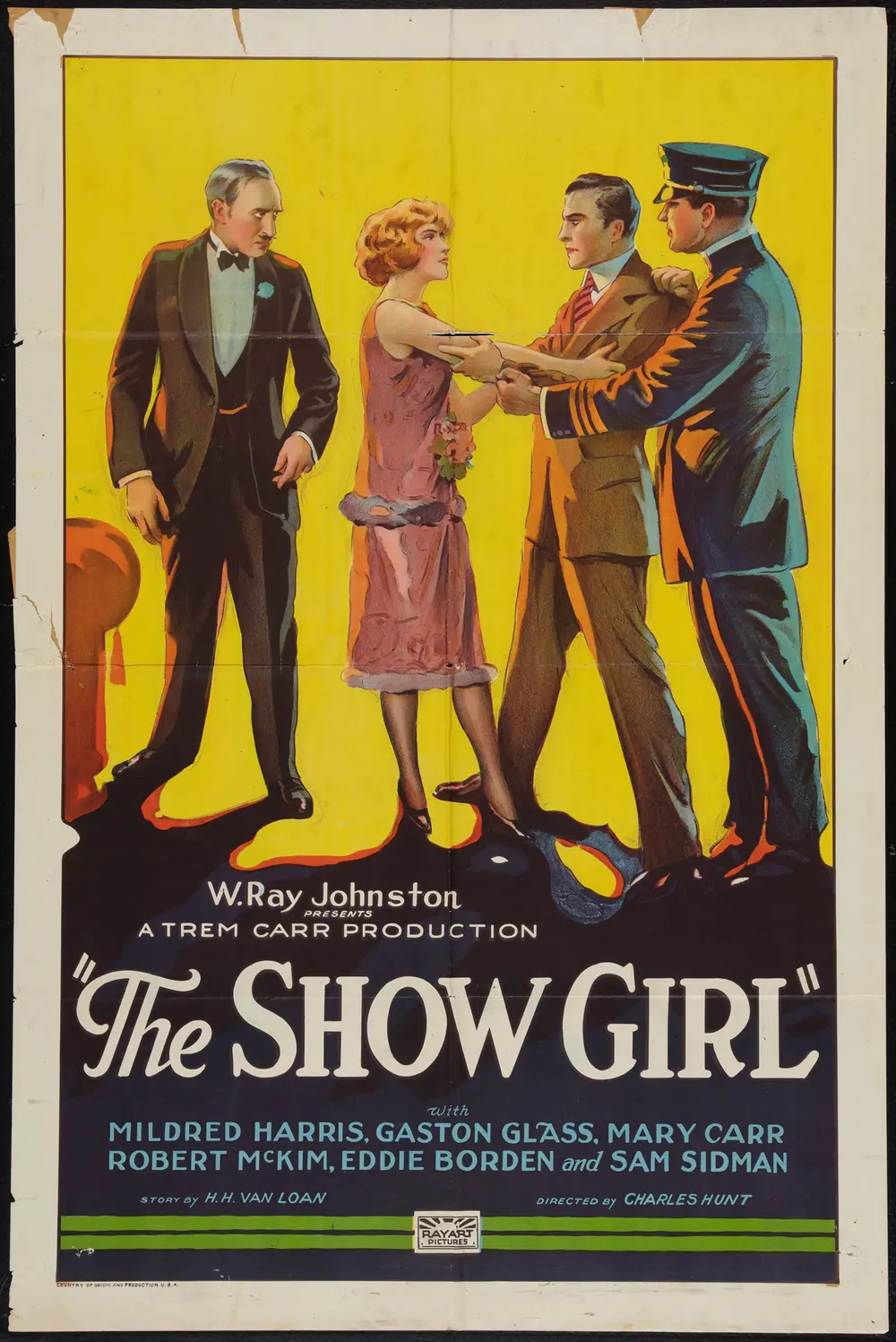
Is The Show Girl a hidden gem of the silent era or just another forgotten reel? Short answer: Yes, it is worth watching, but primarily as a fascinating historical document of early 20th-century marketing cynicism rather than a traditional romance.
This film is for viewers who appreciate the 'behind-the-curtain' mechanics of show business and those who enjoy seeing pre-Code archetypes in their infancy. It is definitely not for audiences who require high-octane action or those who find the deliberate pacing of 1920s melodrama to be a barrier to entry.
To understand this film, one must look past the grainy texture of the film stock. It operates on a level of social commentary that feels surprisingly biting for its time.
1) This film works because: Gaston Glass delivers a performance that perfectly captures the frantic, almost predatory energy of a man who sells dreams for a living.
2) This film fails because: The antagonist's motivations are thin, serving more as a convenient plot device to force a climax than as a fully realized character.
3) You should watch it if: You are interested in the evolution of the 'spin doctor' trope and want to see Mildred Harris at the height of her expressive powers.
The Show Girl isn't just about a girl in a show. It is about the machinery that creates the 'show' in the first place. Gaston Glass plays the press agent with a kinetic intensity that reminds me of the hustlers in later films like A Broadway Saint. He doesn't just promote the honky tonk; he rebrands it, turning 'low-class' into 'exclusive' through sheer force of will and a few well-placed lies.
The transformation of the club is the film's strongest visual arc. We see the transition from sawdust floors to velvet ropes. This mirrors the trajectory seen in Orchids and Ermine, where the allure of luxury is both a goal and a trap. The cinematography captures this shift with a clever use of lighting—shadows are long and oppressive in the honky tonk days, but become bright and artificial once the 'elite' move in.
However, the romance between the lead stars feels secondary to the business of the club. When the 'troublemaker' arrives, played with a sneering efficiency by Robert McKim, the film pivots into a standard melodrama. This shift feels jarring. One moment we are watching a sophisticated satire of public relations, and the next, we are in the middle of a jealous rage that feels like it belongs in Blind Love.
Mildred Harris is the soul of the film. Often overshadowed by her real-life association with Charlie Chaplin, here she proves her dramatic weight. Her character is caught between her loyalty to the club's roots and the shiny new future the press agent promises. There is a specific scene where she looks at her new, expensive costume in a mirror, and for a brief second, her expression isn't one of joy, but of a profound loss of identity. It is a subtle moment that elevates the film.
Gaston Glass is her perfect foil. If Harris is the soul, Glass is the engine. His performance is loud, fast, and unrelenting. He represents the modern world crashing into the old-fashioned world of the honky tonk. It’s a performance that echoes the desperation seen in The Eternal Grind, though with a much flashier wardrobe.
The supporting cast, particularly Mary Carr, provides a grounded reality to the film. Carr, often cast as the long-suffering mother figure, brings a sense of stakes to the proceedings. When she is on screen, the consequences of the agent's schemes feel real. Without her, the film might have floated away on its own artifice.
For a film from 1927, the pacing is remarkably brisk during the first two acts. The editing during the 'club renovation' montage is rhythmic and forward-moving. It captures the frantic energy of New York nightlife. However, the third act suffers from the 'silent film sag.' The intertitles become more frequent and wordy, slowing down the physical momentum of the conflict.
The directing by Alfred E. Green (though H.H. Van Loan is credited for the story) shows a keen eye for spatial dynamics. He uses the club's stage as a literal and metaphorical platform. Characters are often framed through doorways or behind glass, emphasizing the themes of observation and public perception. It’s a sophisticated touch that you don’t always see in standard programmers of the era like The Square Deal.
The Show Girl is worth watching because it captures the exact moment when the American public became obsessed with the concept of the 'celebrity.' It explores how a person can be turned into a product. While the romantic subplot is dated, the central theme of manufacturing fame is more relevant today than it was in 1927. It is a cynical, smart, and visually engaging piece of cinema.
Pros:
Cons:
The Show Girl is a fascinating anomaly. It is a film that wants to be a romance but is actually a sharp-tongued critique of the very industry that created it. It works. But it’s flawed. The villain is a bore, but the atmosphere is electric. If you can forgive the creaky melodrama of the finale, you will find a movie that is surprisingly ahead of its time.
Ultimately, it stands taller than contemporaries like The Sawdust Doll because it has something to say about the world. It doesn't just entertain; it observes. And what it observes about the nature of fame is still true today. It’s a solid 3.5 out of 5 stars for silent film fans.
IMDb 7.4
1931
Community
Log in to comment.