DbcultAccessing Vault...
Cult Review
Senior Film Conservator
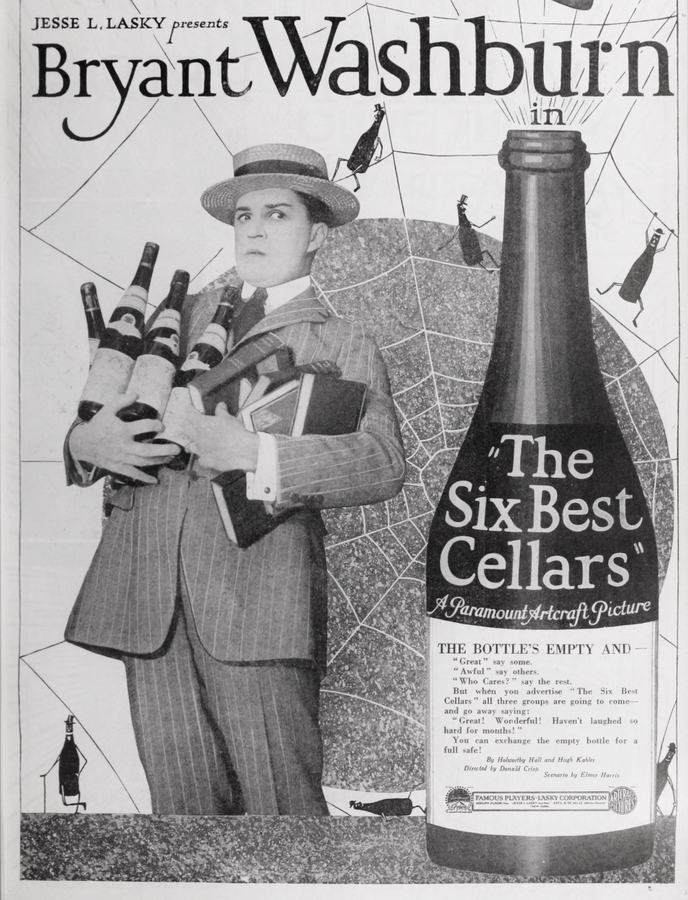
Imagine a champagne bubble suspended in mid-pop: that iridescent tremor is the exact emotional register of The Six Best Cellars, a 1920 silent that corkscrews between drawing-room sparkle and political hangover.
The film opens with a dolly shot that glides past lace curtains into Henry Carpenter’s study, where dust motes waltz like tipsy fireflies around a solitary bottle of Bordeaux. Director Allen Connor—never a household name, yet here operating with Lubitsch-level mischief—lets the camera sniff the cork before we even meet the host. In that single inhalation we understand the whole hierarchy of this micro-society: the bottle is fetish, currency, and relic all at once.
Richard Wayne’s Henry is the silent era’s answer to the unreliable raconteur: eyebrows pitched in permanent apology, smile flickering like a faulty projector lamp. Wayne plays drunk-without-a-drink, a man intoxicated on the memory of intoxication. Watch the way his fingers caress the air where a glass should be, conjuring phantom claret like a stage magician palming ether. It’s a performance pitched at the intersection of hunger and hauteur, and it makes the later conversion to temperance zealot feel less like hypocrisy than like a man swapping one addiction for another—morphine to prayer, absinthe to applause.
Opposite him, Wanda Hawley’s Millicent is no flapper caricature but a society matron forged from porcelain and quiet calculation. She measures every glance the way a sommelier measures pour—never to the brim, always to the plausible limit. Hawley’s genius lies in stillness: when Henry rants about the evils of drink, her pupils dilate a millimeter, a silent scream that says we are ruined more eloquently than pages of title cards. The marital push-pull becomes a shadow referendum on Prohibition itself: can love survive when the social lubricant is outlawed, when the very liquid that greased wit and seduction becomes contraband?
The dinner-party sequence—lit entirely by tapers whose flames seem to hyperventilate—plays like a pagan rite substituted for Holy Communion. Guests arrive clutching crystal tumblers of colored water that taste, one matron sniffs, “like melted Sunday.” Conversation curdles into coded yearning: every mention of “grape juice” elicits titters because everyone knows the word is a stand-in for the sacramental real thing. Connor orchestrates a visual pun by framing the table from above so the white linen resembles a giant communion wafer, the silverware arrayed like an ecclesiastical procession. The joke lands harder because the audience shares the secret: we know Henry’s cellar is down to cobwebs and a single bottle of cooking sherry.
Prohibition-era films often flinch from the legislative elephant; they nudge it with winks. The Six Best Cellars grabs the elephant by the tusks. A title card—lettered in faux-temperance pamphlet font—declares: “Alcohol is the anarchist that blows up the home.” The card is followed instantly by a smash-cut to Henry’s home, where the greatest threat isn’t alcohol but its absence. The hypocrisy is so bald it circles back to honesty: the film argues that what corrodes society isn’t drink, but the performance of purity.
This thematic spine separates the movie from contemporaneous moral fables like Cy Whittaker’s Ward, where temperance is a redemptive cudgel. Here redemption is a carnival mask, passed from hand to hand until nobody remembers whose face it originally covered.
When Josephine Crowell’s Aunt Augusta descends the cellar stairs—her silhouette bulbous with indignation and bustles—the film shifts into mythic gear. She pries open crate after crate, each lid yawning like a stage curtain. The camera adopts Henry’s POV: labels swim into focus, the ink still wet with possibility. Twenty-one cases translate, in 1920 dollars, to roughly a governor’s ransom; in social capital, it’s infinite. Connor lingers on Henry’s reflection superimposed over the bottles, a visual palimpsest suggesting that identity itself is blended like vintages: some years yield greatness, others only tannic bitterness.
Notice how the lighting warms from ghostly blue to amber as the treasure is revealed, a chromatic cue that the narrative’s bloodstream is being transfused. The scene recalls the moment in His Birthright when the protagonist inherits a corrupt empire, except here the empire fits in a fruit crate.
The film’s most radical gambit arrives in the final reel. Henry, trapped between stump speech and sommelier, turns to camera—not in the coy, wink-wink manner of a Fantômas villain, but with the raw desperation of a man asking a jury for a stay of execution. “What would you do?” he pleads, and the intertitle lingers until the letters seem to vibrate with our pulse. In that instant the plush proscenium of the drawing-room comedy collapses; the audience becomes co-conspirator, co-dependent, co-intoxicated. We are no longer spectators but shareholders in the moral distillery.
The device predates by two decades the famous fourth-wall rupture in Kind Hearts and Coronets, yet history has misplaced it, like a mislaid bottle in a labyrinthine cellar. Cinephiles who worship The Battler for its proto-noir fatalism should queue this film for its proto-postmodern self-reflexivity.
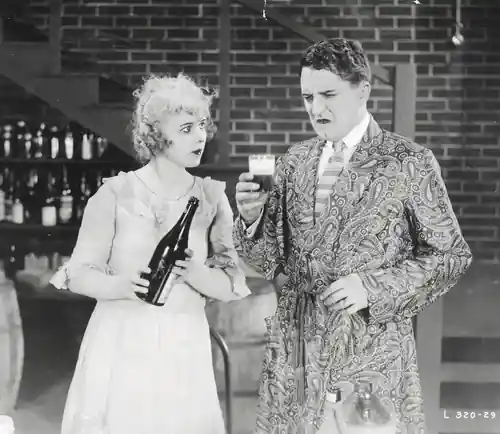
Howard Gaye, saddled with the thankless role of the prohibitionist rival, injects Dickensian sanctimony into every pursed lip; watch how he clasps his hands as though perpetually strangling an invisible serpent. William Boyd’s drunken confidant—pre-Hopalong earnestness—plays the fool with a philosopher’s twinkle, delivering reaction shots that deserve their own sommelier notes: “hints of bemusement, finish of existential dread.”
The women orbiting the periphery—Zelma Maja’s flapper cousin, Elsa Lorimer’s acid-tongued dowager—function like varietal grapes that add complexity to the blend. Each gets a visual leitmotif: Maja’s cigarette smoke curls into question marks, Lorimer’s fan snaps like a guillotine. These are not mere period decorations; they are the tannins that keep the narrative from turning flabby.
Cinematographer William Marshall (unrelated to the later Blaxploitation icon) bathes corridors in chiaroscuro reminiscent of Pyotr Velikiy’s vodka-soaked taverns, yet he pivots to high-key brightness during Henry’s campaign rallies, suggesting that public life is overexposed while private desire festers in tenebrous corners. The shift is subliminal but vertiginous; you feel the temperature change on your skin.
Note the recurring visual rhyme of circular motifs: the dinner table, the barrel bung, the campaign button, even the iris-in that closes the final scene. Circles imply both containment and continuity—Prohibition may cork the bottle, but human appetite rolls on, an endless loop.
Triplicate scribes usually spell catastrophe, yet Hugh McNair Kahler, Elmer Harris, and Holworthy Hall concoct a script that fizzes like champagne sulfites. Their title cards deserve anthology status: “He preached water and yearned for wine—yet found the American dream in an empty decanter.” The line is both epigram and epitaph, a haiku of hypocrisy.
Compare this linguistic sparkle to the moral absolutism of The Devil’s Daughter, where every intertitle lands like a hymnal thud. Here the words dance, stagger, sometimes collapse, but they always rise with a grin.
Surviving prints are silent, yet the rhythm is symphonic. Watch the montage where Henry’s political ascent is cross-cut with the slow-motion demolition of a brewery: steam whistles, falling masonry, cheering crowds. The absence of diegetic sound paradoxically amplifies the industrial growl; you hear the Prohibition axe in your marrow.
Modern viewers, marinated in antihero television, will recognize Henry’s dilemma as the ancestor of Walter White’s barrel-of-money problem and Tommy Shelby’s whisky-politics paradox. The text messages that torment today’s politicos are merely the Prohibition telegram in faster guise. The Six Best Cellars is thus a shot across the bow of every virtue-signaler who keeps a private stash of vice.
Meanwhile, craft-culture hipsters decanting small-batch gin should study this film as cautionary scripture: legality is a label easily swapped, but thirst is vintage.
So, what would you do? The film refuses a neat finish; the last frame freezes Henry mid-gesture, mouth ajar, eyes darting between camera and cellar door. It’s an everlasting pause, a suspended breath, a bottle never quite uncorked. That ambiguity is the film’s gift and its curse: it intoxicates without inebriating, satiates without filling.
Seek out The Six Best Cellars however you can—16mm archive print, bootlegged MPEG, or spectral flicker on a museum wall. Bring friends, bring enemies, bring a flask if you must. Then debate, argue, rage, laugh, and when the lights come up, ask the room the question that has no label: what is your cellar hiding, and who are you when the last bottle is either emptied… or exposed?
IMDb 3.8
1922
Community
Log in to comment.