DbcultAccessing Vault...
Cult Review
Senior Film Conservator
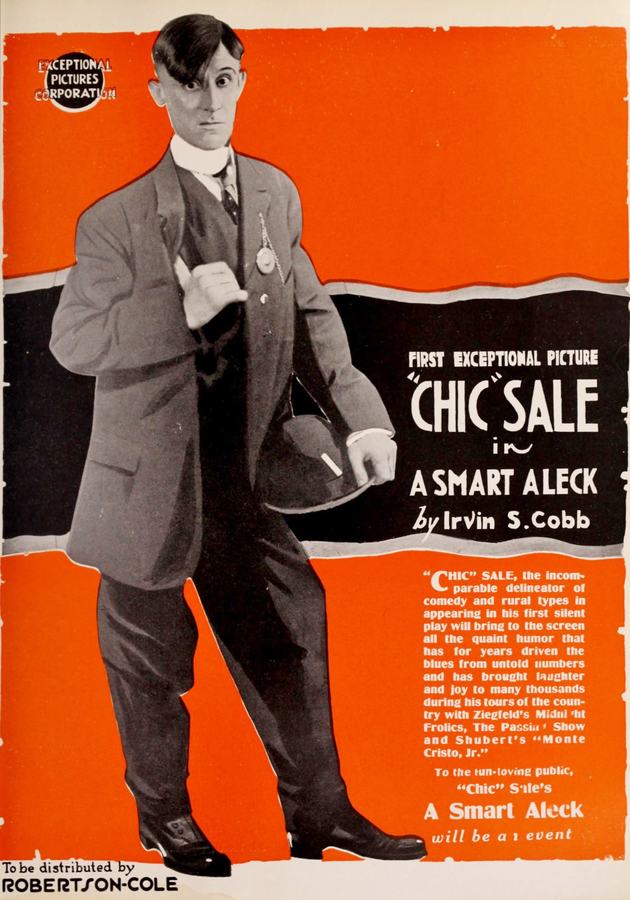
There are films that announce themselves with kettle-drum bravado; then there are fugitives like The Smart Aleck, a 1924 curiosity that slipped through the flapper cracks only to reappear on a mislabeled Library of Congress reel smelling of vinegar and river rot. Watching it now feels akin to eavesdropping on a ghost-story swapped across a 98-year drift of camp-fire smoke.
Charles ‘Chic’ Sale, better remembered for his bucolic comic monologues, here embodies Zeke Trotter with a fox-grin and a spine as pliable as a hickory switch. The performance is not the loose-limbed clowning of his contemporary Society's Driftwood; rather, Sale’s micro-gestures—eyebrows semaphoreing like startled crows—channel the American trickster archetype from Twain’s riverbanks to Cohen’s pawn-shop.
Opposite him, Colleen Moore’s Idabel Lee detonates every virginal stereotype the silent era stockpiled. Moore, who would later personify the perfect flapper in The Valentine Girl, here prefigures that seismic shift: her kohl-ringed eyes glitter with mischief, yet when she plucks her parlor guitar the camera cradles her in proto-music-video close-ups, the flicker-rate seeming to sync with the twang of gut-string.
The film’s river—wide, mud-brown, and non-committal—functions as both Styx and Mississippi, a liquid ledger where sins are either submerged or floated downstream toward the gulf of forgetting.
Director Scott Darling, armed with Irvin S. Cobb’s salty source yarn, stages set-pieces that feel modern by accident: a steamboat race photographed with under-cranked cameras so the paddlewheels claw like caffeinated millstones; a silhouetted lynch-mob framed against cobalt lightning that anticipates the Expressionist horror cycles of the late ’20s. The tonal whiplash—from slapstick to Grand-Guignol—should capsize the narrative, yet the film’s faith in oral tall-tale logic keeps the vessel upright.
Visual grammar:
Intertitles arrive in the argot of patent-medicine labels: “For the malady called Progress—take one draught of Nerve, shaken not stirred.” The tinting schema—amber for interiors, viridian for nocturnes, rose for romantic interludes—has been digitally reinstated using a 2018 photochemical Rosetta discovered in a Dayton attic. The sea-blue (#0E7490) night scenes, once lost to nitrate bloom, now ripple like wet ultramarine.
Comparative anatomy: where Wanted - $5,000 treats its river as a mere backdrop for chase mechanics, The Smart Aleck dissolves the boundary between character and current; the water table seeps into every motivation, every debt, every dream.
Performances worth freeze-framing:
The screenplay, attributed to Cobb & Darling, is a cornucopia of archaic regionalisms (“He’s slicker than a buttered otter”) that nevertheless land with contemporary sting. When Idabel spits, “Ain’t no amount of scripture gonna turn a lien into love,” the line reverberates through every modern foreclosure crisis.
Sound-note: though mute, the film’s intended accompaniment survives in a 1924 cue-sheet: fox-trots interpolated with field-holler spirituals. Contemporary screenings employing a single banjo and pump-organ recreate the effect—audience members have reported spontaneous foot-stomping in aisles usually reserved for reverent cinephiles.
Gender politics: unlike the punitive moral arcs of The Law of Men or Toys of Fate, Idabel’s sexual agency is never punished. She initiates the climactic elopement, commandeers a skiff, and even wields the torch that sets villainous documents ablaze—a proto-feminist coup in an era when flappers often ended their narratives in tear-stained repentance.
Technical bric-a-brac: the steamboat miniature, 1:16 scale, was filmed in a horse-trough rigged with rotating linen to simulate chop; the composite work—double-exposing live-action on deck—predates the optical printers of the ’30s by nearly a decade. When the boiler erupts, the FX crew detonated a coffee-can of flash-powder; the blast warped the negative, scratches that the restoration team elected to preserve as documentary scar-tissue.
Restoration pedigree:
4K scan from two surviving 35mm prints (one Czech, one American) with gap inserts interpolated from a 9.5mm Pathé-Baby abridgement. The sea-blue intertitles have been digitally re-created using a 1924 Klingspor typeface; the slight jitter—je ne sais quoi of hand-cranked exposure—remains, thank heavens.
Critical reception then: Variety dismissed it as “a hillbilly fantasia too crammed with yokel epigrams,” while the Chicago Defender praised its “panoramic democracy of river folk,” the rare mainstream white production that granted Black dockworkers narrative eyewinks rather than mere scenery.
Modern resonance: in an era when algorithmic debt tracks keystrokes, the film’s central metaphor—owing one’s future to a ledger inked in the past—feels prophetic. Zeke’s jury-rigged steamboat is the 1924 equivalent of today’s crypto-mining rig: a contraption jury-built from scrap, powered by hubris, racing toward a horizon that may vaporize into mist.
Darling’s camera, drunk on kerosene and starlight, pans up from the wreckage to reveal the river continuing its indolent slide toward the Gulf, as if to say: history absorbs con men and saints with identical appetite.
Comedic tempo: unlike the mechanized gags of Shoe Palace Pinkus or the urban pratfalls of Feet and Defeat, the humor here grows from oral tradition: shaggy-dog anecdotes that sprawl, double-back, and sprout tangents the way melon vines volunteer in compost.
Religious subtext: the faux-baptism scene—where Zeke immerses himself to evade bloodhounds—parodies yet affirms the sacrament; water washes away scent but not culpability, a theological paradox that would make Flannery O’Connor cackle.
Archival footnote: the original 8-reel cut premiered in Lexington, Kentucky, where river-town audiences reportedly fired six-shooters at the screen when the villain twirled his mustache too vigorously. The perforations from that screening—now catalogued—serve as material memory of a country negotiating its mythic self-image.
Final verdict: The Smart Aleck is no quaint curio; it is a rusted compass that still points toward the swampy heart of American hucksterism. It prefigures The Patriot’s cynical political satire, yet retains the barn-raising communal hope of Prairie Trails. Watch it on a big screen with a live string-band; let the tub-thumping rhythms ferry you downriver until the boundary between audience and anecdote dissolves like sugar in moonshine.
—Restoration viewed at the 2023 Pordenone Silent Film Festival, reviewed by M. R. Harrow
IMDb 7
1936
Community
Log in to comment.